

At the Mathrubhumi International Festival of Letters 2026, poet and novelist Jeet Thayil and his sister Sheba Thayil, journalist and author offered deeply personal reflections
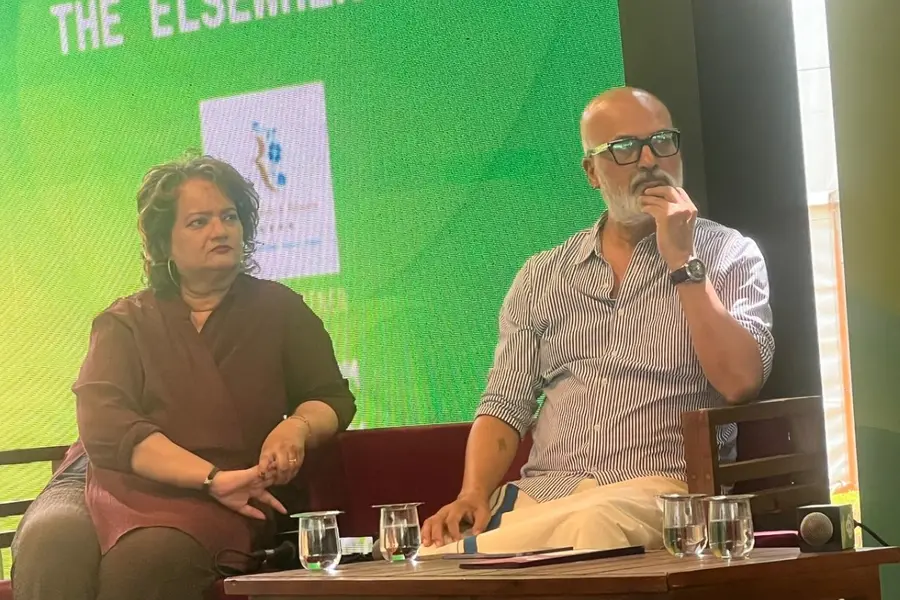
The father was T.J.S. George — towering editor, relentless journalist, a man shaped by discipline, deadlines and public argument. The son wanted to be a poet. Between them lay a gulf that felt unbridgeable: journalism versus poetry, authority versus rebellion, silence versus excess.
“He told me several times that there was no future in poetry,” Jeet Thayil recalled at the Mathrubhumi International Festival of Letters (MBIFL) 2026 in Thiruvananthapuram. “That’s advice you expect from a shopkeeper, not a writer.”
Also Read
It became the defining tension of their relationship. A father warning, a son pushing harder in the opposite direction. Thayil admitted that for years — through his teens, twenties and even into his thirties — his primary impulse was provocation.
“My one and only mission in life was to hassle my father, to cause him trouble in some way or the other,” he said, with a candour that drew knowing laughter from the audience.
This conflict, raw and unresolved, runs quietly through The Elsewhereans, Thayil’s genre-defying “documentary novel”. It is not a book that dramatises reconciliation. Instead, it traces the slow, uncomfortable truth that understanding often arrives too late — and not in the way we expect.
At home, George was not a man of words. Sheba Thayil, his daughter and Jett’s one and only sibling described their father as deeply uncommunicative, shaped by a family culture where feelings were not discussed and disagreements were rarely explained. Silence was not cruelty, but inheritance.
“In the house, you hardly heard his voice,” Sheba Thayil said. “In the office, he was charming. He talked nonstop.”
The contrast unsettled the son. At work, George was magnetic — admired, persuasive, intellectually alive. At home, he was distant, reserved, absorbed in routine. Jeet Thayil said he learned early that authority could wear different faces, and that intimacy did not always accompany admiration.
Their differences sharpened when Sheba Thayil briefly followed his father into journalism, working at The New Indian Express while George was editor. They passed each other in office corridors without speaking. At home, they never discussed work.
“The only thing I asked him was whether he liked the editor I was working under,” Sheba Thayil recalled. “He looked at me like I’d grown three heads.”
It was a lesson, delivered without tenderness or instruction: professionalism did not require affection. You worked with people you didn’t like, didn’t respect, didn’t understand. You did the job anyway.
And yet, beneath the emotional austerity lay something steadier. George never interfered, never micromanaged, never dictated his adult childrens’ choices. When mistakes were made — even irreversible ones — there was no expulsion, no dramatic rupture.
“There was never a shout of ‘get out of my house’,” Sheba Thayil said. “It was quiet support from the background.”
Time, as it often does, altered the equation, Jeet thayil continued.
As George aged, the man Jeet Thayil had spent decades resisting softened. The rigidity eased. The confrontational father gave way to someone more generous, more patient, more willing to listen. The change was neither sudden nor performative; it arrived slowly, almost shyly.
“He mellowed,” Jeet Thayil said simply. “He became a very sweet, supportive father.”
Part of that transformation, Jeet believes, came from George’s lifelong engagement with Hindu philosophy. A voracious reader, George absorbed ideas of detachment and equanimity — the ability to let go of small injuries, to endure conflict without being consumed by it.
“He had the equanimity of a yogi,” Thayil said. “Unfortunately, neither of his children inherited that.”
The reconciliation between father and son was never theatrical. There were no speeches, no apologies carefully worded for closure. Instead, there was acceptance — the quiet recognition that love does not always speak the language we expect it to.
Jeet’s understanding of his father deepened further as he revisited George’s public life: his arrest for standing with student protestors in Bihar, his resignation from The Indian Express after refusing to dilute criticism of BJP political power, his unwavering opposition to authoritarianism.
The irony was not lost on him. A man so fearless in public dissent struggled with emotional intimacy at home.
“He was a lifelong opponent of authoritarianism,” Jeet said. “But emotionally, he came from a very different world.”
George lived to ninety-seven — long enough, Jeet noted, to allow himself to change. That, too, became a lesson.
“To change after fifty, to become more open, more willing to listen — that takes a lot,” he said. “I don’t think this generation is as flexible.”
In The Elsewhereans, the father figure is neither villain nor hero. He is flawed, principled, distant, brave. The son is rebellious, restless, ungrateful — and eventually, understanding. What binds them is not resolution, but recognition.
That may be the book’s quiet truth: that some relationships are not healed by confrontation, but by time; not by agreement, but by endurance.
For Jeet Thayil, the long war with his father ended not in victory or defeat, but in empathy — an understanding that arrived only after the battle had already shaped them both.
Published: 01 Feb 2026, 03:47 pm IST
ABOUT THE AUTHOR
Related Topics
Disclaimer: Kindly avoid objectionable, derogatory, unlawful and lewd comments, while responding to reports. Such comments are punishable under cyber laws. Please keep away from personal attacks. The opinions expressed here are the personal opinions of readers and not that of Mathrubhumi.