

Pulitzer Prize–winning journalist Declan Walsh said journalism remains vital even under repression, arguing that “bearing witness still matters”
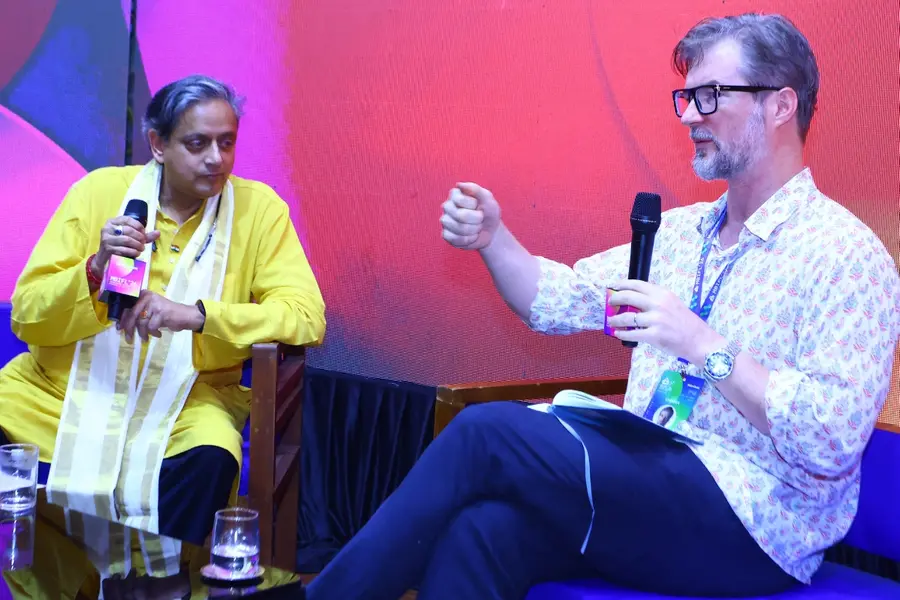
Speaking at the Mathrubhumi International Festival of Letters (MBIFL) 2026, Pulitzer Prize–winning journalist Declan Walsh reflected on the role of journalism in an era marked by authoritarianism, conflict, and historical amnesia. The dialogue, titled ‘Shadows That Refuse to Fade’, featured Walsh in conversation with author and parliamentarian Dr Shashi Tharoor at Kanakakkunnu Palace in Thiruvananthapuram.
Walsh, who has reported extensively from Pakistan, Africa, and the Middle East, said journalism today often operates under intense pressure, but its purpose remains unchanged. “Journalism may not save the world,” he said, “but bearing witness matters.”
Also Read
Drawing from his experiences covering the Sudan civil war—work that earned him the Pulitzer Prize—Walsh described how reporters frequently meet people on “the worst days of their lives”. Yet, he noted, many still believe that telling their stories can make a difference. “That hope humbles me every time,” he said.
Dr Tharoor framed the conversation within a broader historical context, arguing that unresolved pasts continue to shape present conflicts. “History never seems to rest in those chapters,” he said, pointing to Partition in South Asia and ongoing violence in parts of Africa as examples of how “the shadows of the past continue to linger”.
Walsh agreed, observing that many modern security states are built on colonial-era structures designed to control rather than serve citizens. Reflecting on Pakistan, where he lived and reported for nearly a decade, he said the trauma of 1947 still informs the country’s political psychology and military dominance. “The border is not just a line on a map,” he said, describing it as a “psychological condition”.
The discussion also touched on the growing risks faced by journalists worldwide, including expulsion, threats, and surveillance. Walsh himself has been expelled from countries for his reporting. Despite this, he argued that journalism’s core responsibility is to document reality, especially when power seeks to obscure it. “Power tells itself stories to justify why it must remain in control,” he said, adding that reporting challenges those narratives.
Tharoor noted that the democratic world often struggles to respond decisively to repression and violence, creating an environment where truth becomes contested. He stressed that the role of journalists in such contexts is not to provide easy answers but to preserve factual records for history.
Concluding the session, Walsh returned to the human dimension of his work. He said resilience, rather than despair, is what stays with him after years in conflict zones. “The human spirit is extraordinary,” he said, reiterating that journalism’s enduring value lies in giving voice to those living in the shadows of history and power.
Published: 31 Jan 2026, 07:50 pm IST
ABOUT THE AUTHOR
Related Topics
Disclaimer: Kindly avoid objectionable, derogatory, unlawful and lewd comments, while responding to reports. Such comments are punishable under cyber laws. Please keep away from personal attacks. The opinions expressed here are the personal opinions of readers and not that of Mathrubhumi.