

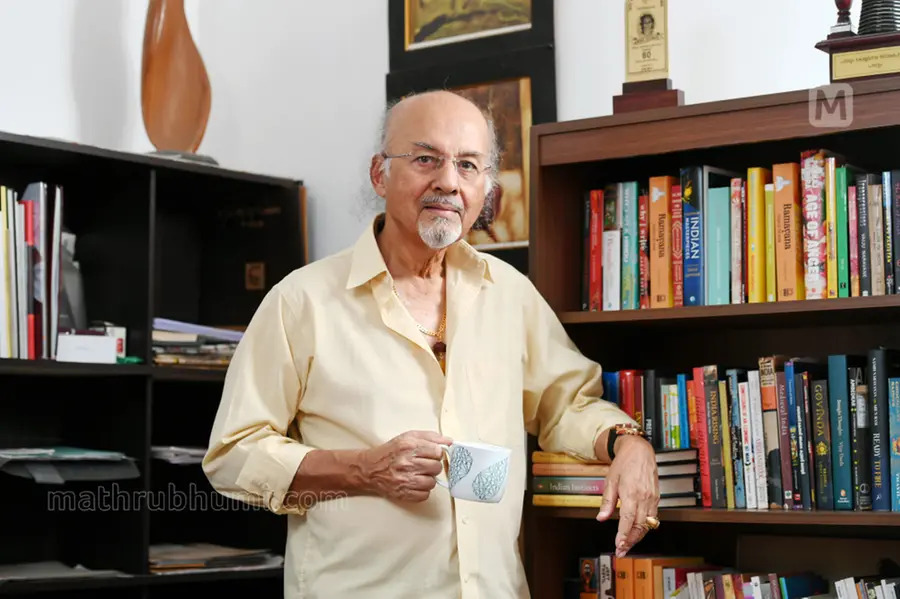
TJS George, who left us the other day, was perhaps the last of the great journalists from Kerala born before Independence who went on to make an indelible mark on India’s national media landscape. That illustrious league had included names such as the brothers George and Pothen Joseph, Karunakara Menon, T.M. Nair, M. Sivaram, Edathatta Narayanan, Shankar, C.P. Ramachandran, B.G. Verghese, and O.V. Vijayan.
Like most in that distinguished list, TJS spoke truth to power till his last breath. His integrity—both professional and personal—was beyond reproach. Yet, he stood apart in one crucial respect: he was the first editor in independent India to be arrested for sedition. He also holds the rare distinction of having founded a publication abroad -Asiaweek- that was later acquired by none other than Time magazine.
Despite a long and glittering career, TJS lacked the common journalistic vanity—the urge to talk about oneself. What he truly excelled in was writing extraordinary profiles of the innumerable people he met: presidents and prime ministers, film stars and musicians, crooks and commoners. Like a sharp-eyed detective, he explored the complex layers of their minds and lives, revealing their good, bad, and ugly sides with equal flair.
A close friend of many of my family elders and a personal hero to me, TJS often indulged me in long, generous conversations. Yet, the man with that mischievous twinkle in his piercing eyes would turn to humour whenever I tried to make him speak about his own journey. He refused to call his marvellous Malayalam memoir Ghoshayatra autobiographical. “It’s about the people I met,” he would insist. “Through them, I’ve tried to tell the story of their world and their times.” He swore he would never write an autobiography—he simply loathed talking about himself.
Perhaps it is this self-effacing nature that makes the long chapter in Ghoshayatra about his 1965 arrest, while he was Editor of The Searchlight in Patna, all the more significant. Since he may never have written about it in English, let me recount that remarkable episode—with the disclaimer that my retelling can hardly match his wit or grace.
In 1965, TJS, then in his mid-thirties, married and with two small children, took over as Editor of The Searchlight in Patna. The paper, owned by the Birlas—who also ran the Hindustan Times—gave him complete editorial freedom despite their vast business interests in Bihar. This was unusual, for the Birlas were not known to tolerate editors -CP Ramachandran and BG Verghese included - who displeased politicians. Though K.K. Birla’s initial remark about TJS’s Christian background had offended him, their relationship remained cordial thereafter. Birla backed him even when the Congress's Chief Minister KB Sahay proclaimed TJS an enemy.
In Patna, it was customary for every new editor to pay respects to the Chief Minister. It was also “tradition” that during law-and-order crises, newspapers should publish only the District Magistrate’s official statements. Having come from the Free Press Journal, TJS was blissfully unaware of such conventions. He published his reporters’ accounts and eyewitness versions alongside the official handouts. Chief Minister Sahay took this as sedition—and promptly had him arrested.
TJS, with characteristic humour and total absence of self-pity, later wrote about the episode, referring to “the editor” in the third person: “It was actually a great service done to me by him. A journalist’s moment of gratification is when he becomes well-known to a few people. As I was bestowed with the honour of being the first editor in independent India to be arrested, my fame spread much beyond a few people.”
The arrest triggered national outrage. Parliamentarians, artists, social leaders, and unions condemned it. When the former Union Defence Minister and Parliament member, V.K. Krishna Menon, himself volunteered to file a habeas corpus petition, the case turned sensational. The Chief Justice even remarked, “See the big crowds today—they’ll go out of control if the accused is present.”
He was right. The court premises became a human sea the day Menon appeared alongside the accused. Menon’s words still resonate: “An editor’s character is his greatest asset and his bequest to the world. Fearlessness is his hallmark. Therefore, he cannot accept conditional bail.”
Bail was granted. Nearly fifty thousand people accompanied the editor from the court to The Searchlight office. The Bihar Advocate General even rushed to Delhi to have the bail cancelled, but the Supreme Court’s quashing of a similar arrest order against Ram Manohar Lohia ended the matter.
The three weeks in jail, TJS later wrote, offered “an unparalleled wealth of experience. I often think that no journalist can come of age without a stint in prison.”
He observed wryly that one could still “come out intact from a Bihar prison in the 1960s”—unlike later years when police brutality became routine. He recalled the “biscuit baron Rajan Pillai was kicked to death in Tihar Jail” and the custodial killing of the student Rajan in Kerala, remarking with irony and refusing to name the the then Home Minister K. Karunakaran;
“When answers were finally given decades later, blame was put on the police chief. What about the police chief’s beloved Home Minister? Wasn’t I totally innocent, Lord Guruvayoorappa!”
At Patna’s Bankipur Jail, he was first locked up in a large hall with 70–80 other prisoners. “I came of age within the first night,” he wrote. The next day, he was moved to a cell with a single plastic bucket. “A bucket for my exclusive use! I accepted it as the most invaluable luxury ever gifted to a human. Suddenly, the prison turned into heaven.”
From nearby women’s cells beyond a twenty-foot wall behind his own, he often heard wails—and once, a sweet voice singing film songs with haunting beauty.
“Her voice was sweet enough to make me spend whatever time possible near the wall,” he wrote. “The heart of the political prisoner across the wall pined to meet the blessed singing gem at least once. He made many attempts to including an adventure, but they were all in vain”.
The experience reminded him of his favourite author, Vaikom Muhammad Basheer’s Mathilukal. With characteristic humour, he added: “The only small mistake Adoor Gopalakrishnan made was choosing Mammootty, who had no such experience, instead of me for the film.”
The multi-storied offices of the Indian Nation, a prominent newspaper, was bang opposite to the Bankipur Jail. One day when TJS came out from his cell to enjoy some breeze to the prison’s open courtyard, he saw the journalists standing crowded on the Indian Nation’s office balcony. They waved at him excitedly. Much later, Janardan Thakur, the prominent journalist at the Indian Nation told TJS that they all used to come to the balcony every day to try catching a glimpse of him. “Their excitement was a big solace to me. From then, coming out to the courtyard became a routine. Even such small things are a big solace for prisoners,” TJS wrote.
Later, TJS was shifted to Hazaribagh Jail, which he found “almost a luxury resort.” The lush campus housed several national leaders, including Ram Manohar Lohia, who “reigned like a Sultan”.
“Prison is an ideal place for cementing friendships,” TJS observed, though lamenting that his bond with Lohia was thwarted by language. Despite knowing English and German, Lohia insisted on speaking only in chaste Hindi—much beyond TJS’s grasp as he was familiar only with Bombay’s “street Hindi”.
He admired Lohia’s choice to remain a socialist despite his wealthy background. Journalist Nikhil Chakraborty, “who knew everything about everyone,” once told TJS, “Lohia’s father owned 35,000 rickshaws in Calcutta.” Though Lohia’s knowledge was awesome, TJS wrote that Ramakrishna Hegde, a Lohiaite, told him that the fiery Socialist was intellectually arrogant and intolerant of all others.
Among his fondest memories of those days was of a humble fish—netholi (anchovy). His close friend, RSP leader N. Sreekantan Nair, had rushed from Delhi to console his family. When a fisherman arrived selling only netholi, TJS’s wife, Ammu, hesitated to buy it for such an eminent guest. Overhearing her, Nair cheerfully insisted: “Netholi? Buy the entire stock—it’s delicious!
After his release, TJS published an open letter in The Searchlight challenging Chief Minister Sahay to resign and contest an election in Patna against him. Sahay never responded. In the 1967 elections, he contested from both Patna and Hazaribagh—to ensure victory—and lost both.
TJS George represented a generation of journalists who believed that truth-telling was a moral duty, not a professional choice. His courage came wrapped in wit, his conviction tempered by humility. “Fearlessness,” he once wrote, “is a journalist’s hallmark.”
By that measure, only very few ever matched him.
Published: 05 Oct 2025, 01:57 pm IST
ABOUT THE AUTHOR
Related Topics
Disclaimer: Kindly avoid objectionable, derogatory, unlawful and lewd comments, while responding to reports. Such comments are punishable under cyber laws. Please keep away from personal attacks. The opinions expressed here are the personal opinions of readers and not that of Mathrubhumi.