
Writers and activists at the Mathrubhumi International Festival of Letters (MBIFL) spoke about art as resistance, survival and testimony against exclusion and silencing
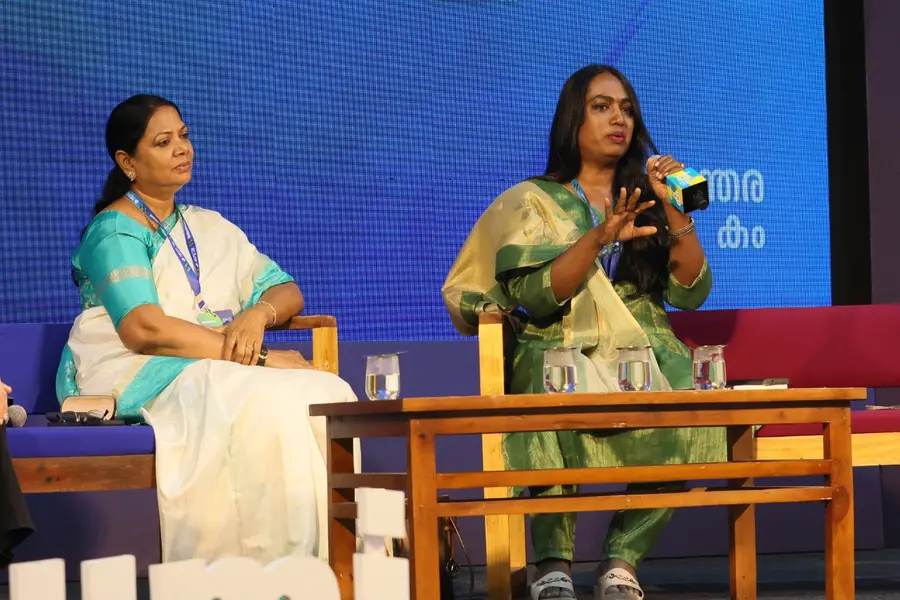
The session Unidentical Lives: Art, Activism and the Self Reimagined, held at the 7th edition of the Mathrubhumi International Festival of Letters (MBIFL), made a forceful case that for marginalised voices, art is not an act of leisure but an act of survival.
Setting the tone early, poet and critic Hoshang Merchant framed creativity as an unavoidable response to violence and silencing. “If somebody slaps you, you will scream. This is my scream,” he said, arguing that art must exist in public spaces to have meaning. “There is no point in screaming in a dark room; nobody is going to help you.”
Also Read

Moderated by author and journalist Nirmala Govindarajan, the session unfolded as a shared reflection on how literature and art become tools to resist erasure, rather than vehicles for aesthetic refinement.
For writer, artist and transgender rights activist Kalki Subramaniam, creative expression was inseparable from lived experience. Rejecting the romanticised portrayal of the hijra community as mystical or symbolic, she insisted on the right to ordinariness. “I am not here to showcase my beauty, showcase my sexuality, or showcase my gender identity,” she said. “I am not anyone’s cup of tea. I am for myself. I live my life.”
Subramaniam spoke of her school years marked by bullying and isolation, describing art as the only space where she could reclaim dignity and agency. She emphasised that society’s fascination with transgender identities often coexists with systemic violence and exclusion. “Creative expression is not for palatial purposes,” she said. “It is an outcry for acceptance.”
Writer and Rajya Sabha member Salma traced her literary journey to the restrictions of a conservative rural upbringing, where education and freedom were denied under the guise of tradition and religion. Confined largely to her room, she turned to literature as a form of quiet resistance. Reading writers such as Periyar, Ambedkar and Russian novelists, she said, allowed her to imagine a life beyond imposed limits.
Salma drew attention to the structural nature of exclusion, noting the distance between symbolic representation and social reality. While she sat on stage as a writer, she pointed out, thousands of women from similar backgrounds remain excluded from education and employment. Literature, she said, became “the bridge where family acceptance and social inclusion failed”.
Merchant reflected on growing up gay in 1960s India, arguing that privilege offered little protection against alienation. Describing himself as a “poet who has to have soil”, he spoke of the absence of a visible gay literary tradition and the need to excavate history to find a sense of belonging. His writing, he said, was shaped less by sexuality alone and more by the experience of being persistently unseen.
He also critiqued the publishing industry’s selective embrace of diversity. While marginalised identities may be celebrated in theory, he noted, institutional and economic support often stops short of genuinely disruptive voices. Recalling his own struggles with self-publishing, he questioned the sincerity of corporate inclusivity.
Across the discussion, a shared understanding emerged: art, for these speakers, is not decorative or detached. It is a response to violence, silence and exclusion. Whether through poetry, fiction or activism, their work asserts presence in spaces that have historically denied them visibility.
The session closed without offering comfort or easy resolutions. Instead, it left the audience with a stark proposition: for those living at the margins, literature is not a mirror reflecting the world as it is, but a tool to make it bearable — and, where possible, transform it.
Published: 01 Feb 2026, 10:40 am IST
Related Topics
Disclaimer: Kindly avoid objectionable, derogatory, unlawful and lewd comments, while responding to reports. Such comments are punishable under cyber laws. Please keep away from personal attacks. The opinions expressed here are the personal opinions of readers and not that of Mathrubhumi.