
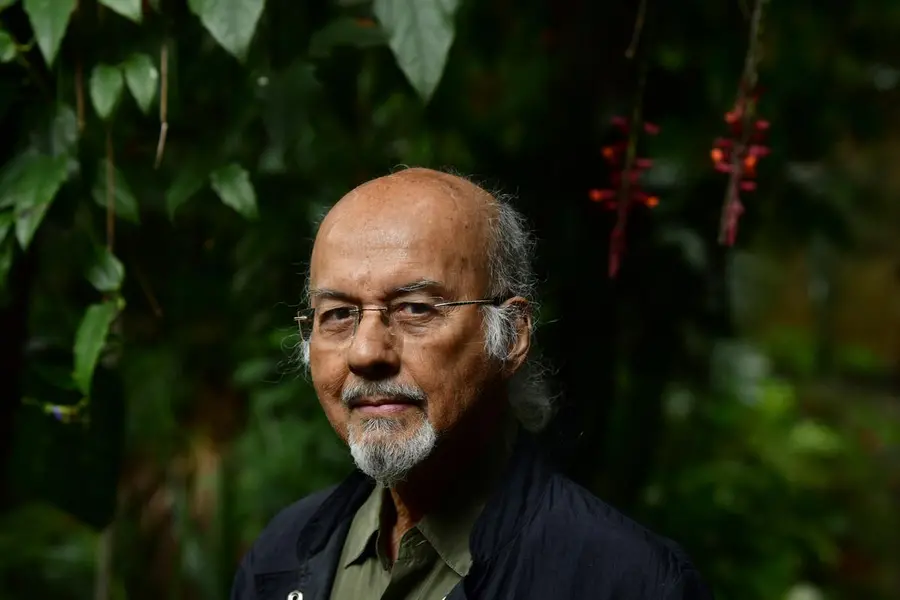
When I joined The Searchlight, Patna, as Assistant Editor in 1980, many of my colleagues, both in the editorial and printing sections, had a treasure of stories to tell me about TJS George, who had served as the paper’s editor for a little over two years, from 1963 to 1965. His impact, though brief, was legendary.
They recounted how, under his leadership, the paper took an uncompromising stand in support of students protesting against fee hikes and rising prices. When a Patna bandh turned violent, George devoted the entire newspaper to saturation coverage of the agitation. The print order soared past one lakh -- a record for those times.
The state establishment struck back. Chief Minister KB Sahay had George arrested under the Defence of India Rules. The spectacle that followed entered journalistic folklore. VK Krishna Menon air-dashed to Patna to secure his bail from the High Court. The court premises had never seen such a large crowd. George was eventually released, becoming the first editor to be arrested in independent India.
Even from prison in Hazaribagh, he remained a journalist at heart. He wrote a booklet on the student unrest in Bihar. The episode cost Sahay his political career -- he was trounced in the next election in both Patna and Hazaribagh. Overnight, TJS George had become a national hero. Yet his stint at The Searchlight ended soon after, when the management overruled his instruction to keep the editorial column blank until his release.
George and I were distantly related. He had begun his career under another remarkable Malayali, S Sadanand, who founded the Free Press Journal in Bombay. Those who worked with George in Patna still recalled his impeccable command of English and the way he would personally supervise the layout of each page before it went to press.
Restless and visionary, he later moved to Hong Kong, where he founded Asiaweek, modelled on TIME and Newsweek. In many ways, his magazine was ahead of its American rivals in its coverage of Asia, and George’s reputation as an international journalist was sealed.
In 1971, he returned to India and joined the Indian Express as Editorial Advisor. When the group split, and the southern editions were rechristened The New Indian Express, George became their pillar of strength. Such was the esteem in which he was held that he was permitted to run his personal column on Page 1, sometimes taking positions that differed from the editorial line. Readers loved him for his boldness, and his bosses knew better than to interfere. It was in those years that colleagues began calling him the "Holy Cow of the Express."
His writing career was prolific. His Handbook for Journalists was prescribed in journalism schools, shaping generations of reporters. As a biographer, he combined elegance with insight, producing acclaimed works on VK Krishna Menon, actress Nargis, pioneering journalist Pothen Joseph, and the legendary Carnatic vocalist MS Subbulakshmi. His books on Lee Kuan Yew’s Singapore and the rise of Islam in the Philippines remain extraordinary achievements by a Malayali journalist writing about foreign societies with rare authority.
George, who wrote under the byline "GOG" during his Searchlight days, lived and breathed journalism. For him, printing ink -- not blood -- ran in his veins. He was not just an editor, but an institution -- one that will be remembered as long as Indian journalism values courage, clarity, and conviction.
Published: 05 Oct 2025, 01:46 pm IST
Related Topics
Disclaimer: Kindly avoid objectionable, derogatory, unlawful and lewd comments, while responding to reports. Such comments are punishable under cyber laws. Please keep away from personal attacks. The opinions expressed here are the personal opinions of readers and not that of Mathrubhumi.
