

Indian authors debate fiction, autobiography and cultural identity at the Mathrubhumi International Festival of Letters 2026.
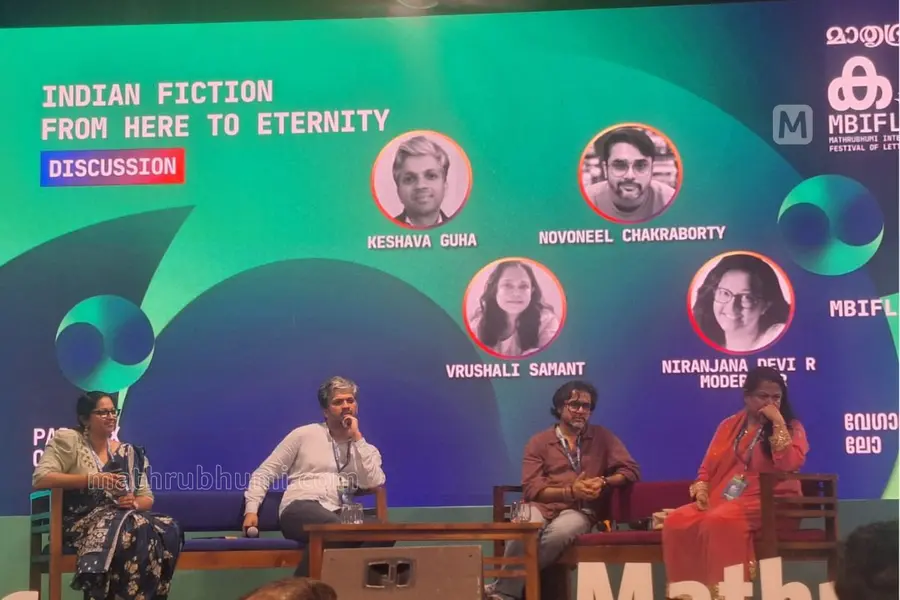
Thiruvananthapuram: The lines between autobiography and art blurred at the latest session of the Mathrubhumi International Festival of Letters (MBIFL 2026), as three of India’s distinct literary voices sparred over the "truth" of their stories. The panel, featuring commercial powerhouse Novoneel Chakraborthy, literary novelist Keshava Guha, urban chronicler Vrushali Samant, and moderated by Niranjana Devi R V, offered a glimpse into the anxieties and inspirations of the modern Indian fiction writer.
Fiction as a protective shield
In the discussion, Novoneel, often called the ‘Sidney Sheldon of India,’ candidly confessed that for commercial fiction writers, the novel often serves as a necessary disguise to protect the author from the repercussions of their own honesty. "We want to say the truth, but we don't have the balls to say it, so we hide behind the fiction, so that nobody can sue us," he explained. For Novoneel, the "truth" is the engine of the story. Without a core of reality, he believes a thriller fails to "ring" with readers, even if the plot is meticulously constructed. He suggested that authors must be "connected with the story of the truth" to write effectively.
The outsider’s gaze vs the insider’s soul
The conversation took a sharp turn when Keshava challenged the notion that fiction should be "relatable" or autobiographical. As a literary writer, he views the novel as a vehicle for unfamiliarity and an escape from the self. "The last thing I ever wanted to do was relate to somebody in a novel. I am looking for a book to give me something that I don't already know. Or the access to an experience I don't already understand," he said.
Citing V S Naipaul, Keshava warned that writers who rely solely on personal history eventually "drain the well" of their first twenty years and lose the spark of creation. While he didn’t set out to make Delhi a "character" in his work, he acknowledged that his status as a migrant allowed him to observe the city’s social segregation with a precision a native might lack.
Vrushali, conversely, argued for the power of the insider. Her novels are deeply rooted in Mumbai, a city she describes as offering a "seamless segue" between different socio-economic strata. For her, the location is an active participant in the character’s evolution.
Pushing the envelope: The Japanese benchmark
A poignant moment in the debate focused on the identity of Indian fiction in English. Novoneel suggested that many Indian thrillers lack a distinct cultural soul compared to their international counterparts. "One thing I love about Japanese thrillers is that they always have their own personality to them. When you read a Japanese thriller, you know you're reading a Japanese thriller. When we read an Indian thriller, it's not always an Indian thriller," he said.
The panel suggested that true innovation is currently found in regional language literature. They argued that writers in English must "push the envelope" by owning their specific regions rather than simply "aping" American or Western styles.
The "coming of age" at forty
The session concluded with a shift towards the "messy" reality of contemporary life. Vrushali discussed her latest work, which explores the bildungsroman—or coming-of-age story—not for a teenager, but for a 40-year-old woman who has already "ticked all the boxes." "By the time a woman reaches 40, she has done everything that was demanded of her. Now so what? When do I live my life exactly the way I want to?"
The panellists agreed that the pressure to succeed and conform is a universal Indian experience. Vrushali argued that a character only truly finds themselves when "pushed into a corner," and that the best way to handle the tragedies of life is through the lens of humour rather than purely spiritual healing.
Published: 31 Jan 2026, 09:04 pm IST
ABOUT THE AUTHOR
Disclaimer: Kindly avoid objectionable, derogatory, unlawful and lewd comments, while responding to reports. Such comments are punishable under cyber laws. Please keep away from personal attacks. The opinions expressed here are the personal opinions of readers and not that of Mathrubhumi.