

Jeet Thayil says writing his documentary novel The Elsewhereans meant negotiating truth, permission and the emotional cost of turning family into literature
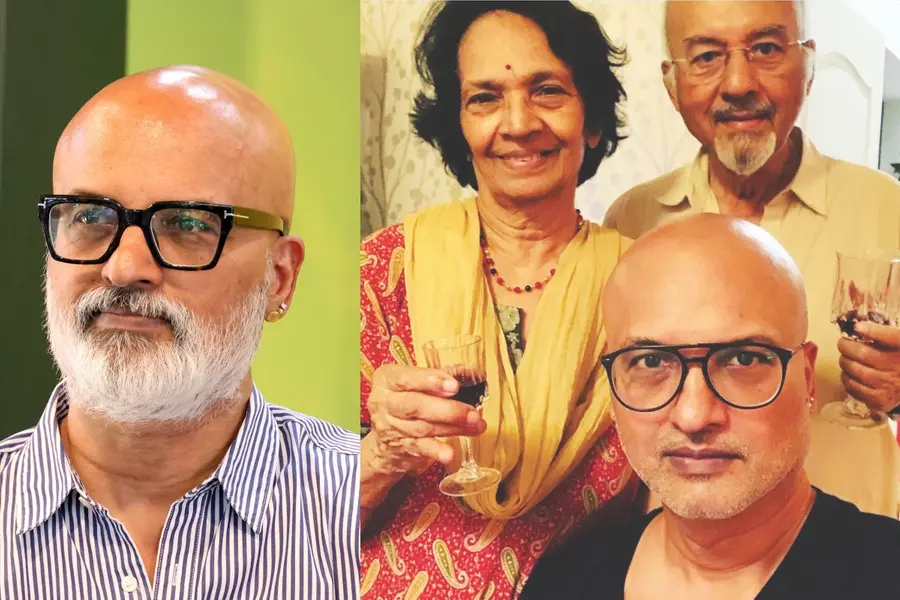
At the Mathrubhumi International Festival of Letters 2026 in Thiruvananthapuram, Jeet Thayil spoke about his new book ‘The Elsewhereans’ not as a literary experiment, but as an act that demanded permission, courage and a certain quiet cruelty.
Described by the author as a “documentary novel”, The Elsewhereans resists classification. It is not quite memoir, not entirely fiction. It carries photographs, letters, diary pages and edited poems alongside imagined interiors of memory. But beneath its genre-defying form lies a simpler, more unsettling question: what does writing do to the people who gave you your life?
Also Read
Jeet Thayil acknowledged that the book, published in 2025, draws deeply from the lives of his parents — his father, T.J.S. George, one of India’s most influential editors, and his mother, the quieter architect of the family’s survival with mentions of his sister, Shebi Thayil, a journalist and author.. Writing their story, he said, was never merely an artistic choice.
“I had to ask my parents’ permission,” Thayil told the audience. “There were private details about their lives.”
His father agreed immediately. Literature, for him, was worth the risk. His mother hesitated. She had lived through Narcopolis, his previous novel and had seen what happens when private worlds are opened to public judgment. She understood, perhaps better than anyone else in the room, that writing does not preserve families — it rearranges them.
At the beginning of The Elsewhereans sits an epigraph that captures this danger with brutal clarity: ‘When a writer is born into a family, the family is finished.’
It is not a line meant to shock. It is a warning.
Jeet explained that the book began as an attempt at non-fiction — a memoir, a family history. But the material resisted the rules of journalism. Fiction became the only ethical way forward.
“When you write non-fiction, you can’t go into people’s heads,” he said. “You can’t inhabit their motivations, their backstories. Fiction allows that.”
Yet The Elsewhereans refuses the safety of full invention. Photographs of his parents appear alongside letters, diary entries and handwritten translations. These are not imagined lives; they are documented ones. The act of writing, then, becomes a negotiation — between truth and empathy, exposure and care.
“There was so much that was non-fictional,” Thayil said. “I didn’t know what to call it.”
He eventually chose the term “documentary novel”, partly to reflect its structure, partly to unsettle expectations. With a trace of humour, he added that he liked the idea of bookshop owners not knowing where to shelve it — fiction or non-fiction — because the book itself occupies that uneasy in-between.
The question of privacy returned repeatedly during the session. Why would a writer place such intimate material before strangers who may not always be kind?
“I honestly don’t know why I do it,” Jeet Thayil admitted. “But I think all novelists do.”
Quoting V.S. Naipaul, he added: “It’s in fiction that you cannot lie.”
What The Elsewhereans reveals is that truth, in literature, is not about accuracy alone. It is about exposure. Writing takes what is held inside families — silence, resentment, tenderness, compromise — and releases it into a public space where it can no longer be controlled.
In one of the session’s most moving moments, Jeet Thayil spoke about his mother again — about how she ultimately agreed, knowing the cost. The book’s emotional freedom, he acknowledged, is built on the trust of those who allowed themselves to be written.
That trust is what gives The Elsewhereans its moral weight. It is not a book that claims ownership over memory. It understands memory as something inherited, shared, and fragile.
Listening to Thayil, it became clear that the paradox of the book lies here: writing may “finish” a family, but it also refuses to let it disappear. It breaks the private world open so that it can be remembered — not as legend, not as nostalgia, but as lived, complicated human life.
In that sense, The Elsewhereans is not just about living between places. It is about living between love and betrayal, gratitude and trespass — and choosing, despite everything, to write anyway.
Published: 01 Feb 2026, 05:31 pm IST
ABOUT THE AUTHOR
Related Topics
Disclaimer: Kindly avoid objectionable, derogatory, unlawful and lewd comments, while responding to reports. Such comments are punishable under cyber laws. Please keep away from personal attacks. The opinions expressed here are the personal opinions of readers and not that of Mathrubhumi.