
Poetry is not a magic trick; it is the radical act of turning a personal nightmare into something universally beautiful
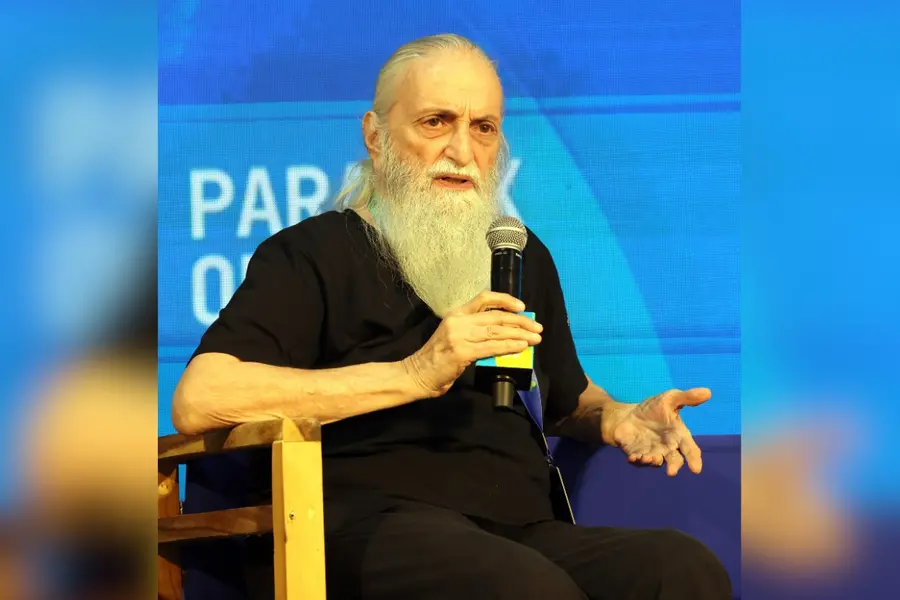
Speaking at the 7th Edition of the Mathrubhumi International Festival of Letters (MBIFL) in a session titled 'Identity and Poetry: The Intimate Verse of Hoshang Merchant', the professor-poet turned a half-hour discussion with Dr Bidyut Bhusan Jena into a masterclass on the "sublimation" of the self.
"I am a homosexual," Merchant stated, revisiting a declaration he made public years ago. "To write this sentence and to speak it publicly is a great liberation. That is why I write." For Merchant, the personal is not just political; it is a survival strategy. He rejected modern labels like "queer" or "gay" as insufficient, leaning instead into the raw honesty of his identity to bridge the gap between the familiar and the unfamiliar.
Also Read

The conversation, which felt less like a formal panel and more like an intimate classroom session, delved into the "schizophrenia" of the Indian identity. Merchant argued that every Indian living today is a genius of survival, negotiating multiple selves -- the colonizer’s language, the ancestral heritage, and the quotidian struggle. "We are Indians who speak English. Right there is schizophrenia," he remarked. Yet, he views this split as a strength rather than a pathology, a "hybrid" state that allows for a deeper search for love.
When pushed by Dr Bidyut on the role of the body in his work, Merchant was unapologetically grounded. He dismissed the idea of dividing sex from love as an artificial cultural construct. Using the metaphor of Bhakti and Sufi poets, he explained that divine love can only be understood through the lens of human, often sexual, connection.
"You see, everyone has sex," he told the audience, "But you have to find love. We have sex because we want love."
Merchant’s poetry, characterized by what he calls "prose with feeling," is deeply rooted in music -- a lesson he carried from his teacher Ezra Pound. To him, the intervals and breaths in a line are what prevent language from becoming mere noise. This rhythmic sensitivity was evident as he read Broken Bangle, a poem dedicated to a former student, which transformed a mundane classroom observation into a meditation on Lila (divine play) and the transition from childhood to womanhood.
The dialogue took a poignant turn toward the inevitability of death. Merchant challenged the modern obsession with living forever, asserting that love is meaningless without the shadow of the end. "Death gives meaning to life," he said, reflecting on a lifetime of "staking his life on a throw of the dice." He described his work as a form of healing, claiming that if his poetry helped even one person choose life over suicide or find the courage to leave an oppressive marriage, it was worth more than a thousand research papers.
"I’m an old-fashioned person," he concluded, with a wit that belied his age. "I’m not a modern person. I’m a person who wants to heal people." In a world obsessed with "inflicting discourses" on nature and identity, Hoshang Merchant remains a practitioner of the ancient art of living reminding his audience that while the body gets old, the spirit, fueled by idealism and poetry, remains perpetually young.
Published: 02 Feb 2026, 07:35 pm IST
Related Topics
Disclaimer: Kindly avoid objectionable, derogatory, unlawful and lewd comments, while responding to reports. Such comments are punishable under cyber laws. Please keep away from personal attacks. The opinions expressed here are the personal opinions of readers and not that of Mathrubhumi.