

What unsettled her even more was cinema’s habit of reframing harassment as romance
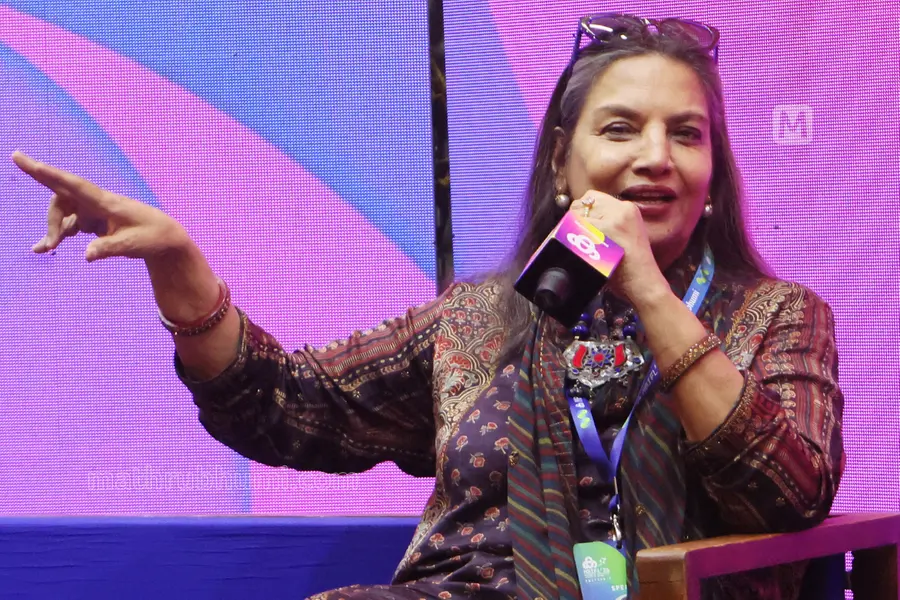
For Shabana Azmi, longevity in cinema has meant learning not just when to say yes, but when to refuse, even when the offer is tempting, or commercially rewarding.
Speaking at Of Fire and Grace, her conversation with Vishal Menon at MBIFL 2026, Azmi traced that clarity to an early Rajesh Khanna film, where a line in the script suggested that the pain of a woman in her husband’s home outweighed the joy of her maternal one. “That’s when I consciously realised that some films, no matter how attractive, carry the wrong message,” she said. From then on, she began turning down roles that normalised women’s subservience or dressed inequality up as emotional truth.
The male gaze
Her critique extended sharply to item songs — once considered non-negotiable fixtures of mainstream cinema. Azmi said she found many of them deeply degrading. “When a woman is reduced to shaking her navel or pumping her body for the camera, she is no longer a character, she becomes an object,” she said. The issue, she stressed, was not sexuality but agency. “There is a difference between celebrating sexuality and surrendering to the male gaze.”
ALSO READ | ‘You’re always watching’: Shabana Azmi on the occupational hazard of acting at MBIFL 2026
What unsettled her even more was cinema’s habit of reframing harassment as romance. Films where a man relentlessly pursues a woman after she has said no, Azmi argued, quietly legitimise entitlement. “Men learn this behaviour from cinema,” she said. “It affects how women walk on the streets. This is not about being moralistic. It’s about responsibility.”
That sense of responsibility, she said, also shaped how she approached romance on screen. As a method actor, she rejected the idea that romantic truth must always come from personal emotion. “You can hate someone and still act lovingly,” she said. Craft, not sentiment, was the anchor.
ALSO READ | From Manmohan Desai to Karan Johar: Shabana Azmi on learning the grammar of cinema
Worldview with Javed Akhtar
Azmi located much of this moral clarity in the worldview she shares with her husband, poet and screenwriter Javed Akhtar. Their arguments, she said, were frequent but grounded in the same ethical framework. Even when writing anti-heroes, she noted, Akhtar’s scripts rebelled against society rather than revelled in cruelty. “Our worldview is the same,” she said simply.
The values behind these choices, Azmi added, came from home. Her parents believed art had to function as a tool for social change — a belief that shaped not only her filmography but also her sustained engagement with social issues beyond cinema.
Asked how she would like to be remembered, Azmi offered an answer as unembellished as her convictions: “She tried.”
Published: 01 Feb 2026, 03:54 pm IST
ABOUT THE AUTHOR
Related Topics
Disclaimer: Kindly avoid objectionable, derogatory, unlawful and lewd comments, while responding to reports. Such comments are punishable under cyber laws. Please keep away from personal attacks. The opinions expressed here are the personal opinions of readers and not that of Mathrubhumi.