
Swiss-German novelist Jonas Lüscher reflected on technology, survival and the future of democracy during a session at the MBIFL
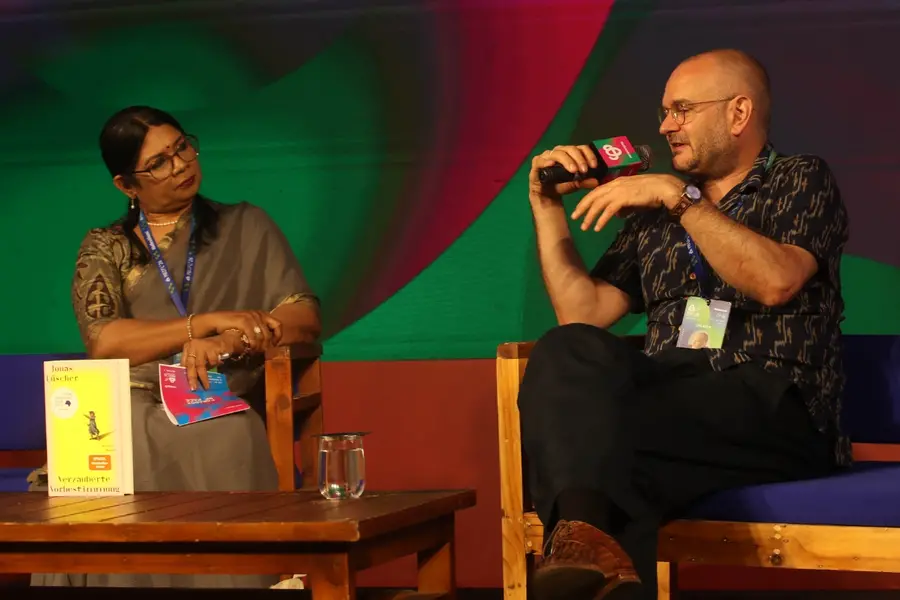
"I was Case Number 10." When Swiss-German novelist Jonas Lüscher stood before the gathering at the 7th Mathrubhumi International Festival of Letters (MBIFL), the humid air of Kerala felt worlds away from the sterile, oxygen-fed silence of a Munich isolation ward.
Yet, as he looked out at the "isolated seats" of a post-pandemic crowd, the irony was thick enough to touch. The man who made a career out of fearing a techno-capitalist dystopia had to admit, with a mix of gratitude and "embarrassment," that he is only alive because he became a cyborg.
Also Read

Seven weeks in a COVID-induced coma didn't just save Lüscher; it rewrote him. "It would have been dishonest not to admit that I, as a writer, was completely dependent on technology," he reflected, describing the jarring experience of reading his own pre-pandemic drafts as if they were penned by a stranger.
This wasn't just research for his latest work, Verzauberte Vorbestimmung (Enchanted Predeterminism); it was a visceral, medical merger of man and machine. The conversation, sparked by moderator Bindu Amat, quickly pivoted from the hospital bed to the barricades. Lüscher invoked the ghost of the Luddites -- the 19th-century rebels who smashed textile frames to save their souls. But he threw a haunting challenge to the modern digital age: "Today, when it comes to artificial intelligence... what would be the hammer and what would be the frame to break?"
In a world where the "machine" is an invisible algorithm, the old hammers are useless. Lüscher sees this systemic rot manifested in the "post-democratic" architecture of our time. He spoke of Egypt’s New Administrative Capital, a billion-dollar ghost city rising in the desert with the tallest building in Africa and a crumbling, empty opera house as a monument to the same "male ego" that drives a postman to build a palace of pebbles or a writer to build a "massive novel."
It is the architecture of immortality, built while the real world, the "Old Cairo" is left to turn to dust. "In writing, you have to dare everything. You even have to dare to write about the embarrassing and the obscene."
Lüscher’s skepticism is heavy, almost Gothic. He dismisses the "optimistic" hope that technology will blur gender boundaries or create a digital utopia, arguing instead that as long as capitalism holds the remote, the "cyborg future" will only be about profit. Yet, in the quiet shade of the festival, he offered one exit ramp from this algorithmic muddle.
Trade agreements and capital are zero-sum games, if you sell a car, you no longer own it. But a story? The story is a cornucopia. "If you share a poem or a story, the other guy has it... but you still have it too." In the face of a future that feels "pre-determined" by code, Lüscher suggests that our only real rebellion is the shared, untradable word.
Published: 02 Feb 2026, 08:06 pm IST
Related Topics
Disclaimer: Kindly avoid objectionable, derogatory, unlawful and lewd comments, while responding to reports. Such comments are punishable under cyber laws. Please keep away from personal attacks. The opinions expressed here are the personal opinions of readers and not that of Mathrubhumi.