
A blistering coronal mass ejection from the Sun raced to Earth in just 25 hours, triggering a severe G4 geomagnetic storm
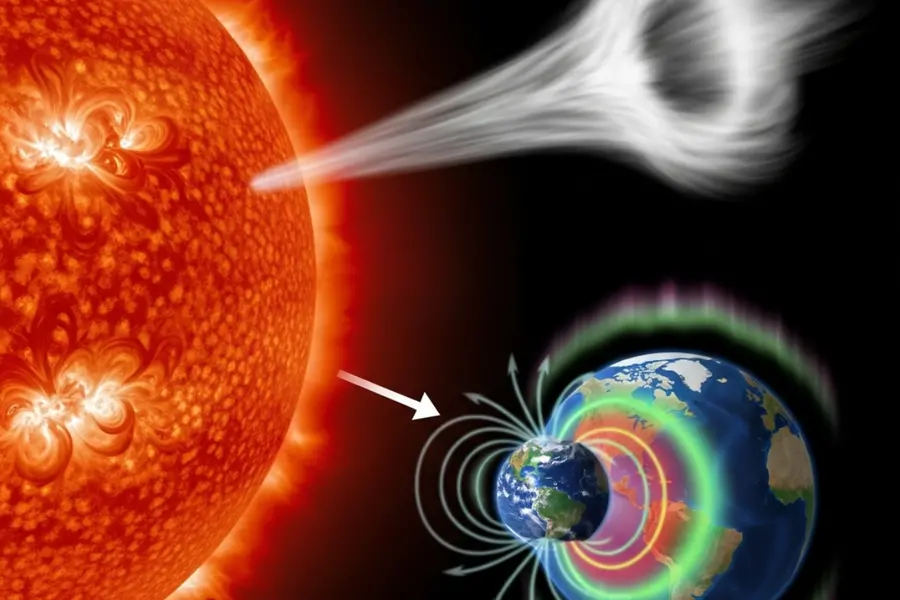
On January 18, 2026, sunspot region AR4341 produced an X1.9-class solar flare — one of the most powerful categories — launching a massive coronal mass ejection (CME) into space. This CME travelled at a record-breaking speed of 1,660 km/s, reaching Earth in only 25 hours, far faster than the typical 3–4 days.
A CME is a huge burst of solar plasma and magnetic field released from the Sun’s outer atmosphere, called the corona. When these charged particles collide with Earth’s magnetosphere, they can disturb the magnetic field, producing geomagnetic storms. This particular storm was rated G4 — severe — the second-highest level on NOAA’s five-tier G-scale.
Also Read

What is CME?
A coronal mass ejection (CME) is a powerful eruption from the Sun in which billions of tonnes of charged plasma and magnetic field are blasted into space from the Sun’s outer atmosphere, called the corona. When a CME travels towards Earth and strikes the planet’s magnetic field, it can trigger a geomagnetic storm, disrupting satellites, GPS and radio communications, power grids, while also producing vivid auroras such as the northern and southern lights.
Also read: ‘Platforms are deliberately engineered to hook kids’: US Senate flags harmful algorithms
Why this CME is unusual:
- Speed: Most CMEs take several days to reach Earth; this one travelled at over 1,600 km/s.
- Trigger: It was reinforced by fast-moving solar wind from a coronal hole, intensifying its impact.
- Timing: The storm arrived earlier than forecasters expected, demonstrating the unpredictability of solar activity.
Effects of a G4 geomagnetic storm:
- Satellites may experience operational disruptions.
- GPS and radio communications can be affected.
- Power grids may experience voltage fluctuations in rare cases.
- Northern and southern lights (auroras) are visible much farther from the poles than usual.
Also read: Explosion at GTA 6 studio? Rockstar office hit by blast in Edinburgh
Auroras:
Charged particles funnel along Earth’s magnetic field lines and collide with gases in the upper atmosphere, creating vivid light displays. During strong storms, the auroral oval expands, allowing auroras to appear in lower-latitude regions. This storm brought auroras to parts of Europe, and it was expected to reach northern US states like Washington and Minnesota.
Why it matters:
Solar storms are more frequent and intense during the Sun’s 11-year cycle peak, known as solar maximum. As the world relies increasingly on satellites, GPS, and other technology, understanding geomagnetic storms and preparing for their effects has become crucial. Events like this CME remind us that solar activity can affect everyday life — from communication systems to spectacular natural phenomena like auroras.
The January 19, 2026 CME is a rare combination of speed, power, and timing, providing both a natural spectacle and a reminder of how solar activity can interact with technology on Earth. Scientists continue to monitor space weather closely to predict and mitigate its impact.
Published: 20 Jan 2026, 05:20 pm IST
Related Topics
Disclaimer: Kindly avoid objectionable, derogatory, unlawful and lewd comments, while responding to reports. Such comments are punishable under cyber laws. Please keep away from personal attacks. The opinions expressed here are the personal opinions of readers and not that of Mathrubhumi.