
A rare total solar eclipse will darken skies on August 12, with parts of Greenland, Iceland, Spain and Portugal witnessing daytime darkness.
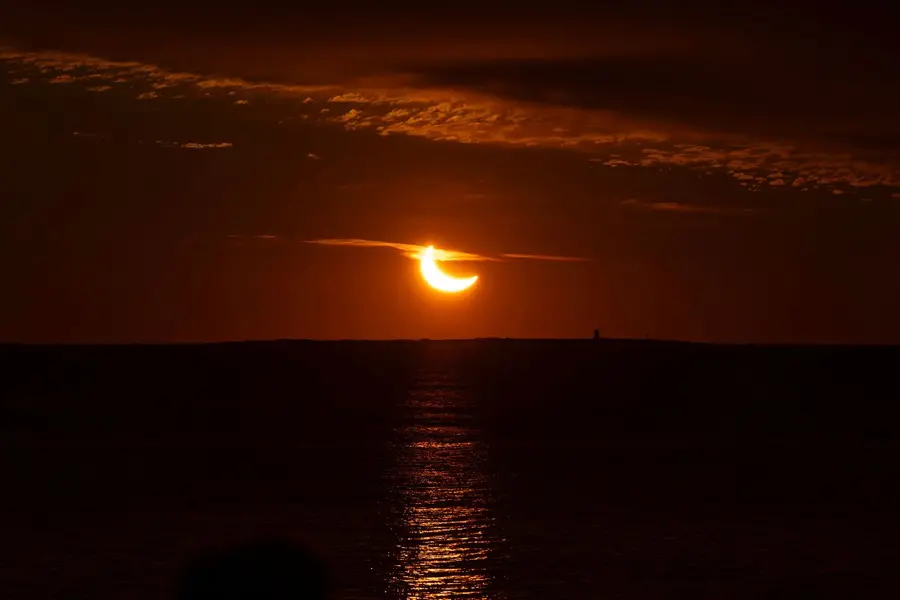
A spectacular celestial event is set to unfold in Earth's skies once again. In just a few weeks, a total solar eclipse will take place, temporarily obscuring the Sun, the central star of our solar system.
On August 12, people in several parts of the world will witness daytime darkness as the Moon passes directly between the Earth and the Sun.
According to the National Aeronautics and Space Administration (NASA), the Moon will move between the Sun and Earth on August 12, casting its shadow on parts of the planet.
In certain regions, the alignment will be so precise that sunlight will be completely blocked, resulting in a total solar eclipse.
NASA says residents of Greenland, Iceland, northern Spain, and northwestern Portugal will be able to witness the total solar eclipse.
During the event, the Sun will be entirely covered by the Moon, causing darkness to fall during the day. The eclipse is expected to begin around 1 pm local time in these regions.
Unlike a total solar eclipse, a partial solar eclipse occurs when the Sun is only partially covered. On August 12, a partial eclipse will also be visible from several locations across Europe, Africa, and parts of North America.
The last total solar eclipse was widely visible across Mexico, the United States, and Canada in April 2024.
According to the European Space Agency, the last total solar eclipse visible from mainland Europe occurred in 2006. For mainland Spain, this will be the first total solar eclipse since 1905.
Spain is expected to witness the first of three total solar eclipses that will occur before 2028. Following the August 12 event, another total solar eclipse will be visible on August 2, 2027, across southern Spain, North Africa, Saudi Arabia, and Yemen.
The United States will not see another total solar eclipse until March 30, 2033, when it will be visible only from Alaska.
A further total solar eclipse is expected on August 22, 2044, and will be visible across parts of the United States, including North Dakota and Montana.
Published: 11 Jun 2026, 08:14 am IST
Related Topics
Disclaimer: Kindly avoid objectionable, derogatory, unlawful and lewd comments, while responding to reports. Such comments are punishable under cyber laws. Please keep away from personal attacks. The opinions expressed here are the personal opinions of readers and not that of Mathrubhumi.
