
A powerful solar storm is heading toward Earth, raising the possibility of rare auroras at lower latitudes. Could parts of India witness the spectacle?
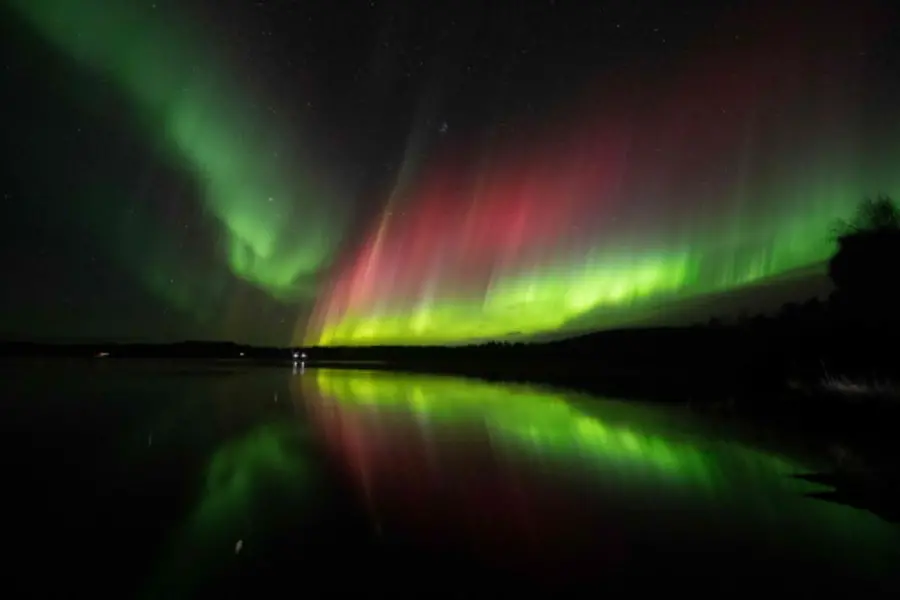
A giant cloud of charged solar material is racing toward Earth, carrying the potential to turn parts of the sky into a rare natural light show.
Scientists say the incoming disturbance, launched by an eruption on the Sun, could push auroral activity well beyond its usual polar boundaries. While sightings in India remain uncertain, the storm has drawn attention from skywatchers hoping for a rare display at unusually low latitudes.
Space weather forecasters are tracking a dense stream of magnetised solar plasma that erupted from an active region on the Sun over the weekend. The event has prompted a G3, or "strong," geomagnetic storm watch — a level capable of producing widespread auroral displays and minor disruptions to some technologies.
Could India really see the Northern Lights?
Auroras, popularly known as the Northern Lights in the Northern Hemisphere, are normally confined to regions near the Arctic Circle, where charged particles from the Sun regularly interact with Earth's magnetic field.
During stronger solar storms, however, that activity can spread much farther south.
That possibility is what has captured the attention of skywatchers across India.
Experts say the storm could push auroral activity into unusually low latitudes. While northern parts of India would have the best chance if the storm intensifies, visibility remains uncertain and will depend on several factors, including cloud cover, darkness and the strength of the storm when it arrives.
Auroras occur when charged particles from the Sun collide with gases in Earth's upper atmosphere, producing shimmering curtains of green, red and purple light. Under powerful geomagnetic conditions, these displays can extend thousands of kilometres from the poles.
For many observers, the possibility of seeing such a phenomenon from India is reason enough to keep an eye on the sky.
Why are scientists waiting until the last minute?
Despite tracking the solar eruption for days, researchers still do not know exactly how intense the storm will become once it reaches Earth.
The key lies in the magnetic field embedded within the incoming solar cloud. If that magnetic field aligns in a way that allows it to connect efficiently with Earth's own magnetic shield, energy can pour into the planet's upper atmosphere and dramatically strengthen auroral activity.
The challenge is that scientists cannot accurately measure this crucial detail until the solar material is relatively close to Earth, leaving only a short warning window before impact.
That uncertainty means the storm could range from a relatively modest geomagnetic event to a much stronger display capable of pushing auroras farther south than usual.
While the storm is not expected to pose a direct threat to people on the ground, stronger geomagnetic activity can occasionally affect satellite systems, GPS services, radio communications and power infrastructure. Space weather agencies around the world are continuing to monitor the situation and update forecasts as new data arrives.
Published: 08 Jun 2026, 10:11 am IST
Disclaimer: Kindly avoid objectionable, derogatory, unlawful and lewd comments, while responding to reports. Such comments are punishable under cyber laws. Please keep away from personal attacks. The opinions expressed here are the personal opinions of readers and not that of Mathrubhumi.
