

Swiss-German novelist Jonas Lüscher used irony, philosophy and satire to challenge uncritical faith in technology during a discussion on techno-optimism and catastrophe
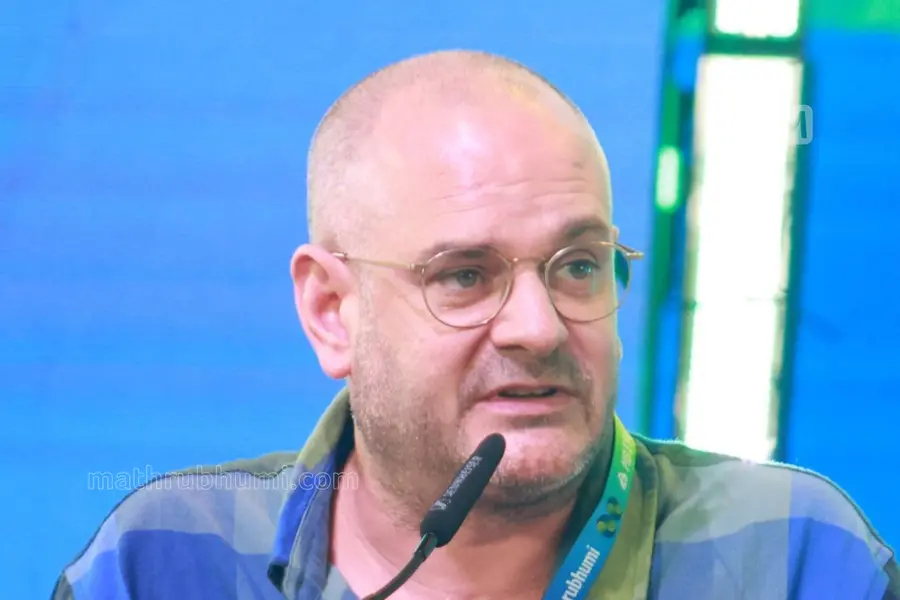
The session ‘The Technoptimistic nude: Satire in the times of catastrophe’ at the Mathrubhumi International Festival of Letters (MBIFL) 2026 brought together Swiss-German novelist Jonas Lüscher and public policy leader Atul Kumar Tiwari for a wide-ranging conversation on technology, philosophy, politics and the limits of optimism.
Reading, doubt and the making of a writer
Also Read
Lüscher traced his intellectual formation to a childhood surrounded by books and shaped by solitude. “I grew up in a house with many books and without a television. Reading was what we did or what all we could do,” he said, recalling how a nearby library became central to his life after his family moved from the countryside to a city.
Doubt, he stressed, is not an obstacle but a creative force. “I never fully trust my language, my ideas, or my words,” Lüscher said, describing himself as what philosopher Richard Rorty called an “ironic being”. According to him, scepticism towards language is essential because “language can betray you”.
Language, long sentences and uncertainty
Explaining his distinctive style, Lüscher said his famously long sentences were a deliberate refusal of certainty. “A full stop suggests certainty,” he said. “When you end a sentence, you say: I have no doubts anymore. I never want to say that.” For him, sentences that keep moving reflect unresolved questions rather than final answers.
Writing through questions, not conclusions
Lüscher said his novels always begin with questions rather than characters or plots. The Kraft, he explained, emerged from his time studying philosophy and living near Stanford, where he encountered Silicon Valley’s intense faith in progress. Europe, he observed, approaches the world with scepticism, while Silicon Valley operates with “almost religious” techno-optimism. The novel, he said, asks how these worldviews collide and whether they can meaningfully coexist.
Also read: Amid ED scrutiny, Confident Group owner C J Roy found dead; suicide suspected
Technology, vulnerability and the “nude” metaphor
One of the novel’s most striking images — the protagonist stranded naked on an island facing Silicon Valley — was meant to foreground human vulnerability. Lüscher said humans are “imperfect, needy beings” who rely on technology to survive, even as it exposes their fragility. The image, he explained, reflects the paradox of dependence and exposure in a technological age.
Responding to questions on politics, Lüscher said philosophy inevitably enters fiction when social and political uncertainty deepens. However, he cautioned that “a bad philosophical novel is when philosophers simply talk to each other”. Philosophy, he argued, must shape lived experience on the page.
Reflecting on recent global shifts, Lüscher said the world has grown darker since he completed Kraft. Figures once treated as exaggerated caricatures now wield real power. “Comedy becomes difficult when reality itself becomes grotesque,” he said, pointing to the growing influence of technology-driven ideologies.
Capitalism, Silicon Valley and power
Lüscher described Silicon Valley not as a space of philosophy but of ideology. He said philosophical ideas are often selectively used to justify political and economic agendas, with capitalism remaining the dominant force. The culture of relentless confidence and self-promotion, he argued, leaves little room for doubt, reflection or ethical hesitation.
Irony, Lüscher said, functions both as distance and survival. “Irony allows distance from a painful world,” he said, adding that laughter remains essential even in moments of catastrophe. He also acknowledged that Kraft gently mocks a generation of male intellectuals prone to over-explanation, linking intellectual bravado to deep insecurity.
Why humanities still matter
Concluding the discussion, Lüscher warned that as artificial intelligence and corporate power expand, the role of the humanities becomes more urgent. Writers, philosophers and artists, he argued, must continue asking what it means to be human. “These answers will not come from economics or computer science alone,” he said.
The MBIFL 2026 session reinforced the festival’s commitment to critical inquiry, using satire, doubt and literature to question technological certainty and the political ideologies that increasingly shape contemporary life.
Published: 30 Jan 2026, 06:18 pm IST
ABOUT THE AUTHOR
Related Topics
Disclaimer: Kindly avoid objectionable, derogatory, unlawful and lewd comments, while responding to reports. Such comments are punishable under cyber laws. Please keep away from personal attacks. The opinions expressed here are the personal opinions of readers and not that of Mathrubhumi.