
At a moment when global conversations are increasingly dominated by transactions and geopolitical alignments, Lüscher’s words positioned MBIFL as a counter-space
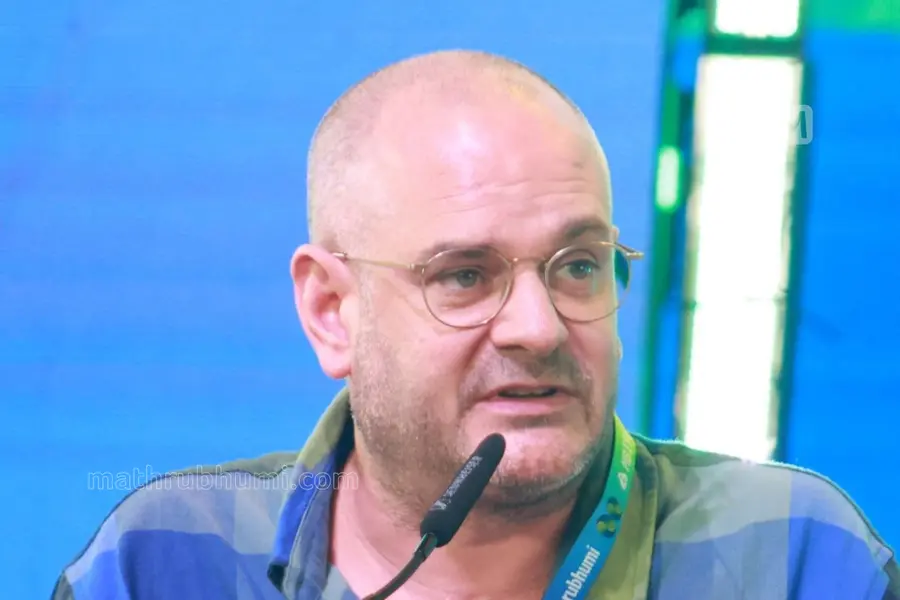
As Europe and India celebrate a landmark trade agreement, Swiss-German writer Jonas Lüscher chose a different register at the Mathrubhumi International Festival of Letters (MBIFL) on Thursday, setting aside markets and machinery to speak instead about stories, self-doubt and the quiet work of listening.
Visiting India for the first time, Lüscher confessed his surprise at how long it had taken him to arrive in a country so familiar to him through culture and art. “Indian movie stars, Indian food, Indian music—these had already reached me in the Swiss alpine pastures,” he said, drawing a gentle laugh from the audience. Later, when he moved to Germany, he became part of the European Union, further shaping his perspective on borders and exchange.
This personal journey framed his keynote address, which subtly moved away from economics even as it acknowledged their influence. Referring to the recently signed Europe–India trade agreement—hailed in policy circles as the “mother of all deals”—Lüscher noted the scale and ambition of such arrangements, forged at a time of rising nationalism and global isolationism. The language surrounding these agreements, he observed, is filled with “grand words,” focused on raw materials, machinery and markets.
ALSO READ | India-EU trade deal: How the ‘mother of all deals’ may reshape stock markets
Yet, standing before a literary gathering in Thiruvananthapuram, Lüscher chose to dwell on what trade frameworks cannot measure.
“I am happy that we are meeting here to discuss the non-materialistic and non-monetary things in life,” he said. “These are just as important as the trade of goods.”
Literature, he argued, expands the intellectual horizon—but it does so in a language fundamentally different from commerce. Where markets demand certainty and speed, literary language allows hesitation. “Our literary language is a cautious one,” he said. “It takes self-doubt into account. Sometimes, it is more like listening.”
Over the coming days, he suggested, stories and poems exchanged at the festival would travel home with audiences, crossing borders without tariffs or negotiations. And yet, paradoxically, they would remain with the writers too—reshaped, retold, and shared again in future works.
ALSO READ | Spices to Rubber: Know how Kerala stands to gain from India‑EU trade pact
At a moment when global conversations are increasingly dominated by transactions and geopolitical alignments, Lüscher’s words positioned MBIFL as a counter-space: a forum where value is not extracted but experienced, and where exchange happens not through contracts, but through attention.
As policymakers debate the movement of goods between Europe and India, MBIFL offered a quieter reminder—stories, once shared, never really leave, and their circulation follows a logic all its own.
Published: 29 Jan 2026, 08:32 pm IST
Related Topics
Disclaimer: Kindly avoid objectionable, derogatory, unlawful and lewd comments, while responding to reports. Such comments are punishable under cyber laws. Please keep away from personal attacks. The opinions expressed here are the personal opinions of readers and not that of Mathrubhumi.
