

Explore fears around interfaith interaction, identity validation, and the shrinking space for coexistence
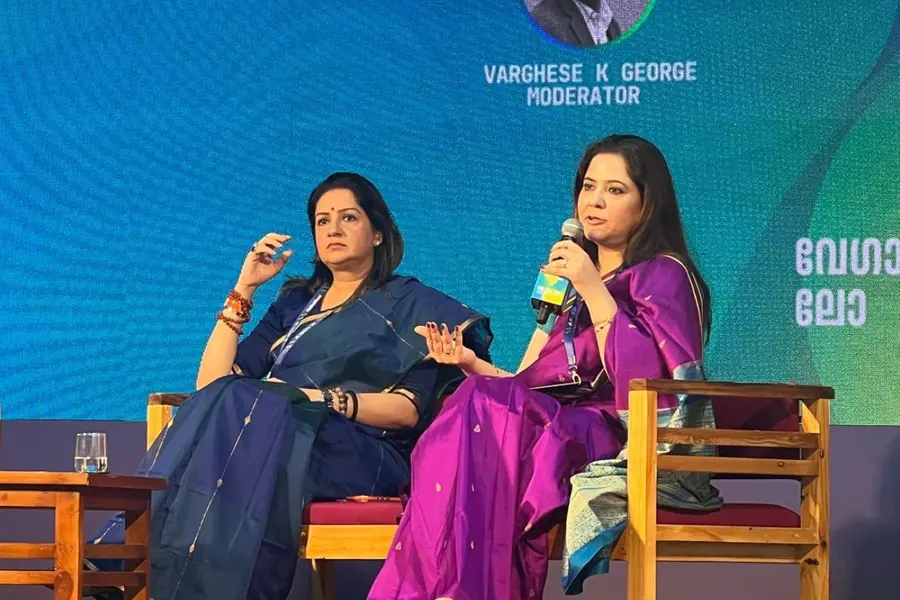
The session, Conflicting paradigms: seeking new direction, was moderated by K George, resident editor at The Hindu. Speakers included Priyanka Chaturvedi, Member of Parliament, Rajya Sabha, and Saira Shah, social activist, educator and writer.
The discussion focused on religion, identity, democracy and the shrinking space for coexistence in public life.
‘The real conflict today is the fear of intermingling’
MP Priyanka Chaturvedi spoke at length about how interaction across faiths has become fraught with suspicion. Drawing from her own life, she described how exposure to diversity shaped her understanding of inclusion.
“I studied in missionary institutions. No one tried to convert me. What I gained was exposure—understanding how others live, believe, and think. That made me more inclusive,” Chaturvedi said.
She warned that this openness is now increasingly questioned. “The real conflict today is the fear of intermingling. Understanding another religion is seen as a threat. Even friendship is suspect,” she said.
Shah also referred to her upbringing in an Indian Army family, saying it played a defining role in shaping her worldview. She said growing up in military surroundings meant living among people from different regions, languages and religions, where harmony was natural rather than enforced.
She expressed gratitude for that environment, noting that it taught her respect, coexistence and a sense of shared citizenship beyond religious identity.
Inclusion is not imposition
Questioning the demand for constant identity validation, Shah said social interaction should not require individuals to defend who they are.
“If I celebrate a festival, I don’t need to prove my identity. Inclusion does not weaken belief—it strengthens society,” she said.
Priyanka Chaturvedi cautioned against framing cultural engagement as religious imposition. She said understanding other religions and cultures strengthens society and should not be perceived as a threat to individual belief.
She warned that equating interaction with imposition narrows democratic space and deepens social insecurity rather than protecting faith.
Fear-driven narratives and democratic cost
Both speakers said rising suspicion around interfaith interaction reflects growing insecurity rather than any genuine danger to belief systems. They flagged fear-driven narratives around religion as a serious challenge to India’s plural and democratic values.
The panel stressed that democracy depends not only on constitutional safeguards but also on everyday acts of inclusion — the freedom to learn, interact and coexist without fear.
As debates around religion and identity grow more polarised, the MBIFL 2026 discussion highlighted how ordinary human interactions — friendships, education and shared cultural spaces — are becoming political flashpoints. The speakers warned that treating inclusion as imposition risks weakening the very social cohesion that sustains democracy.
Published: 30 Jan 2026, 01:52 pm IST
ABOUT THE AUTHOR
Disclaimer: Kindly avoid objectionable, derogatory, unlawful and lewd comments, while responding to reports. Such comments are punishable under cyber laws. Please keep away from personal attacks. The opinions expressed here are the personal opinions of readers and not that of Mathrubhumi.