

At MBIFL 2026, Harish Trivedi and Vanamala Viswanatha discuss translation as intimate reading, authorship, English translation, and Indian languages.
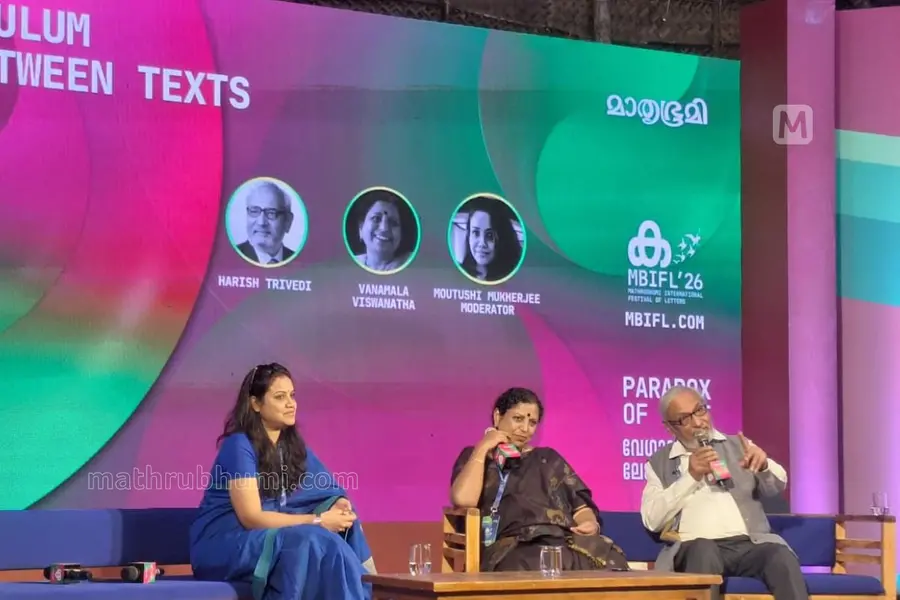
The session 'The Wordy Pendulum; Oscillating between texts' at the seventh edition of Mathrubhumi International Festival of Letters (MBIFL 2026) explored translation as one of the most intimate forms of reading. Harish Trivedi, who translated 'Prenchand: His Life and Times', opened the discussion by revisiting a long-standing question in translation studies: does a translator know the text better than the author? According to Trivedi, the translator engages with the work at a depth that goes beyond authorship, navigating not only the content but also the pressures of publishers, censorship, and reception.
Translation, he argued, exists in a constant tussle between the original text and its surrounding social, cultural, and institutional environments.
The translator’s gaze: Words, silences, and subtext
Vanamala Viswanatha, who translated Kuvempu's work in the title 'Bride in the Hills', noted that critics often focus on the “big picture” or attempt to fit texts into theoretical frameworks. Translators, in contrast, must engage with every word—along with the spaces between words and the meanings beneath them. This immersion can be so intense that it alters rational thinking, carrying the translator into a different cognitive and emotional space.
Personal translation journeys
Trivedi reflected on translating the biography of Premchand, while Vanamala spoke about translating the works of Kuvempu into English. Sharing an anecdote, Trivedi recalled being advised by a professor that translation was something to be undertaken only in old age, while younger scholars should focus on critical writing—an idea he implicitly questioned through his own career.
When and why translators say no
On how translation projects begin, Trivedi admitted that he often declines requests—from both authors and publishers—to avoid entering what he described as a “big hole”. The decision to translate, he suggested, must be driven by intellectual and ethical readiness, not mere opportunity.
Expansion, censorship, and titles
A translated work often expands by nearly 20 per cent compared to the original. However, editorial censorship and publishing constraints can affect both length and quality. Translators are also frequently inclined to change titles, a practice that reflects the shift in audience and cultural context.
One striking example from Premchand’s biography involved forms of address. In the original, Premchand is referred to as Munshiji, following a social practice where wives and children did not use the husband’s or father’s name. Since this context would be unfamiliar to English readers, Trivedi chose to replace Munshiji with “Premchand” throughout the translation.
Context is non-negotiable
Vanamala stressed that a text cannot be read—or translated—without context. Translators must understand how the work was received in its original language, its historical moment, linguistic choices, and earlier interpretations. Through translation, translators often come to know the author and their oeuvre more intimately than most readers.
Presence, absence, and copyright
Another issue discussed was the presence and absence of the author in translation, particularly in relation to copyright. Trivedi observed that in India, copyright is often overlooked. When authors are no longer alive, translators sometimes have greater freedom to showcase linguistic embellishments, though this raises ethical questions.
Footnotes, glossaries, and the reader
Footnotes emerged as a contested issue. Excessive annotation can clutter pages, while notes placed at the end of the book are often ignored. Trivedi argued that translators should provide all possible support—footnotes, glossaries, explanations—especially for readers encountering a text without access to the original language. This, he noted, creates a paradox where translation becomes both an aid and a substitute.
From pre-modern to modern translation practices
Vanamala contrasted pre-modern translations—which included commentary, explication, anvaya, and literary interpretation—with modern translations that demand translators be broadly informed rather than overtly scholarly. In classical texts, translators must inhabit every character, illuminating vast narrative worlds—an especially demanding task.
Indian language translations and their challenges
The discussion also addressed translation between Indian vernacular languages. Translation quality remains a major concern for publishers. Vanamala pointed out that Malayalam–Kannada translations are particularly productive due to shared cultural and geographical contexts, including the Kasaragod connection. However, she emphasised the need for much greater effort and investment.
English translation and linguistic shifts
Trivedi observed that most translations today are directed into English. Authors writing in smaller languages often translate into larger ones for wider reception, while many such projects rely on funding. English translation, he warned, is a “ticking bomb”—highly visible yet politically and culturally fraught.
Translations between Indian languages, by contrast, remain largely invisible. Yet, a seismic shift is underway: languages now share more common ground within the literary cosmos than ever before.
English as an Indian language
Vanamala noted that English is shared by more Indians than Hindi and has immense pedagogical potential. Over time, English has become an Indian language—a platform for plurality and cultural expression. Effective translation into English must therefore retain natural flavours: place names, characters, cuisine, idioms, and proverbs.
Translation as a miraculous act
Concluding the session, Trivedi described translation as a “miraculous activity”—a movement from the unknown to the known, from darkness to light. Despite inevitable losses, the translator often gains a book that stands at a height far beyond those losses.
Published: 30 Jan 2026, 02:59 pm IST
ABOUT THE AUTHOR
Disclaimer: Kindly avoid objectionable, derogatory, unlawful and lewd comments, while responding to reports. Such comments are punishable under cyber laws. Please keep away from personal attacks. The opinions expressed here are the personal opinions of readers and not that of Mathrubhumi.