
NASA marked the occasion with an invitation to people around the world to shine lights skywards, flashing the letters VGR in Morse code, Voyager's call sign
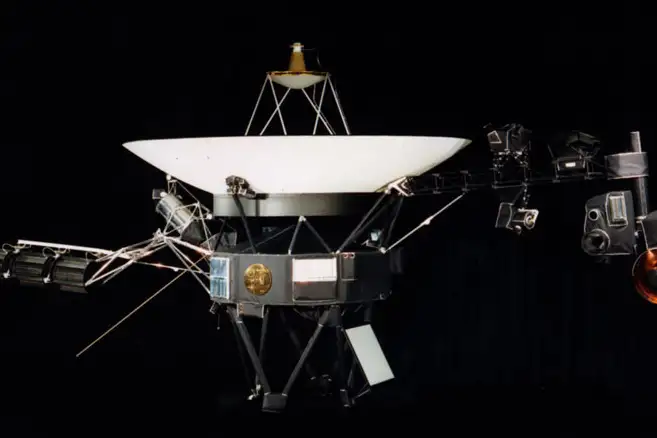
Almost half a century after leaving Earth, Voyager 1 has travelled farther than any human creation in history. As it crosses the extraordinary threshold of one light-day from home, it offers us something more enduring than scientific data; a reminder of what humanity is capable of when curiosity is allowed to outrun its prejudices.
On September 5, 1977, a spacecraft weighing barely 722 kilograms left Cape Canaveral aboard a Titan IIIE-Centaur rocket. It carried no astronauts, no provisions, no elaborate arrangements for a return journey and, rather importantly, no intention of coming home. It was called Voyager 1. Nearly half a century later, this extraordinary piece of human engineering has travelled more than 25.9 billion kilometres from Earth, reaching a distance at which even a beam of light takes 24 hours to reach it. On November 18, 2026, Voyager 1 will become the first human-made object to reach one light-day from Earth. It is difficult to comprehend the enormity of that achievement without pausing to consider what a light-day actually means. Light travels at approximately 300,000 kilometres per second. Multiply that by 86,400 seconds, and you have a distance of roughly 25.9 billion kilometres. A radio command sent from Earth now takes an entire day to reach Voyager 1. Its response takes another day to return. Even a conversation with our most distant technological emissary has become a rather protracted affair.
Also Read

NASA marked the occasion with an invitation to people around the world to shine lights skywards, flashing the letters VGR in Morse code, Voyager's call sign. There is something wonderfully touching about this gesture. It is, of course, symbolic. A torchlight from Earth is not going to illuminate a spacecraft billions of kilometres away. But perhaps that is precisely the point. We are not attempting to communicate with Voyager so much as acknowledging what it represents. To appreciate the achievement, one must return to the extraordinary circumstances of its conception. Voyager 1 and its twin, Voyager 2, were designed to exploit a rare planetary alignment that allowed a spacecraft to use the outer planets' gravitational fields to accelerate and redirect itself.
This technique, known as a gravity assist, lets a spacecraft borrow orbital energy from a planet, saving enormous amounts of fuel. It was a celestial opportunity that comes around only once in several generations. Voyager 1 visited Jupiter in 1979 and Saturn in 1980. Its cameras revealed a universe far more complicated and fascinating than our earlier observations had suggested. It discovered two moons of Jupiter, Thebe and Metis, and revealed volcanic activity on Io, the first active volcano ever observed beyond Earth. At Saturn, it uncovered previously unknown moons and intricate structures in the planet's rings. Its observations of Titan revealed an atmosphere rich in nitrogen and opened new questions about the chemistry of worlds that might harbour the ingredients for life.
The spacecraft was equipped with eleven scientific instruments, including cameras, spectrometers, magnetometers and particle detectors. Its electrical power came from three radioisotope thermoelectric generators, which convert heat released by the radioactive decay of plutonium-238 into electricity. Unlike solar-powered spacecraft, Voyager could operate far beyond the reach of useful sunlight. The arrangement was ingenious, although hardly inexhaustible. Its electrical output has steadily declined, forcing engineers to switch off instruments and non-essential systems to conserve power.
The cameras have long since been retired. Several scientific instruments have also been switched off. Yet Voyager continues to transmit measurements of the interstellar environment, including information about magnetic fields, plasma waves and cosmic rays. The fact that engineers are still communicating with a machine built using technology from the 1970s is a triumph of engineering discipline and ingenuity that deserves considerably more attention than it receives.
In August 2012, Voyager 1 crossed the heliopause, the boundary beyond which the solar wind no longer dominates the surrounding environment. It became the first spacecraft to enter interstellar space. This distinction deserves the qualification that it has left the Sun's protective bubble, but not escaped every gravitational influence of our solar system. The Oort Cloud, a vast and still largely hypothetical reservoir of icy bodies, lies considerably farther out. Nevertheless, Voyager has crossed a frontier that humanity had previously encountered only in theoretical calculations. Another achievement makes this mission particularly poignant. In 1990, at the suggestion of astronomer Carl Sagan, Voyager 1 turned its camera back towards home and photographed Earth from a distance of approximately six billion kilometres. The resulting image became known as the Pale Blue Dot. Our planet appeared as an almost imperceptible speck suspended in a sunbeam, occupying a pixel of the immense cosmic canvas. Sagan's reflections on that image remain among the most profound observations about our place in the universe. Every human being who has ever lived, every empire that has risen and collapsed, every religious conflict, every revolution, every war, every love affair and every act of extraordinary kindness has unfolded on that tiny speck. It is a rather humbling perspective for a species that has not yet mastered the art of sharing its own planetary resources without fighting over them.
Voyager also carries something that transcends its scientific mission. Attached to each spacecraft is a 30-centimetre gold-plated copper disc, the famous Golden Record, containing greetings in 55 languages, sounds of Earth, music from different cultures and 115 images depicting life and civilisation on our planet. The record was conceived as a message to any intelligent civilisation that might someday encounter the spacecraft. Whether anyone will ever find it is another matter. The odds are fantastically remote. But the exercise itself was an extraordinary declaration of optimism; that humanity had something worth introducing about itself. The record itself is not without its delightful contradictions. It contains Bach and Beethoven, Chuck Berry and the sounds of whales, greetings from Earth and the instructions for playing the disc. It is perhaps the most ambitious introduction humanity has ever prepared for an audience that may not exist. One hopes that whoever eventually finds it will be advanced enough to understand the music and forgiving enough to overlook our politics.
What does Voyager mean for our future? Its immediate scientific contribution is invaluable. It has allowed us to study the interstellar medium directly, rather than infer its properties from observations made within the heliosphere. It has transformed our understanding of planetary systems, magnetospheres and the boundaries of our stellar neighbourhood. Its engineering legacy will inform generations of deep-space missions. But its larger significance is philosophical. Voyager proves that human ambition need not always be driven by conquest, commercial advantage, or the immediate gratification of political constituencies. It was built to explore, observe, and discover. Its journey has outlasted governments, political ideologies, technological fashions and generations of scientists and engineers. Many of the people who built it are no longer alive, and the machine continues.
There is, finally, something rather beautiful about this achievement being celebrated with a flashlight. We live in an age when humanity can produce artificial intelligence, edit genes and contemplate settlements on Mars, yet remains spectacularly inept at resolving some of the most elementary disputes on its own planet. We have perfected the technology of reaching across billions of kilometres while struggling with the politics of crossing a street without hostility. Perhaps Voyager offers a useful corrective to our inflated sense of importance. It reminds us that we are neither the centre of the universe nor its most consequential inhabitants. We are, however, capable of asking extraordinary questions and building extraordinary things in pursuit of the answers.
One day, Voyager's power will run out. Its transmitter will fall silent, and it will continue travelling through interstellar space without sending us another word. The Golden Record will remain attached to it, carrying a small, imperfect portrait of a restless species from an insignificant planet orbiting an ordinary star. And that may be its greatest achievement. Long after its instruments have ceased functioning, Voyager will remain an artefact of a moment when human beings looked into the darkness and decided that the appropriate response was not fear, superstition or surrender, but curiosity. We sent a machine into the infinite darkness, and it carried with it the sounds, images and music of an entire world. That, surely, is worth switching on a flashlight for.
(The author is a National Award winner for Best Narration and an independent political analyst. Views expressed are personal.)
Published: 18 Nov 2026, 10:59 am IST


Related Topics
Disclaimer: Kindly avoid objectionable, derogatory, unlawful and lewd comments, while responding to reports. Such comments are punishable under cyber laws. Please keep away from personal attacks. The opinions expressed here are the personal opinions of readers and not that of Mathrubhumi.