
Launched in 1977, NASA's Voyager 1 is approaching an extraordinary milestone: becoming the first human-made object to travel one light-day from Earth.
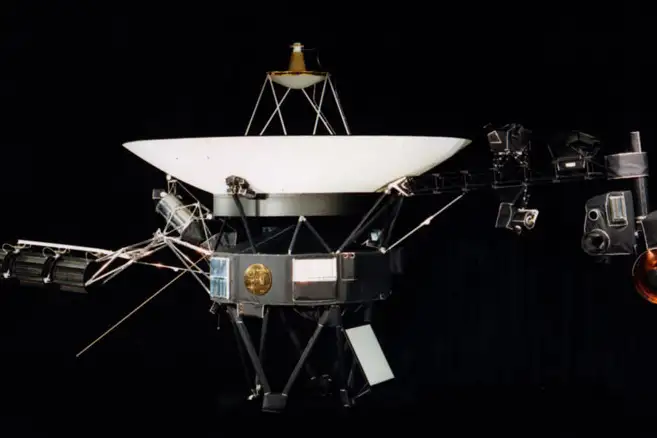
Nearly 50 years after leaving Earth, NASA's Voyager 1 spacecraft is preparing to achieve another historic milestone, becoming the first human-made object to travel a distance of one light-day from Earth.
Launched in 1977, the spacecraft is expected to cross the landmark on Wednesday, November 18, at 5:16:07 am EST (3:46:07 pm IST), according to NASA. The achievement will mark a significant moment in humanity's exploration of space, with Voyager 1 having travelled farther from Earth than any other human-made object.
A light-day is the distance that light travels in 24 hours, equivalent to approximately 16 billion miles (26 billion kilometres). NASA estimates that Voyager 1 will have taken 49 years, two months and 11 days to cover this distance from Earth.
What is a light-day, and how far is it?
A light-day measures distance rather than time. Light travels at approximately 186,000 miles per second, covering an enormous distance of around 16 billion miles in a single day.
The measurement helps put the scale of space exploration into perspective. Sunlight takes approximately eight minutes and 20 seconds to travel the 93 million miles (150 million kilometres) between the Sun and Earth.
The distance between Earth and Neptune, the most distant planet in the solar system, is also substantial, with light taking around four hours and 10 minutes to travel between the two.
Voyager 1 reaching the one-light-day mark will therefore represent an extraordinary distance covered by a human-made spacecraft.
Why is Voyager 1's achievement significant?
Despite travelling through space at nearly 38,000 miles per hour (61,000 kilometres per hour), Voyager 1 remains relatively slow compared with the speed of light.
The spacecraft's journey highlights the enormous distances involved in interstellar exploration and the limitations of even the fastest human-made objects when compared with the vastness of space.
Voyager 1 entered interstellar space in 2012 and has continued its journey beyond the solar system, transmitting information from a region of space never before explored by a human-made spacecraft.
Where is Voyager 1 heading?
NASA said Voyager 1 is currently travelling in the direction of a star known as AC +79 3888, also called Gliese 445, located more than 17 light-years from Earth in the constellation Ursa Minor.
The spacecraft is expected to pass within approximately 1.7 light-years of the star in around 40,000 years.
Although the spacecraft has travelled an extraordinary distance since its launch, reaching its stellar destination remains a journey spanning tens of thousands of years.
What about Voyager 2?
Voyager 1's twin spacecraft, Voyager 2, was also launched in 1977 but followed a different trajectory through the solar system.
Voyager 2 explored Uranus and Neptune before continuing its journey into interstellar space. According to NASA, it is expected to reach the one-light-day distance from Earth in November 2035.
The two spacecraft were originally launched to explore the outer planets, but their journeys eventually extended far beyond their initial planetary missions.
A nearly 50-year journey through space
Voyager 1's upcoming milestone is another testament to the longevity of NASA's Voyager programme, which has continued to push the boundaries of human exploration for nearly five decades.
Having travelled farther from Earth than any other human-made object, the spacecraft continues to carry humanity's exploration efforts into interstellar space.
Its journey towards the one-light-day mark offers a striking reminder of both the achievements of space technology and the immense distances that separate Earth from the rest of the universe.
Published: 15 Nov 2026, 07:31 am IST


ABOUT THE AUTHOR

Disclaimer: Kindly avoid objectionable, derogatory, unlawful and lewd comments, while responding to reports. Such comments are punishable under cyber laws. Please keep away from personal attacks. The opinions expressed here are the personal opinions of readers and not that of Mathrubhumi.