
Behind this extraordinary journey are generations of scientists and engineers who have kept the mission alive. Voyager 1 reminds us that human curiosity has no fixed boundary.
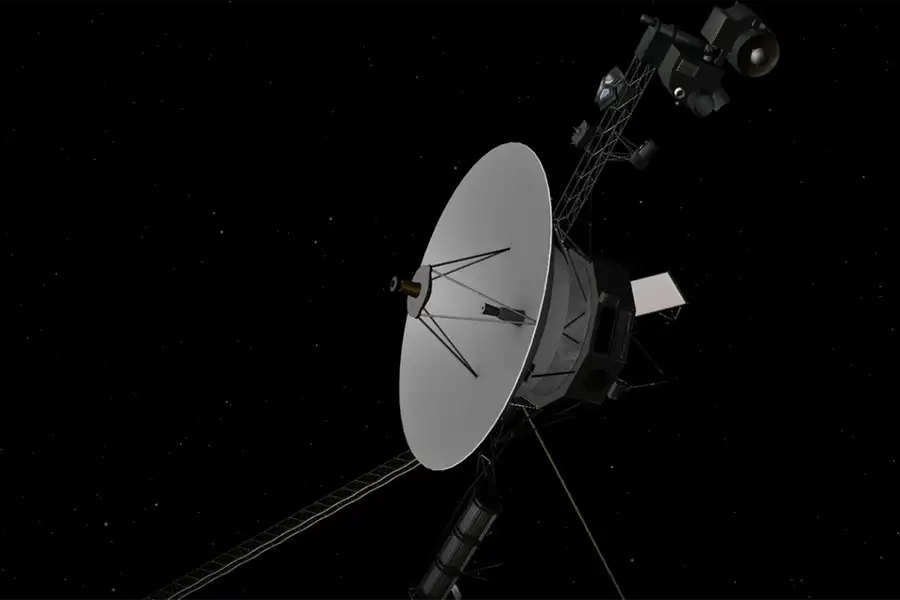
Imagine sending a machine into space and still receiving messages from it nearly 50 years later. That is the remarkable story of NASA’s Voyager 1. Launched in 1977, this spacecraft has travelled farther from Earth than any other human-made object. Now, it is approaching another historic achievement by reaching a distance of one light-day from our planet.
According to NASA, Voyager 1 will reach this distance on Wednesday, November 18, 2026, at approximately 3:46 p.m. Indian time. By then, the spacecraft will be about 16 billion miles, or roughly 26 billion kilometres, away from Earth.
But what exactly is a light-day? It is simply the distance light travels in one full day. Light moves at nearly 300,000 kilometres every second, fast enough to circle the Earth more than seven times in just one second. That is approximately 186,000 miles per second, or 1.08 billion kilometres per hour.
Even at this incredible speed, light would take an entire day to travel from Earth to Voyager 1.
To understand this enormous distance, consider sunlight. It takes only eight minutes and 20 seconds to cover the 150 million kilometres between the Sun and Earth. Light takes roughly four hours and ten minutes to travel between Earth and Neptune, the farthest planet in our solar system, although the time changes as the planets move.
Voyager 1 will have spent 49 years, two months and 11 days reaching this milestone. NASA explains that a light-day measures distance, not the time a spacecraft takes to travel. Voyager 1 itself moves at approximately 61,000 kilometres per hour, or 38,000 miles per hour.
Voyager 1 has a twin spacecraft called Voyager 2. Both were launched in 1977, with their original missions expected to last about five years. Interestingly, Voyager 2 left Earth first, but Voyager 1 followed a faster route and eventually moved farther away.
The two spacecraft travelled in different directions. Voyager 1 headed north of the path followed by most planets around the Sun, while Voyager 2 moved south. Voyager 2 also explored Uranus and Neptune, taking a longer route. NASA expects Voyager 2 to reach a distance of one light-day from Earth in November 2035.
Voyager 1 completed its original mission of studying planets after flying past Saturn in 1980. However, its journey did not end there. It continued travelling towards the distant regions of our solar system.
In 2004, Voyager 1 entered an area where the solar wind begins slowing down. Solar wind is a stream of tiny particles released by the Sun. These particles carry electric charges and can travel at about 1.6 million kilometres per hour. Far from the Sun, they encounter material present in space and gradually lose speed.
Scientists watched these changes to understand when Voyager 1 would reach the heliopause. This is the boundary where the Sun’s solar wind meets the material between stars. Beyond this boundary lies interstellar space, the enormous region between stars.
Scientists initially believed Voyager 1 might take several more years to cross this boundary. However, later measurements confirmed that it had already entered interstellar space in August 2012. Voyager 2 crossed the same boundary in November 2018.
Voyager 1 is also called a space probe because it carries no astronauts. A space probe is a machine sent to explore space and collect scientific information. Its instruments measure magnetic fields, tiny dust particles and galactic cosmic rays, which are powerful particles arriving from beyond our solar system.
Both Voyager spacecraft get their electricity from heat released by radioactive plutonium. This special power system has kept them working for decades, although their electricity supply is gradually decreasing.
Voyager 1 is now heading towards a star called Gliese 445, also known as AC +79 3888, located more than 17 light-years from Earth in the constellation Ursa Minor. A light-year is the distance light travels in one year.
In about 40,000 years, Voyager 1 is expected to pass roughly 1.7 light-years from this star. Even light would take 1.7 years to cover that remaining distance. At its present speed, the spacecraft would need approximately 18,000 years to travel just one light-year.
The greatest achievement is not simply the distance Voyager 1 has covered. It is that a machine built nearly half a century ago continues sending valuable information from a place no human has ever visited.
Behind this extraordinary journey are generations of scientists and engineers who have kept the mission alive. Voyager 1 reminds us that human curiosity has no fixed boundary. Even after its instruments stop working, the spacecraft will continue travelling silently through space, carrying humanity’s dream of exploring the unknown.
Published: 15 Nov 2026, 11:53 am IST


ABOUT THE AUTHOR

Related Topics
Disclaimer: Kindly avoid objectionable, derogatory, unlawful and lewd comments, while responding to reports. Such comments are punishable under cyber laws. Please keep away from personal attacks. The opinions expressed here are the personal opinions of readers and not that of Mathrubhumi.