
NASA's X-59 experimental jet is designed to fly faster than sound with a quieter sonic signature. Here's how it could change future air travel.
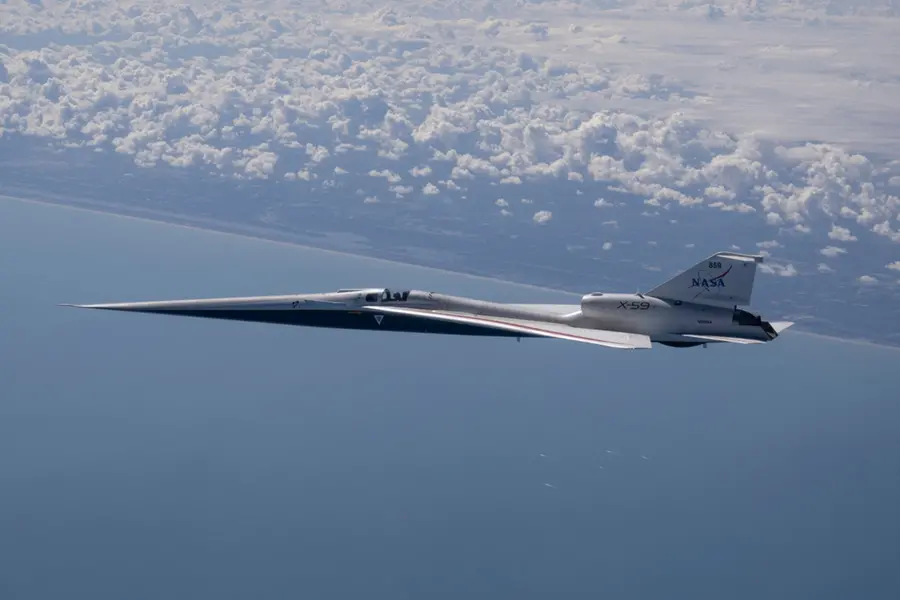
NASA's X-59 is an experimental jet designed to fly faster than sound while producing only a quiet “thump” instead of the loud sonic boom that has kept commercial supersonic flight over land largely off-limits. It is the centerpiece of NASA’s Quesst mission, which aims to give regulators the evidence needed to reconsider those rules.
The X-59 is a one-of-a-kind NASA research aircraft, built with Lockheed Martin’s Skunk Works, rather than a passenger plane or a commercial prototype. It is designed to cruise at Mach 1.4 -- about 925 mph -- at 55,000 feet, and it carries a single pilot in a 99.7-foot-long airframe.
Its most distinctive feature is its extremely long, needle-like nose. That shape is intended to reshape the shockwaves created during supersonic flight so they do not combine into the sharp, disruptive boom people associate with aircraft such as Concorde.
Why NASA's X-59 matters
Current US rules prohibit supersonic flight over land because of the noise produced by sonic booms. NASA’s goal is not simply to build a fast aircraft, but to show that a supersonic aircraft can be quiet enough for communities below to tolerate.
If successful, the research could support a shift from today’s “speed limit” on overland supersonic flight to a future “sound limit.” That would open the door for manufacturers to develop faster passenger aircraft that could legally fly over populated areas.
How quiet is “quiet”?
NASA expects the X-59’s sonic signature to sound like a gentle thump -- roughly comparable to a car door closing from about 20 feet away -- rather than a thunderous boom.
The aircraft reached supersonic speed for the first time on June 5, 2026, flying at about Mach 1.1 and 43,400 feet. A week later, it reached the conditions planned for future community tests: Mach 1.4 at 55,000 feet.
How NASA will test X-59
The programme has moved through several stages: early handling tests, expansion of the aircraft’s speed and altitude envelope, and now preparation for acoustic validation. By late 2026, NASA had logged more than 40 flights, including a record six flights in one week and a top speed of Mach 1.53.
Next, researchers will measure the X-59’s shockwave signature using ground sensors and an instrumented NASA F-15 flying alongside it. The aircraft will then fly over selected U.S. communities so NASA can survey how residents experience and respond to its quieter sound.
Could NASA's X-59 change air travel?
Potentially -- but not immediately. The X-59 will not carry passengers; its job is to produce the flight data, noise measurements and public-response evidence needed for future commercial aircraft designs and regulations.
If regulators eventually accept quieter supersonic flight over land, future airliners could dramatically shorten long journeys. Reports have suggested that a New York–London trip could take about 3.5 hours, though such services would depend on new aircraft, certification and rules that do not yet exist.
The X-59 is not trying to break speed records; it is trying to solve the noise problem that has prevented supersonic air travel from returning over land. Its next major test is whether its carefully engineered shape can make supersonic flight quiet enough for the public and acceptable enough for regulators.
Published: 06 Nov 2026, 10:26 am IST


Related Topics
Disclaimer: Kindly avoid objectionable, derogatory, unlawful and lewd comments, while responding to reports. Such comments are punishable under cyber laws. Please keep away from personal attacks. The opinions expressed here are the personal opinions of readers and not that of Mathrubhumi.
