
Iran says it launched missile strikes on US military bases in Bahrain and Kuwait after Washington resumed its naval blockade on Iranian ports. US officials have not yet confirmed the claims.
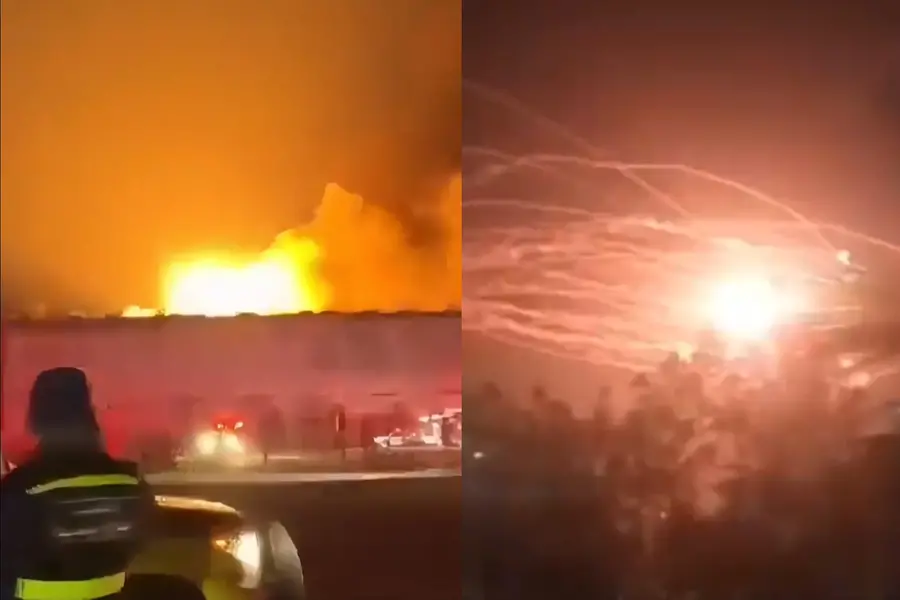
Tehran: Iran has claimed it launched missile strikes targeting the US Fifth Fleet headquarters in Bahrain and a US military facility in Kuwait in retaliation for Washington's renewed naval blockade on Iranian ports.
The claims were made by Iranian authorities after the United States resumed its blockade and carried out another round of strikes on Iranian targets. However, the missile attacks have not been independently verified, and US authorities have not officially confirmed the strikes.
Also Read

According to reports, Iran also alleged that a bottled water factory inside the country was hit by three US projectiles, causing damage to the facility.
Kuwait reports major missile and drone assault
Kuwait's Ministry of Defence confirmed that the country came under a large-scale attack involving five cruise missiles, one ballistic missile and 33 drones.
Officials described it as the largest single-day barrage since Kuwait's international airport was attacked for the second time last month, an incident that killed one person and injured more than 60 others.
Four Kuwaiti navy personnel were reportedly injured after a naval vessel was struck during Tuesday's attacks.
The Kuwaiti military said the strikes targeted several "vital" and civilian facilities, while falling debris caused additional damage in different parts of the country.
Authorities urged residents to remain alert and follow official safety instructions.
Bahrain issues shelter advisory
Following reports of incoming Iranian missiles and drones, sirens sounded across Bahrain as air defence systems were activated.
Bahrain's Interior Ministry urged residents to remain calm and seek shelter in the nearest safe location while security forces responded to the developing situation.
Iran claims one of its targets was the headquarters of the US Fifth Fleet, which is based in Bahrain.
US attacks Iranian islands before fresh retaliation
Hours before the reported missile attacks, US forces launched fresh strikes on the Iranian islands of Kish and Qeshm, according to Iranian media.
Qeshm Island is strategically significant because of its location near the Strait of Hormuz. It is believed to host military infrastructure and missile storage facilities that help Iran monitor and control one of the world's busiest maritime routes.
Iran has not released an official assessment of damage caused by the latest US strikes.
Naval blockade fuels regional escalation
The latest attacks come after the United States reinstated its naval blockade on Iranian ports and coastal areas, accusing Tehran of targeting commercial shipping and threatening maritime security in the Strait of Hormuz.
The blockade resumed at 4 pm Washington time, shortly after another wave of US military strikes on Iranian targets.
Washington says the operation aims to reduce Iran's ability to attack commercial vessels passing through the strategic waterway.
Kuwait remains a key target
Kuwait has become one of the countries most affected by the ongoing conflict.
Since the collapse of the earlier ceasefire, the country has experienced repeated attacks on military bases, oil infrastructure, airports and other strategic facilities.
According to reports, Kuwait has faced at least 16 attacks since the US-Iran truce announced in April, more than any other Gulf Arab state during the same period.
The country hosts thousands of US military personnel across five military installations, including Ali Al-Salem Air Base, which has repeatedly come under attack since fighting escalated earlier this year.
Netanyahu warns of stronger retaliation
Israeli Prime Minister Benjamin Netanyahu also issued a fresh warning, saying Israel would respond with overwhelming force if attacked by Iran. "The days are over when someone would hit us and we wouldn't hit back with double the force."
He warned that any future Iranian attack would trigger retaliation that would be "much stronger and harsher than any previous conflict."
The renewed US blockade, fresh American strikes on Iranian territory and Iran's claimed missile attacks on US military facilities have pushed the region closer to a broader military confrontation.
Although Tehran has claimed responsibility for the attacks in Bahrain and Kuwait, independent verification remains pending, and the United States has not yet issued an official confirmation regarding the reported strikes.
Published: 15 Jul 2026, 08:09 am IST
Related Topics
Disclaimer: Kindly avoid objectionable, derogatory, unlawful and lewd comments, while responding to reports. Such comments are punishable under cyber laws. Please keep away from personal attacks. The opinions expressed here are the personal opinions of readers and not that of Mathrubhumi.