

Dr Gitanjali Angmo spoke at the MBIFL on Ladakh’s alternative model of education, sustainability and resistance amid ecological and political uncertainty
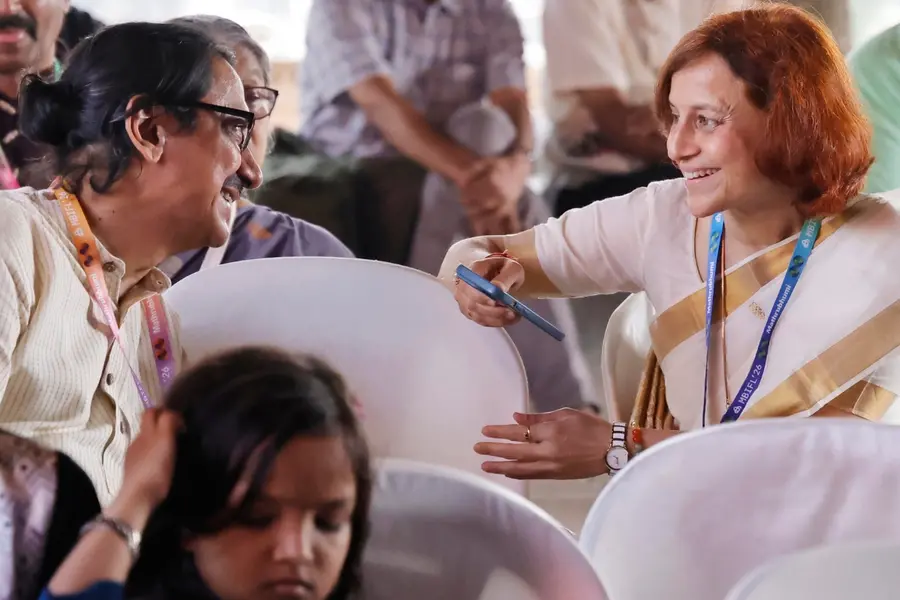
At a time when Ladakh is freezing at minus 20 degrees, its voice travelled far south to the Mathrubhumi International Festival of Letters (MBIFL) 2026. Carrying that voice was Dr Gitanjali Angmo, founder and dean of the Himalayan Institute of Alternatives, Ladakh (HIAL), and life partner of climate and education activist Sonam Wangchuk, who is currently in jail.
Her presence itself spoke volumes. Wangchuk’s absence hovered quietly over the session, but Angmo did not anchor her narrative in grievance alone. Instead, she spoke of what Ladakh has been building patiently over decades—an alternative imagination of education, development and resistance, rooted in empathy and place.
Also Read
“Bringing the voice of a high-altitude mountain desert to coastal India,” she said, “reminds us how deeply diverse this country is. Education, ecology and policy cannot be the same everywhere. They must belong to their context.”
A university without classrooms
Himalayan Institute of Alternatives Ladakh (HIAL), Angmo explained, does not resemble a conventional university. There are no classrooms, textbooks or fixed syllabi. Instead, students are given problems—real ones, unfolding in real landscapes.
“One of the problems we give our students,” she said, “is an abandoned village.”
That village is Kulum, deserted after a receding glacier dried up irrigation canals. Students live in the village, speak to residents and trace the crisis to its roots. Solutions emerge not as academic exercises, but as lived responses.
“We don’t teach innovation as arrogance,” Angmo said. “Innovation has to be rooted in empathy—understanding a problem before trying to fix it.”
Artificial glaciers were built to restore water flow. Agricultural research helped revive crops. Homes were retrofitted with passive solar technology that keeps interiors at 20 degrees even when temperatures outside plunge to minus 20—without artificial heating.
“We are exporting this technology,” she noted quietly, “not importing it.”
Today, these methods are being used through UNDP-supported initiatives in Afghanistan and other high-altitude regions.
Fifteen years after work began in Kulum, the village harvested 500 kilos of potatoes. Broccoli followed. Half the villagers returned, and eventually, the entire village came back to life. The model is now being adopted to revive dozens of villages across Ladakh.
Empathy as curriculum
Angmo described HIAL’s philosophy as resting on five pillars: contextual education, experiential pedagogy, transdisciplinary problem-solving, empathy-driven thinking and purpose.
“What education must teach,” she said, “is how to solve the problems of your own land, with your heart and your hands.”
That approach has earned national and international recognition. India’s Parliamentary Standing Committee on Education has recommended HIAL as a role model, and the institute is set to be showcased at London’s Victoria and Albert Museum as a “university for the future”.
Yet Angmo resisted any sense of triumph.
“This work,” she said, “comes from humility—knowing how little we understand when we first arrive in a place.”
When asked about the Sustainable Development Goals, Angmo responded with gentle humour.
“When we applied for a grant,” she said, “we realised we were ticking 16 out of 17 SDGs. The only one we couldn’t tick was Life Below Water—because Ladakh is a desert.”
Her point, however, was deeper. India, she argued, practised local sustainability long before global frameworks arrived.
“Our medicine is local. Our architecture is local. Our food systems are local,” she said. “The crises we see today are failures of forgetting that.”
In Ladakh’s remote Zanskar region, she recounted, strangers are welcomed without questions, fed without calculation and hosted without deadlines.
“I asked myself,” she said, “what is real abundance? Is it money, or is it the ability to host without fear?”
Why Ladakh is resisting
The conversation inevitably turned to Ladakh’s political struggle. After the abrogation of Article 370, Ladakh became a Union Territory—something it had demanded for decades. But Angmo said constitutional safeguards for its fragile ecosystem were not honoured.
“Ladakh is not just land,” she said. “It is the Third Pole. Its glaciers support close to a billion people across South Asia.”
Decisions affecting such a region, she argued, cannot be made by short-term administrators unfamiliar with its ecology and culture.
“It took me ten years to begin understanding Ladakh,” she said. “How can someone come for five years and decide its future?”
Sonam Wangchuk’s arrest and quiet resilience
Wangchuk’s arrest, Angmo said, followed years of peaceful, Gandhian protest—fasts, marches and dialogue—seeking to remind the government of its promises. Violence that broke out elsewhere was used, she claimed, to frame him, despite his absence from the site.
“He was asking questions,” she said simply. “That made him inconvenient.”
A habeas corpus petition is currently before the Supreme Court. Angmo spoke not with bitterness, but with faith.
“I am a spiritual seeker,” she said. “I believe nothing happens without a purpose. These months have shown us the realities of the system—and maybe that knowledge will help us make things better.”
Rather than weakening them, she said, the experience has made both of them stronger.
Resilience beyond repression
Angmo also spoke of the silent fallout—public sector units withdrawing Corporate Social Responsibility (CSR) funding from HIAL after Wangchuk’s arrest.
“They tried to cut our wings,” she said. “But they cannot control the creativity of our minds or the strength of our souls.”
HIAL itself began through crowdfunding, using the prize money from Wangchuk’s Rolex Award for Enterprise. One of the most moving contributions came from a school student.
“She gave ₹5,000,” Angmo recalled, smiling. “She said, ‘When I grow up, I want to study at your university.’”
The institute plans to reopen its crowdfunding platform soon.
Holding ladakh together
In the audience interaction that followed, Angmo reflected on fear and silence in contemporary India.
“We Indians are very good at silent support,” she said. “But sometimes, we need the courage to stand up for each other.”
Unity, she argued, must be taught early—not merely as diversity, but as shared responsibility.
As the session closed, On Thin Ice revealed itself as more than a discussion on Ladakh’s fragile landscape. It became a meditation on fragile democracies, resilient communities, and the quiet courage of those who continue to believe that empathy—practised daily—can still reshape the future.
Published: 03 Feb 2026, 09:25 pm IST
ABOUT THE AUTHOR
Disclaimer: Kindly avoid objectionable, derogatory, unlawful and lewd comments, while responding to reports. Such comments are punishable under cyber laws. Please keep away from personal attacks. The opinions expressed here are the personal opinions of readers and not that of Mathrubhumi.