

At the Mathrubhumi International Festival of Literature 2026, social entrepreneur Dr Gitanjali Angmo spoke on the challenges of social entrepreneurship in Ladakh
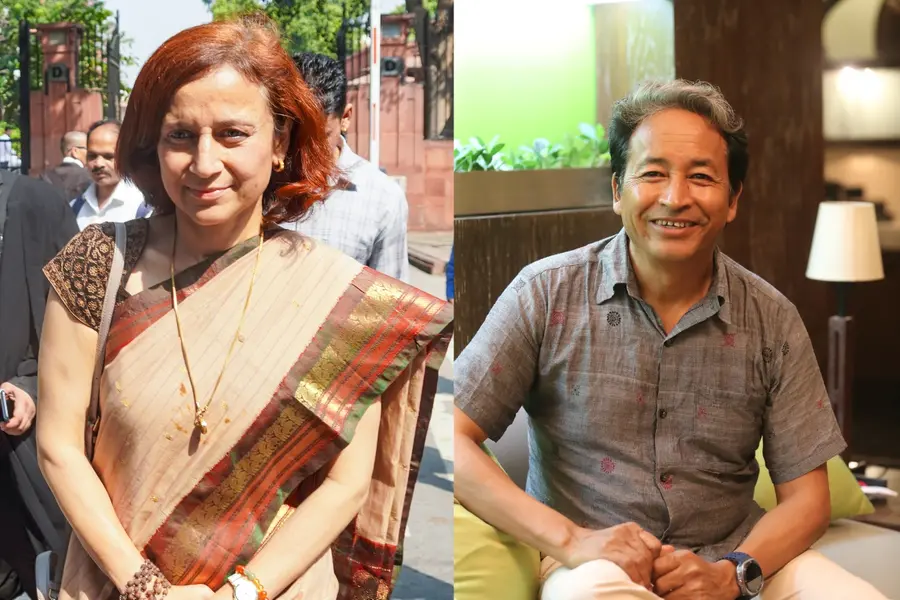
Dr Gitanjali Angmo repeatedly returned to the argument that the actions against Sonam Wangchuk reflect a broader discomfort with forms of development that prioritise ecological balance, community wellbeing and local knowledge.
At the seventh edition of the Mathrubhumi International Festival of Literature 2026, spouse of Sonam Wangchuk, a renowned Ladakhi engineer, innovator, and climate activist said.
Also Read
Wangchuk is known for inspiring the character "Phunsukh Wangdu" in the film 3 Idiots, has been detained in Jodhpur Central Jail, Rajasthan, since September 26, 2025. He was arrested under the stringent National Security Act (NSA) following a crackdown on a peaceful march from Ladakh to Delhi, which was demanding statehood and constitutional safeguards (Sixth Schedule) for Ladakh.
“All the allegations are based on doctored videos and false interpretations,” she said, adding that these were used “to defame a person who has been working at the grassroots level in educational entrepreneurship and innovation for over thirty years”.
Allegations, silence and the cost of mindful development
She argued that such actions effectively silence voices advocating alternatives to extractive and profit-driven growth models. According to Dr Angmo, Ladakh’s work in contextual education and social entrepreneurship challenges dominant narratives of development that focus primarily on large-scale infrastructure and centralised control.
“Our work focuses on contextual education—solving problems of the local context and developing enterprises that do not destroy the environment or ecosystem,” she said.
Social entrepreneurship as a threat to dominant models
Dr Angmo questioned why the term “social entrepreneurship” is treated as an exception rather than the norm. She said the separation of enterprise from social responsibility has created a system where community-centred initiatives are marginalised.
“Entrepreneurship today is often seen as profit maximisation. Social entrepreneurship, on the other hand, focuses on impact,” she said, before adding, “to me, social entrepreneurship is actually a tautology. Every enterprise should be social by its very nature.”
She suggested that initiatives rooted in mindful development—those that integrate environmental limits, social cohesion and long-term sustainability—are often seen as inconvenient because they resist rapid exploitation of land and resources.
Ladakh as a test case
Dr Angmo framed Ladakh as a test case for India’s approach to development in ecologically sensitive regions. She warned that policy decisions made without local participation risk irreversible damage.
“Ladakh is called the Third Pole,” she said, noting that its glaciers and water systems sustain large populations beyond the region. “Any mindless exploitation will not only harm Ladakh but the rest of the country.”
She linked this to the absence of constitutional safeguards after 2019, saying that Ladakh lost all protections and now lacks a representative legislature. According to her, this governance structure leaves little space for dissenting or alternative development perspectives.
“Policies are framed without understanding Ladakh’s history, ecology and culture,” she said.
Copy-paste development and ecological consequences
The session highlighted how standardised development approaches imported from the plains have failed in Ladakh. Dr Angmo cited embankments built to control flash floods as an example of solutions imposed without contextual understanding.
“In Ladakh, water flows steeply,” she explained, adding that such embankments collapsed during flash floods and worsened destruction.
In contrast, she described locally developed solutions such as artificial glaciers, valley plantations and solar passive buildings as examples of mindful innovation rooted in science and tradition.
“This is applied physics and traditional wisdom combined,” she said.
Education as resistance
Dr Angmo positioned education itself as a form of resistance to unsustainable development. She said institutions must go beyond classroom learning and become centres for real-world problem-solving.
“A university should not merely give certificates based on memorised answers,” she said. “A university must conduct research, build prototypes, solve community problems and act as a policy laboratory for governments.”
She argued that such models empower communities and challenge top-down decision-making, which may explain the hostility towards institutions and individuals advocating decentralised, mindful development.
Dissent, pluralism and shrinking space
During the audience interaction, Dr Angmo addressed concerns about shrinking space for dissent. Referring to Sonam Wangchuk’s case, she said, “Dissent should expand consciousness, not be criminalised.”
She warned that when alternative viewpoints are recast as offences, it signals a deeper erosion of democratic and intellectual space. “This reflects a deeper crisis of consciousness, where truth and falsehood blur,” she said.
Concluding the session, Dr Angmo suggested that the struggle is not only about Ladakh or one individual, but about the future direction of development in India.
“You cannot control the stimulus, but you can control the response,” she said, reflecting on the past 125 days. She added that the experience had revealed “broken systems—media, judiciary, incarceration”, but also offered an opportunity for growth and introspection.
Published: 31 Jan 2026, 02:19 pm IST
ABOUT THE AUTHOR
Disclaimer: Kindly avoid objectionable, derogatory, unlawful and lewd comments, while responding to reports. Such comments are punishable under cyber laws. Please keep away from personal attacks. The opinions expressed here are the personal opinions of readers and not that of Mathrubhumi.