
Poet Sonnet Mondal reflected on hunger, absence and the ethical limits of poetry during a session at the Mathrubhumi International Festival of Letters in Thiruvananthapuram.
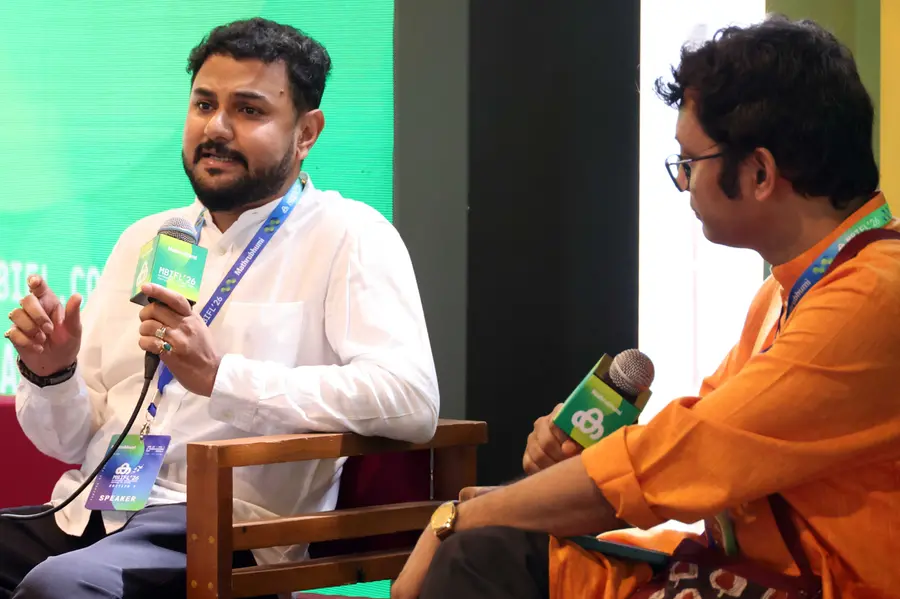
Can poetry emerge from hunger, loss, and absence and still offer hope? This haunting question lay at the heart of the session 'Poems on Deprivation' at MBIFL 2026 where poet Sonnet Mondal engaged in a deeply philosophical conversation with moderator Dr Bidyut, exploring how scarcity shapes not just lives, but language itself.
Opening with the idea that "when a writer embraces the world as their own, whatever they write about is also about themselves," Mondal suggested that writers do not seek subjects in grand theories but in "quiet observations that linger" moments gathered from newspapers, streets, memory, and sleepless nights.
Also Read

For the poet, deprivation is not only material but emotional and existential. Referring to his works centered on hunger and poverty, he said scarcity "does not only shape bodies, but thoughts", adding that its the most dangerous effect which "quietly erases humanity". He always attempted to restore these fading voices within his works.
The session repeatedly returned to the idea of absence of people, places, and pasts that can never fully be reclaimed. Talking about nostalgia, Mondal reflected that it runs through his works because "some of my dearest people are no longer there", and poetry becomes a fragile bridge between memory and the present. Happiness in poetry, he observed, is often "either a memory or a desire", rarely a lived present.
Yet the poet was careful not to romanticize suffering. "Poetry cannot feed the hungry," he said plainly, "but it can feed awareness." Where statistics reduce people to numbers, poetry restores feeling, texture, and dignity. He argued that the role of a poem is not to applause but impact and make readers look at "any ordinary thing differently".
A striking moment came when Mondal described poetry as existing in the pause "between hunger and home", between sleeping and waking, between what is said and unsaid. He said that its only between these spaces, art and philosophy meet. While philosophy searches for answers, poetry offers "a direction to an un-nameable elsewhere".
The poet illustrated this inner landscape with a reading of his poem "overcoat", which portrayed a mind trying to build "a granary to store sorrows" in a room stripped of stories which gives an image of emotional survival amidst isolation. The "you" in his poems, he explained, is not a single person but a shifting presence, memory, self, absence, and longing intertwined.
A personal anecdote further grounded the conversation. Mondal recalled a homeless man who appeared near his house, was fed for days, then disappeared after asking for clothes. The incident, he said, revealed the "gap between society and deprivation" and not always of resources, but of sustained attention.
The session connected these reflections to global literature, citing poets who wrote of love in the middle of war and a Bengali poet who once said the moon looked like bread to him when he was hungry. Such examples, he mentioned to show that deprivation does not silence poetry instead it shapes its urgency. In Mondal’s words, "art is not a retreat from reality, it is a return to it".
Published: 02 Feb 2026, 10:23 pm IST
Related Topics
Disclaimer: Kindly avoid objectionable, derogatory, unlawful and lewd comments, while responding to reports. Such comments are punishable under cyber laws. Please keep away from personal attacks. The opinions expressed here are the personal opinions of readers and not that of Mathrubhumi.