
Prof Jagmohan Singh urged young people to engage seriously with Bhagat Singh’s writings rather than reducing the revolutionary to a symbolic martyr
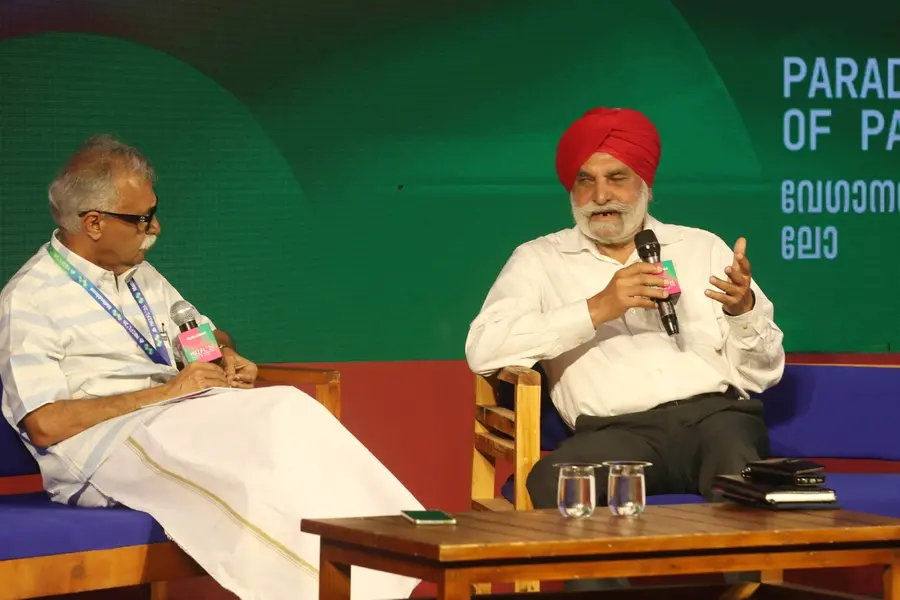
The 7th edition of the Mathrubhumi International Festival of Letters turned into a powerful reflection on history, ideology, and responsibilities of the youth, during the session titled 'The Radical as the Inspirational -- Bhagat Singh, the Shaheed'. The discussion featured Prof Jagmohan Singh an academic, social activist, and nephew of Bhagat Singh in conversation with moderator J Prabhash.
Moving beyond the popular image of Bhagat Singh as merely a martyr, Prof Singh presented him as a deeply intellectual, widely read, and self critical thinker whose revolutionary politics were rooted in study, humanism, and social equality.
Also Read

"He must not be worshipped as a distant hero; when we turn revolutionaries into idols, we stop learning from them," he said.
He noted that Bhagat Singh belonged to a generation that learned from global movements, including the Russian Revolution, and began to see freedom not only as political independence but as social and economic justice.
"He read nearly everything he could and laid his hands on history, philosophy, political theory, and novels," Prof Singh said, referring to Bhagat Singh's famous jail notebooks. He mentioned that Bhagat Singh shifted towards socialism and "did not come from emotion alone, but from systematic study and reflection."
A key theme of the session was Bhagat Singh’s insistence on fighting inequality in all forms. Prof Singh highlighted that the revolutionary believed freedom was meaningless without ending caste discrimination and mass poverty.
"He argued that the youth must rise above caste and religious divisions, or the nation could never truly be free," he explained.
He also spoke about Bhagat Singh’s essay 'Why I Am an Atheist', describing it as an "intellectual autobiography" that showed his commitment to rationalism. "He believed revolutionaries must be guided by reason and scientific temper, not blind belief," Prof Singh said.
Sharing personal and family anecdotes, Prof Singh illustrated how Bhagat Singh practiced what he preached. From refusing a life of comfort and marriage alliances to treating workers with dignity and rejecting social hierarchy, his life reflected his politics. Even in jail, he continued to read intensely reportedly asking his lawyer for books just hours before his execution. "His revolution was not about hatred," Prof Singh emphasized. "It was about love for the people and the courage to remove fear from society."
Prof Singh concluded by stressing that Bhagat Singh’s biggest message to Indian society was the courage to question. "He charged society with the habit of compromise," he said, adding, "He wanted young people to think critically, study deeply, and stand against injustice and whoever commits it."
The session left the audience with a portrait of Bhagat Singh not only as a fearless revolutionary but as a thinker whose ideas on equality, rationalism, and social transformation remain strikingly relevant today.
Published: 02 Feb 2026, 10:13 pm IST
Related Topics
Disclaimer: Kindly avoid objectionable, derogatory, unlawful and lewd comments, while responding to reports. Such comments are punishable under cyber laws. Please keep away from personal attacks. The opinions expressed here are the personal opinions of readers and not that of Mathrubhumi.