
The finding made by Chinese scientists could reshape understanding of how water and organic materials spread through the early Solar System.
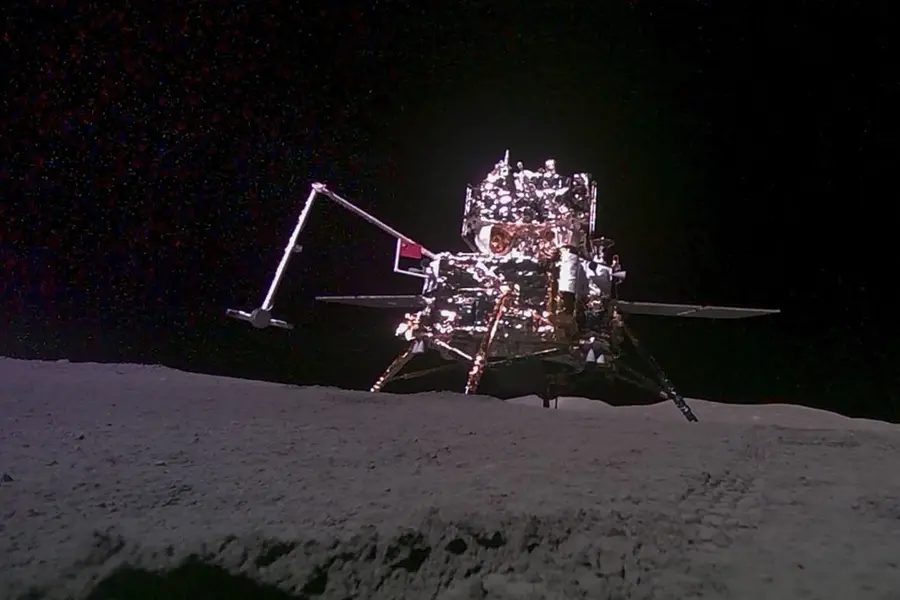
Chinese scientists have discovered rare water-bearing meteorite fragments in lunar samples from the Chang'e 6 mission, providing the first direct evidence that extremely fragile carbonaceous asteroids bombarded the Moon billions of years ago.
The finding, published October 20 in the Proceedings of the National Academy of Sciences, could reshape understanding of how water and organic materials spread through the early Solar System.
Researchers from the Guangzhou Institute of Geochemistry under the Chinese Academy of Sciences identified seven tiny fragments of CI chondrites -- among the rarest meteorites known -- embedded in soil samples from the Moon's far side.
These carbonaceous chondrites are so fragile and water-rich that fewer than one percent of meteorites found on Earth belong to this category.
"This discovery not only indicates that material from the outer Solar System can migrate to the inner Solar System, but also has important implications for explaining the origin of water on the lunar surface," said Lin Mang, a researcher at the institute.
The team analyzed over 5,000 fragments from samples collected by Chang'e 6 in 2024, which brought back 1,935.3 grams of material from the South Pole-Aitken Basin, the Moon's largest and oldest impact crater.
Using advanced microscopy and chemical analysis, they confirmed the fragments came from CI-type chondrites through distinctive iron-to-manganese ratios and oxygen isotope signatures.
Implications for solar system evolution
The discovery suggests the Earth-Moon system experienced significantly more collisions from water-bearing asteroids than previously estimated. CI chondrites can contain up to 20 percent water by weight as hydrated minerals and originate in the outer Solar System, making their preservation on the Moon particularly significant.
Unlike Earth, where these meteorites rarely survive atmospheric entry, the Moon's lack of atmosphere and geological activity preserves them like a "natural archive" of ancient impacts. The research indicates CI chondrites could account for as much as 30 percent of the Moon's meteorite collection -- far higher than their representation on Earth.
This finding supports theories that carbonaceous chondrites may have delivered water and organic compounds to both Earth and the Moon during the early Solar System's formation, offering new directions for understanding lunar water resources and their evolution.
Published: 21 Oct 2025, 05:57 pm IST
Related Topics
Disclaimer: Kindly avoid objectionable, derogatory, unlawful and lewd comments, while responding to reports. Such comments are punishable under cyber laws. Please keep away from personal attacks. The opinions expressed here are the personal opinions of readers and not that of Mathrubhumi.
