
Where will it hit? Scientists expect a head-on strike near the Einstein and Bell craters, on the western edge of the Moon as we see it from Earth
On August 5, at 12.05 pm Indian time — that is 2.35 a.m. Eastern time in the United States — a used piece of a human-made rocket is expected to smash into the Moon at very high speed. That is early morning in America and midday in India. There will be no sound, because the Moon has almost no air. But there will be a flash, and then something far more interesting: a cloud of grey lunar dust rising slowly above the surface, thrown up by the crash.
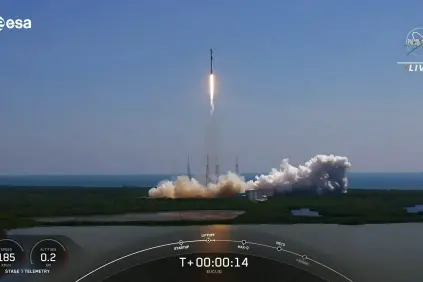
The object is the upper stage of a SpaceX Falcon 9 rocket — the part that gives the final push and is then left behind in space with no fuel and no control. This stage launched Firefly Aerospace's Blue Ghost-1 lander on January 15, 2025, and that lander touched down safely on March 2, 2025. The same launch also carried Resilience, the Hakuto-R Mission 2 lander of the Japanese company ispace, which sadly crashed during its final descent on June 5, 2025. Since then it has drifted in space, and now gravity is pulling it in.
Where will it hit? Scientists expect a head-on strike near the Einstein and Bell craters, on the western edge of the Moon as we see it from Earth. That spot matters, because a dust cloud rising above the edge stands out against the black sky behind it. A new international study on the arXiv research server says this cloud may glow brightly enough, for a few minutes, to be seen by powerful telescopes on Earth and by spacecraft in orbit.
Using computer simulations, William Jo, a graduate research assistant at the University of Texas, Austin, and his team calculated that the dust could rise 75 to 100 kilometres above the surface — higher than most of our weather systems on Earth. Speaking to Space.com, Jo said the plume would be far brighter than the dark sky for the first few minutes after the crash. He added that this is only a prediction; the real event may look different.
Another team, led by Benjamin Fernando of Los Alamos National Laboratory in New Mexico, says this will be the first man-made impact on the Moon watched live from start to finish. Such an event helps in four practical ways: it fixes the exact spot of impact, it prepares the ground for studying moonquakes, it shows how dust spreads after a hit, and it warns us about flying debris. Fernando's group estimates the biggest pieces could fly nearly 1,000 kilometres — roughly the distance from Delhi to Nagpur — before landing again.
NASA's Lunar Reconnaissance Orbiter, or LRO, has been going round the Moon since its launch on 18 June 2009 on an Atlas V rocket, mapping the surface and marking safe landing places. Brent Garry, a project scientist for the mission at Goddard Space Flight Center, said the orbiter will pass over the expected crash site about seven days before the event and again about seven days after, so that the "before" and "after" pictures can be compared.
As SpaceNews.com has reported, this is not the first such crash. In 2022, the upper stage of a Chinese Long March 3B rocket from the 2014 Chang'e-5 T1 mission hit the Moon and left a strange double crater. That crash was an accident; nobody planned it. The next two were deliberate. In 2009, a Centaur upper stage was crashed on purpose into Cabeus Crater near the south pole, and the LCROSS spacecraft studied the rising dust before crashing itself — giving strong proof of water ice. During the Apollo years, spent Saturn V third stages were also dropped on the Moon, and instruments left there recorded the shaking, revealing what lies inside our neighbour.
India, too, has done this — and did it early. On 22 October 2008, ISRO launched Chandrayaan-1 from Sriharikota. Weeks later, on 14 November 2008, a 32 kg Moon Impact Probe separated from the spacecraft and dropped deliberately near Shackleton Crater at the south pole. The impact threw up dust and buried material, which the instruments above studied at once. That bold experiment helped India announce water molecules on the Moon, and the spot was named Jawahar Point.
Jo says a hollow rocket body behaves very differently from a solid asteroid, because it is mostly empty metal, and few models exist for such objects. His worry is that many will watch only the flash, which lasts less than a second, and miss the slow dust cloud that follows — where the real science hides.
The author is a defence, aerospace & geopolitical analyst.
Published: 04 Aug 2026, 02:35 pm IST
Related Topics
Disclaimer: Kindly avoid objectionable, derogatory, unlawful and lewd comments, while responding to reports. Such comments are punishable under cyber laws. Please keep away from personal attacks. The opinions expressed here are the personal opinions of readers and not that of Mathrubhumi.
