
The planet emerged unexpectedly while scientists were using Webb's Near-Infrared Spectrograph (NIRSpec) to examine the atmosphere of Beta Pictoris b.
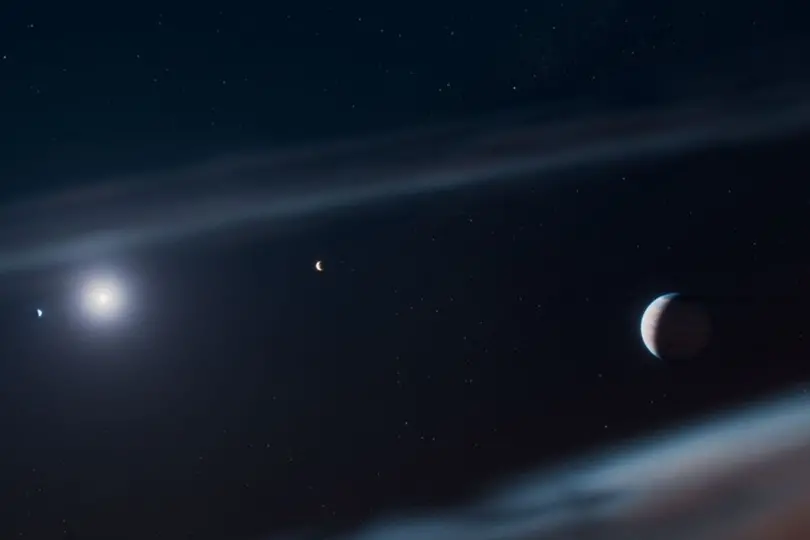
Washington: Astronomers using NASA's James Webb Space Telescope have discovered a previously hidden giant exoplanet orbiting the nearby young star Beta Pictoris, marking only the second known planetary system where three planets have been directly imaged.
The newly identified world, named Beta Pictoris d, was not found through conventional imaging but by detecting the unique chemical fingerprint of its atmosphere using spectroscopy, a breakthrough scientists say could transform the search for planets around other stars.
The discovery was published in The Astrophysical Journal Letters.
Located about 63 light-years from Earth, the Beta Pictoris system is around 23 million years old and has long been regarded as a key laboratory for studying how planetary systems form and evolve. Two giant planets, Beta Pictoris b and Beta Pictoris c, had already been identified in the system.
Researchers estimate Beta Pictoris d is at least twice the mass of Jupiter, making it the smallest of the system's three known giant planets. It likely orbits its host star at roughly 30 astronomical units, a distance comparable to Neptune's orbit around the Sun.
The planet emerged unexpectedly while scientists were using Webb's Near-Infrared Spectrograph (NIRSpec) to examine the atmosphere of Beta Pictoris b.
"We weren't looking for a new planet," said lead author Aidan Gibbs, a postdoctoral researcher at the University of California, San Diego. "We were trying to understand one we already knew existed. Then, this telltale signal appeared in the data where we didn't expect it."
Instead of spotting a bright object, researchers identified a distinctive pattern of carbon monoxide absorption lines in the spectroscopic data, the atmospheric signature of a giant planet. Follow-up observations with Webb's Mid-Infrared Instrument (MIRI) also detected water vapour and methane, confirming the planet's identity and providing new insights into its atmosphere.
Scientists said the discovery demonstrates the power of spectroscopy to identify planets hidden within dusty planetary systems where traditional imaging often struggles.
"A spectrum contains an incredible amount of information," said Jean-Baptiste Ruffio, a research scientist at the University of California, San Diego. "You don't just learn that something is a planet; you immediately begin learning about its temperature, chemistry, and motion."
The researchers believe the newly discovered planet may also explain the sharply defined inner edge and other unusual features of the Beta Pictoris debris disk, whose structure had previously hinted at the presence of another unseen planet.
NASA said the finding is the first direct discovery of an exoplanet primarily through moderate-resolution spectroscopy, demonstrating a new technique that could help astronomers detect worlds hidden in complex planetary environments.
The team plans further observations to refine estimates of Beta Pictoris d's orbit, temperature and atmospheric composition, offering a more detailed picture of one of the best-studied planetary systems beyond our solar system.
Published: 17 Jul 2026, 07:35 am IST
Related Topics
Disclaimer: Kindly avoid objectionable, derogatory, unlawful and lewd comments, while responding to reports. Such comments are punishable under cyber laws. Please keep away from personal attacks. The opinions expressed here are the personal opinions of readers and not that of Mathrubhumi.
