
The first total solar eclipse of 2026 will take place on August 12. Here's everything to know about its timings, visibility, safety and the best places to witness totality.
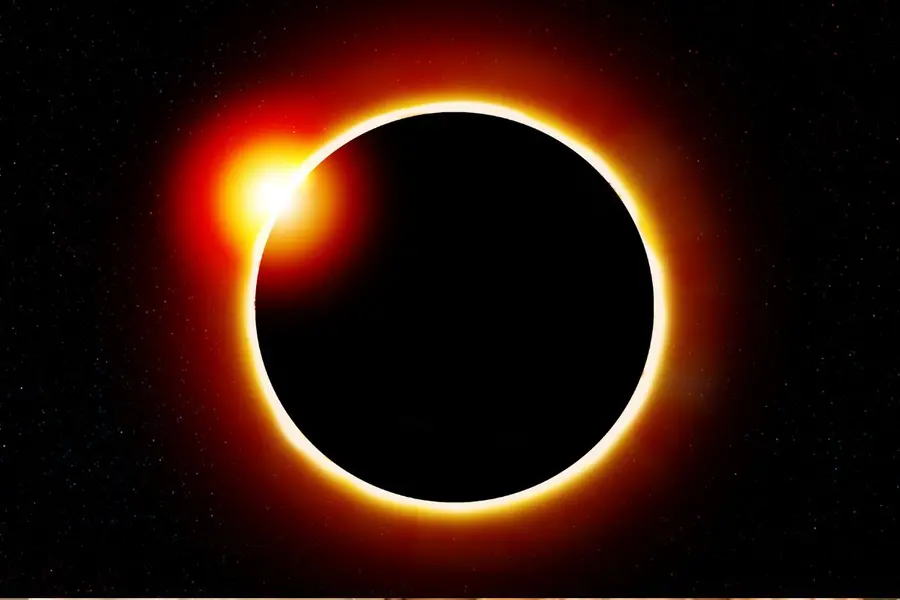
Skywatchers are preparing for one of the biggest celestial events of 2026 as the Moon gets ready to move directly between the Earth and the Sun, briefly turning day into darkness along a narrow stretch of the planet.
The total solar eclipse will take place on Wednesday, August 12, 2026, with the Moon completely covering the Sun for observers positioned along the path of totality. The event will be visible in parts of Greenland, Iceland, Spain, Portugal and northern Russia, while a much wider area across Europe, North America and north-western Africa will see a partial eclipse.
For observers within the path of totality, the disappearance of the Sun's bright disc will reveal its outer atmosphere, or corona. The longest period of totality will last about 2 minutes and 18 seconds, although the duration will vary depending on the viewing location.
When is the total solar eclipse in 2026?
The eclipse will occur on August 12, with the event taking several hours to progress across different parts of the world.
According to NASA's eclipse predictions, the global partial phase will begin at approximately 15:37 UTC, reach its greatest point at 17:46 UTC and conclude at around 19:52 UTC.
The Moon's shadow will travel across the Earth for roughly four to five hours, but individual observers will see the eclipse for a much shorter period depending on their location.
2026 solar eclipse timings in UTC
- Partial eclipse begins: 15:37 UTC
- Greatest eclipse: 17:46 UTC
- Partial eclipse ends: 19:52 UTC
The exact local time will differ considerably across the countries and cities in the eclipse zone.
Will the solar eclipse be visible in India?
No. The August 12 total solar eclipse will not be visible from India.
India is outside the eclipse's geographical visibility zone, meaning neither totality nor the partial phases will be observable from the country.
Although the eclipse's global timings extend into the late evening and early hours of August 13 in India, that does not mean the event will be visible from Indian skies.
Indian skywatchers who want to follow the phenomenon can instead look for official online broadcasts from organisations such as NASA and the European Space Agency.
Solar eclipse timings in India
If the global UTC timings are converted to Indian Standard Time, they fall at:
- Partial eclipse begins: 9:07 pm IST on August 12
- Greatest eclipse: 11:16 pm IST on August 12
- Partial eclipse ends: 1:22 am IST on August 13
These are time conversions of the global eclipse phases, not viewing times for India.
Where will the total solar eclipse be visible?
The narrow path of totality will pass through several northern regions.
According to NASA's eclipse information, totality will be visible across:
- Greenland
- Iceland
- Northern Spain
- A small section of Portugal
- Northern Russia
People located within this corridor will see the Moon completely obscure the Sun.
Spain is expected to be particularly attractive to eclipse travellers because the total eclipse will occur close to sunset in parts of the country, producing a striking low-on-the-horizon view of the eclipsed Sun.
Which countries will see a partial solar eclipse?
The partial eclipse will cover a much larger area than the path of totality.
Observers in parts of Europe, Canada, the United States and north-western Africa will see the Moon cover a portion of the Sun.
European countries expected to experience a partial eclipse include:
- United Kingdom
- Ireland
- France
- Germany
- Italy
- Belgium
- Netherlands
- Switzerland
- Austria
- Norway
- Sweden
- Finland
- Denmark
- Poland
- Czech Republic
Parts of Morocco, Algeria, Tunisia and neighbouring areas of north-western Africa will also experience the partial phase.
In North America, portions of Canada, Alaska and the northern and north-eastern United States will be able to see the eclipse.
Solar eclipse 2026: Best places to watch
For those hoping to experience totality, the key is to be inside the relatively narrow path of totality rather than simply somewhere where a partial eclipse is visible.
- Spain: Northern Spain will be among the most accessible locations for eclipse watchers. The country's position within the path, combined with its extensive transport and accommodation options, makes it a major destination for eclipse enthusiasts. The eclipse will occur near sunset in Spain, meaning the Sun will appear relatively low in the western sky during totality.
- Iceland: Iceland will also fall within the path of totality, offering observers the opportunity to see the corona against a dramatically changing daytime sky.
- Greenland: Parts of Greenland will experience totality, although the remote nature of many viewing areas makes travel planning particularly important.
- Northern Russia: The path will continue through northern Russia, including areas in the Arctic region. Accessibility and weather conditions will be important considerations for anyone planning to observe the eclipse there.
- Portugal: Only a relatively small section of Portugal will fall within the path of totality. Other parts of the country will experience a partial eclipse instead.
What will the eclipse look like?
A total solar eclipse occurs when the Moon lines up closely enough between the Earth and Sun to cover the Sun's visible surface.
As totality approaches, the daylight can change noticeably. Once the Moon completely blocks the bright solar disc, the Sun's corona becomes visible around the dark silhouette of the Moon.
The experience is very different from a partial eclipse. During a partial eclipse, some portion of the Sun remains visible, so the sky does not reach the same level of darkness.
The longest totality during the 2026 event is expected to last 2 minutes and 18 seconds. Most locations along the path will experience a shorter period.
In Spain, the duration will vary by location. NASA's predictions indicate that cities such as León could experience roughly 1 minute and 45 seconds of totality, while other locations will have different durations.
What about the eclipse in the UK?
The United Kingdom will not experience totality, but much of the country will see a substantial partial eclipse.
In London, the maximum eclipse is expected at around 7:13 pm BST, with roughly 91% of the Sun covered. The partial phase there will run approximately from 6:17 pm to 8:06 pm BST.
Locations further west and north are expected to see greater coverage.
Solar eclipse 2026: Viewing times in North America
North America will experience a partial eclipse, with the greatest coverage concentrated towards the northern and eastern parts of the continent.
Some predicted maximum-eclipse timings include:
- Iqaluit, Nunavut: 1:24 pm EDT (61%)
- St. John's, Newfoundland and Labrador: 3 pm NDT (53%)
- Fairbanks, Alaska: 8:27 am AKDT (37%)
- Anchorage, Alaska: 8:21 am AKDT (28%)
- Quebec City: 1:46 pm EDT (24%)
- Bangor, Maine: 1:53 pm EDT (23%)
- Montreal: 1:45 pm EDT (18%)
- Boston: 1:55 pm EDT (16%)
- New York: 1:54 pm EDT (9%)
Because these locations will experience only a partial eclipse, protective solar viewing equipment will be required throughout the event.
Solar eclipse 2026: Viewing times in Europe
Several European cities will experience a particularly deep partial eclipse, with some locations seeing more than 90% of the Sun covered.
Approximate maximum-eclipse times include:
- Madrid: 8:32 pm CEST (99.9%)
- Barcelona: 8:29 pm CEST (99.8%)
- Nice: 8:24 pm CEST (95%)
- Lisbon: 7:36 pm WEST (94%)
- Dublin: 7:10 pm BST (94%)
- Cardiff: 7:13 pm BST (93%)
- Paris: 8:17 pm CEST (92%)
- Tangier: 7:40 pm WEST (92%)
- London: 7:13 pm BST (91%)
- Edinburgh: 7:05 pm BST (91%)
Despite the high percentage of coverage in some European cities, these locations will still experience a partial, rather than total, eclipse unless they are within the narrow path of totality.
How to safely watch the 2026 solar eclipse
Solar viewing safety is essential even when most of the Sun is covered.
The National Solar Observatory advises people not to look directly at the Sun during the partial phases unless they are using appropriate solar viewing glasses or a certified solar filter.
Regular sunglasses are not a substitute for specialist eclipse glasses. Looking directly at the Sun without suitable protection can cause serious and potentially permanent damage to the eyes.
The exception is the short period of totality. People who are positioned within the path of totality can look at the completely eclipsed Sun without solar glasses during the brief period when the bright solar disc is fully covered. Solar protection must be put back on before totality ends.
When is the next total solar eclipse?
The 2026 eclipse is part of a series of major total solar eclipses that will occur over the coming decades.
Some of the next events include:
- August 2, 2027: Totality across southern Spain, North Africa and parts of the Middle East
- November 25, 2030: Total eclipse crossing parts of southern Africa and Australia
- August 23, 2044: Total eclipse visible across parts of North America
- August 12, 2045: Total eclipse crossing areas of North and South America
For Indian observers, the August 12, 2026, event will therefore be one to follow remotely rather than from the country's skies. For those able to travel to the path of totality, however, it offers a rare opportunity to witness one of nature's most dramatic astronomical spectacles.
Published: 09 Aug 2026, 12:51 pm IST
ABOUT THE AUTHOR

Related Topics
Disclaimer: Kindly avoid objectionable, derogatory, unlawful and lewd comments, while responding to reports. Such comments are punishable under cyber laws. Please keep away from personal attacks. The opinions expressed here are the personal opinions of readers and not that of Mathrubhumi.