

Overseas Indians, including long-term workers and students, have expressed confusion and concern after the MEA clarified that a passport is not conclusive proof of Indian citizenship, reigniting debate over how citizenship is established in India.
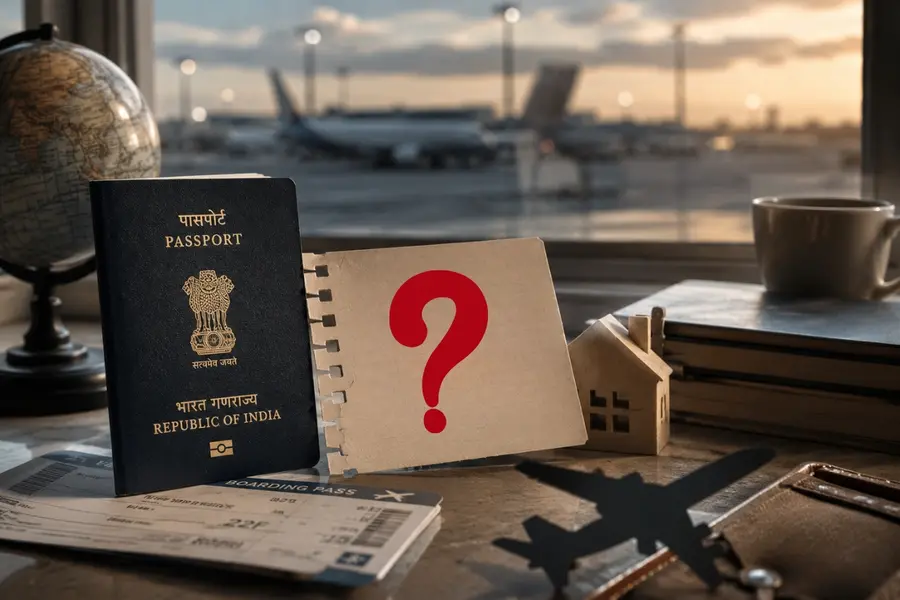
The passport is often the one document millions of Indians abroad carry without thinking twice. It is shown at airports, renewed on time, and tucked safely away as proof of identity, travel and belonging.
So when the Ministry of External Affairs clarified that a passport is not conclusive proof of citizenship, it has left many overseas Indians unsettled, confused, and asking a simple question: if not this, then what truly defines who we are?
Also Read
The Ministry of External Affairs’ clarification that a passport is a travel document and not conclusive proof of citizenship has triggered concern and confusion among many overseas Indians, especially those who have spent years or even decades building their lives abroad while relying on their Indian passports as their strongest link to home.
Some NRIs and individuals who depend heavily on passports as their primary identity document spoke to Mathrubhumi English, saying the statement has left them uncertain about what truly defines their citizenship in practical terms.
Long-term workers express uncertainty
Asraf, who has lived in Saudi Arabia for nearly 40 years, said the clarification has unsettled him after a lifetime of working abroad with official Indian documents as his anchor. “They asked us to take Aadhaar, so we did. Then the Supreme Court said Aadhaar is not proof of citizenship. The passport was the one document we carried throughout our lives and livelihoods abroad. Now that too is being described as not being proof. We are people who have worked outside India for decades and eventually have to come back to our country. What are we supposed to carry with us?” he said.
For him, the concern is not just legal but deeply personal, tied to years of work, sacrifice and the hope of returning home with clarity about identity.
Mohan, a pharmacist based in Fujairah, echoed similar worries, saying the uncertainty feels especially difficult for families settled overseas.“I have been here for the past 20 years. I brought my family here after staying away from them for years. My children are enrolled in school here. We are not always able to update identity documents whenever policies change because government services are not always efficient from abroad. The passport was the one document we could rely on. Now even that seems uncertain,” he said.
Dr Suresh Babu, Consultant Respiratory Physician at Queen Alexandra Hospital, Portsmouth, who has lived in the UK since 1999 and holds dual citizenship, said a passport should be seen as supporting evidence rather than definitive legal proof. “Passport is predominantly a travel document. While it supports citizenship, it is not conclusive proof. There are countries which issue passports to permanent residents and they do not have citizenship. In the UK, revoking a passport does not revoke citizenship. So a passport neither confers nor defines citizenship,” he said.
Students abroad caught in confusion
For students studying outside India, the issue has added a layer of uncertainty to already complex visa and documentation systems.
Shayan, a medical student from Chennai studying in Uzbekistan, said the passport has always been the simplest and most universally accepted identity proof. “When I travel, my passport is the only document everyone recognises as proof of who I am and which country I belong to. Hearing that it is not proof of citizenship in India feels confusing,” she said.
Adil Khan from Vadodara, a PhD student in Canada who also works as a sales manager, said young Indians abroad now face uncertainty about something they always took for granted. “Students already deal with visas, permits and renewals. We assumed the passport was the final identity link with India. Now there is uncertainty about what document actually settles citizenship,” he said.
Emotional strain among families abroad
For many families separated across countries, the debate has also created emotional stress and anxiety about documentation and identity.
Joseline Maria, a nurse from Kannur working in the UK for past two years, said the discussion has left many overseas Indians unsettled. “We built our lives on documents the system itself issued. Now we are told they may not be enough. It feels like the goalposts are moving after we already crossed them,” she said.
She added that the uncertainty goes beyond paperwork. “There is constant pressure about what is required and what is not. The panic of arranging documents for yourself and your children never really ends,” she said.
A gap between law and lived reality
Others pointed to a broader structural issue: India’s lack of a single, universally accepted citizenship document.
Prabha, a social science teacher from Kerala whose family works across the Gulf and Canada, said the system depends on multiple identity documents instead of one clear proof of citizenship. “India has many identity documents, but no single universally accepted citizenship card,” she said.
A software engineer based in the United States added that overseas verification systems further complicate matters. “Every renewal, every verification depends on embassy processes. If even passports are not considered final proof, it adds another layer of confusion,” he said.
Bigger debate over citizenship and identity
The MEA has clarified that while passports are issued only after verifying citizenship, they are not legally conclusive proof under the Citizenship Act, 1955. Citizenship is determined through birth, descent, registration, naturalisation or incorporation of territory and is assessed using multiple supporting records when required.
The clarification has triggered wider political and public debate in India over what document ultimately defines citizenship. Rajya Sabha MP Kapil Sibal questioned the implications of the statement, while journalist Rajdeep Sardesai highlighted confusion around Aadhaar, voter ID, PAN cards and passports all not being treated as conclusive proof of citizenship. Veteran lyricist Javed Akhtar also called the argument “absurd”, questioning how passports are issued if citizenship is not fully established.
Why the debate feels personal
Beyond legal definitions, the controversy has struck a deeper emotional chord because it touches identity, belonging and certainty.
For many overseas Indians, the passport is not just a travel document—it is a symbol of home, memory and connection to India. The current debate has therefore gone beyond policy, raising a simple but unsettling question: if not the passport, then what truly proves who they are?
Published: 25 Jun 2026, 12:47 pm IST
ABOUT THE AUTHOR
Related Topics
Disclaimer: Kindly avoid objectionable, derogatory, unlawful and lewd comments, while responding to reports. Such comments are punishable under cyber laws. Please keep away from personal attacks. The opinions expressed here are the personal opinions of readers and not that of Mathrubhumi.