
India’s successful test of the Agni-4 ballistic missile from Odisha’s Chandipur range has underlined the growing sophistication of its nuclear deterrent. The intermediate-range, solid-fuel, road-mobile missile sits at the heart of the Agni family’s second generation
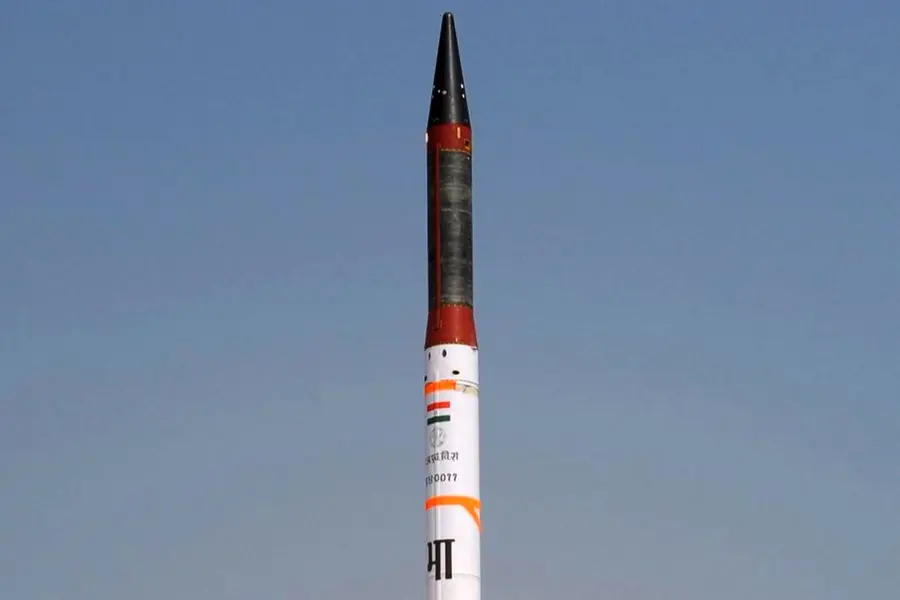
On Thursday, 6 August 2026, India successfully tested the Agni-4 ballistic missile from the Integrated Test Range at Chandipur in Odisha. The Ministry of Defence said that all important operational and technical systems worked exactly as expected during the flight. The test was carried out under the Strategic Forces Command, the special wing of our armed forces that handles nuclear-capable weapons.
The official statement described Agni-4 as a medium-range ballistic missile. By the range limits usually accepted around the world, that is 3,000 to 5,500 kilometres, it fits better as an intermediate-range ballistic missile. So remember it in one simple line: this is an intermediate-range ballistic missile, sometimes officially listed as medium-range.
Also Read: Inside India's secret hypersonic leap over Bay of Bengal
Agni-4 is a two-stage, surface-to-surface missile powered by a solid-fuel rocket motor, and it can strike targets up to 4,000 kilometres away. Two-stage means the missile has two parts that burn one after the other. When the first part finishes its fuel, it separates and falls away, making the missile lighter so the second part can push it much farther.
Solid fuel is like a hard cake of chemicals packed inside the body. Unlike liquid fuel, it needs no long filling time, so the missile can be fired within minutes of an order.
Developed by the Defence Research and Development Organisation, Agni-4 is about 20 metres long, weighs nearly 17 tonnes at launch and carries a payload of roughly 800 to 1,000 kilograms. It is nuclear capable. Its guidance comes from a Ring Laser Gyro-based Inertial Navigation System, which is a heavy name for an inbuilt sense of direction. The missile keeps measuring its own movement every second and corrects its path without depending on any outside signal. This enables it to land within 100 metres of the chosen point even after travelling thousands of kilometres.
Also Read: India’s mobile nuke-carrier Agni-5 can wipe out targets across the continent
Agni-4 is carried on a road-mobile launcher. Instead of standing at one fixed spot where an enemy can easily find it, the missile travels on a heavy vehicle and can be fired from many different places. This quality is called survivability. Even if an enemy strikes first, the missile is likely to survive, because nobody knows exactly where it is parked. This supports India's declared policy of no first use, which promises that we will never begin a nuclear attack but can certainly reply.
The Agni family is the backbone of India's nuclear deterrence, and each member has a separate duty.
| Missile Name | Effective Range | Missile Capability |
| Agni-I | 700 - 1,200 km | Single stage, our first operational Agni |
| Agni-Prime | 1,000 - 2,000 km | Two-stage, canister-launched from road or rail, replacing Agni-I |
| Agni-II | 2,000 - 2,500 km | Two-stage, deep regional reach from rail and road launchers |
| Agni-III | 3,000 - 3,500 km | Two-stage, solid-fueled missile that can launch a 1,500 kg payload |
| Agni-IV | 3,500 - 4,000 km | Two-stage, advanced composite rocket motor and ring laser gyros payload |
| Agni-V | 5,000 – 5,500 km | Three-stage, canisterised and road-mobile, with MIRV technology already validated |
| Agni-VI | 8,000 - 12,000 km | Three-stage, design ready with DRDO and awaiting final government approval |
Agni-VI is still only a design. It has not been flight-tested or inducted into service. Notice also that every missile listed uses solid fuel, and the stages increase as the distance increases, because greater range needs more pushing power.
Also Read: Inside India's defense strategy to deal with Pakistan's arsenal
The growth of this family can be seen in three generations. The first generation, Agni-I and Agni-II, moved India from liquid fuel to solid fuel and cut launch preparation time sharply. They were placed on rail and road systems that could move but were not sealed in canisters.
The second generation, Agni-III and Agni-IV, replaced heavy steel bodies with light composite materials, so the same push could carry the missile farther, and added ring laser gyro navigation for sharp accuracy beyond 4,000 kilometres.
The third generation, Agni-Prime and Agni-V, brought canisterisation. The missile stays sealed inside a protective tube, safe from rain, dust and heat, and can be fired within a few minutes. This generation also uses manoeuvrable re-entry vehicles and MIRV platforms. MIRV has one missile carrying several warheads with each warhead having the ability to hit a different target. Such a design makes enemy defence systems almost helpless, because stopping one incoming missile no longer stops the whole attack.
Earlier this year, India also tested Agni-Prime and Agni-3 successfully. Each test quietly tells the world that our deterrence is alive and dependable. India does not wish to attack anybody, but it has built the strength to protect its people. Behind every launch stand thousands of engineers, technicians and soldiers whose patient work keeps the nation safe.
The author is an award-winning science communicator and a Defence, Aerospace & Geopolitical Analyst.
Published: 07 Aug 2026, 11:33 am IST
Related Topics
Disclaimer: Kindly avoid objectionable, derogatory, unlawful and lewd comments, while responding to reports. Such comments are punishable under cyber laws. Please keep away from personal attacks. The opinions expressed here are the personal opinions of readers and not that of Mathrubhumi.
