
She approached women at temples, promised divine intervention and used their faith to lure them into deadly traps. The story of K.D. Kempamma, better known as Cyanide Mallika, reveals a chilling trail of murders driven by greed and stolen gold.
They say the house of God is the safest sanctuary on Earth. A place where the heavy-hearted go to shed their tears, pray for miracles, and seek peace. But in the shadowy corners of South India’s most revered temples, a real-life predator was lurking in plain sight.
She didn’t wear a terrifying mask or carry an open weapon. She wore colourful saris, placed fresh flowers in her hair, and spoke with the comforting warmth of a saint. But behind her gentle demeanour was a heart of stone and a handbag filled with pure, lethal poison.
This is the chilling chronicle of K.D. Kempamma—the cold-blooded monster who tricked, poisoned, and stripped the corpses of innocent women, earning her spot in history as India’s first officially convicted female serial killer: Cyanide Mallika.
The nightmare began on October 19, 1999, in the quiet taluk of Hoskote, a temple-laden sanctuary near Bangalore known for its serene lakes and sacred grounds.
Thirty-year-old Mamatha Rajan walked into the Jalageramma temple with a heavy heart. Overwhelmed by deep personal sorrow and sleepless nights, she desperately needed divine intervention. As she wiped away tears in the shaded, cool courtyard of the temple complex, a dark-complexioned, smiling woman approached her.
"Sister, whatever seems to be bothering you, leave it to God," the stranger whispered softly.
The woman introduced herself as "Lakshmi". She was a master observer of human misery. Spotting dark circles beneath Mamatha’s eyes and smudged kohl on her cheeks, "Lakshmi" preyed on the woman's vulnerability. She claimed to have a direct line to the Almighty and offered to perform a secret, highly potent Mandala Puja that guaranteed to make Mamatha's darkest troubles vanish.
The catch? The ritual had to be done in complete secrecy at Mamatha's home, and no one else could be present.
Ten days later, on October 29, "Lakshmi" arrived at Mamatha’s empty house. Armed with fruits, flowers, and brass utensils, she began chanting bizarre, gibberish incantations. She instructed Mamatha to close her eyes and prepare to swallow "holy water" to complete the divine spell.
Trusting the pious woman, Mamatha closed her eyes.
Suddenly, her head was violently yanked backward by her braid. A steel glass was shoved against her lips, forcing a foul liquid down her throat. Before she could process what was happening, the predator's hand clamped down hard over her nose and mouth, cutting off all air.
Mamatha gagged and thrashed, her eyes snapping open in terror to see her "saintly" helper’s face now changed to an evil expression of a murderer. As the lethal chemical choked the life out of her cells, Mamatha’s toes turned crimson, and her heart stopped beating.
The killer didn't flinch. She calmly ripped the gold earrings, toe-rings, gold rings, and heavy chain off the fresh corpse, turned the body on its side facing the wall, packed her violent loot, and walked out into the light of day.
God hadn't answered Mamatha's prayers—a monster had.
Who was this Asuri—this demon-like, cruel female preying on God-fearing women?
The Genesis
Born in Kaggalipura, a rural village surrounded by thorny Acacia trees 23 kilometres from Bengaluru, K.D. Kempamma was no stranger to the harsh sting of poverty. Forced to drop out of school in the fifth grade because her family couldn't afford fees, she always felt small and worthless, living a life of humiliation due to her poverty.
She wanted to be rich at any cost. She wanted the gold, the silk saris, and the luxury she saw on the wealthy women she later cleaned up after as a domestic maid.
Her desperate parents married her off young to Devraj, a humble tailor at NIMHANS in Bangalore. But modest living wasn't enough for Kempamma. Her insatiable greed led her to steal gold from the homes where she worked. In 2001, she was caught red-handed trying to rob a home in Bidadi and served six months in prison.
Far from reforming her, prison became her crime academy.
When she was released, she tried running an illegal chit-fund (a local financial scheme) that rapidly went bust, wiping out her finances. Sickened by her continuous criminal antics, her honest husband threw her out of the house in 1998.
Drifting through odd jobs, Kempamma landed a role assisting a local goldsmith. It was there she made a discovery that would change her life forever.
She noticed the goldsmith using powders to polish gold.
"One drop can kill a person?" she casually asked.
"Yes. In a matter of seconds," the goldsmith replied.
Potassium Cyanide. The ultimate weapon. It was silent, instantly lethal, and virtually impossible for a gasping victim to fight off in time. Kempamma bought a stash of the deadly white powder—enough to wipe out an entire village—and began plotting.
She knew she couldn't target strong men or rob high-security banks. She needed vulnerable, trusting prey. And where do vulnerable women congregate with their finest gold jewellery and open hearts?
Temples.
Her sinister blood-formula was finalized:
Sympathy + Role-play + Cyanide = Death + Jewellery
After her first strike against Mamatha in 1999, Kempamma went dormant, lying low like a predator in the tall grass. But by 2007, her greed flared up again with an insatiable, bloodthirsty intensity.
What followed was a horrific, months-long killing spree across the temple towns of Karnataka. She targeted and hunted mercilessly on women who were vulnerable, using her excellent skills of acting and role-play, and using her excellent knowledge of the local temples and deities.
Elizabeth (52)
Kempamma targeted Elizabeth at the Kabalamma Temple, Kabbal Village at Ramanagara. Elizabeth was weeping at the famous shrine after her beloved granddaughter went missing.
Kempamma approached the crying woman, claiming to be an emissary sent by Goddess Kabalamma to perform a special "Mandala Puja" at dusk. She ordered Elizabeth to wear her finest saris and gold, warning her that telling anyone would destroy the divine spell.
Kempamma met Elizabeth at dusk, bringing a box of Mysore Paak spiked with lethal potassium cyanide. After the puja, Kempamma dropped her caring act, pounced on the 52-year-old, stuffed the poisoned sweet down her throat, and held her mouth shut until her body went limp. Kempamma stripped the gold bangles, earrings, and chain from the fresh corpse and melted into the night.
Yashodhamma (60)
Yashodhamma was an elderly, chronic asthma patient gasping for air after a hospital visit at the Yelahanka Government Hospital Bus Stop. This is where Kempamma snared her.
Posing as a friendly stranger, Kempamma claimed her own uncle was "miraculously cured" of severe asthma after drinking holy water at the 14th-century Siddhaganga Mutt in Tumkur. She lured the desperate old woman on a 1.5-hour journey to the monastery.
Kempamma rented a choultry (guesthouse) room for 20 rupees. In the dead of night, she told Yashodhamma to wear all her gold to show reverence. As the old woman closed her eyes in prayer, Kempamma grabbed a fistful of her hair, yanked her head back, and poured cyanide-laced water into her open mouth. Yashodhamma swallowed, believing it was holy water. Moments later, she choked to death on her own poisoned blood. Kempamma stripped her body clean.
Muniyamma (60)
Muniyamma was a God-fearing woman who wanted to learn devotional songs. Kempamma approached her using the alias “Lakshmi”.
On December 15, 2007, Kempamma convinced Muniyamma to travel 95 km to Yediyur for a secret ritual. Kempamma checked them into Room 28 of the Parvathi Block, paying extra to hold the room for days.
At 12:30 PM, while Muniyamma was praying with her eyes closed, Kempamma shoved raw cyanide into her mouth. She robbed the dying woman of her gold chain, rings, earrings, and mobile phone. Kempamma stepped out, locked the door from the outside, and walked away. Three days later, temple staff had to break down the door after a putrid, unbearable stench filled the hallway. Inside, they found Muniyamma's decomposing corpse alongside a coconut, a lemon, a box of sandalwood, and her dropped eyeglasses.
Pilamma (60)
Pilamma was a beloved temple priestess and social worker whose life dream was to build a grand new decorative arch at her local temple. Kempamma befriended Pilamma and offered to fully fund the temple arch out of the goodness of her heart. She convinced the tearful, grateful priestess to travel to the Vaidyanatheshwara Temple, Maddur for a ritual to seal the deal..
Once there, Kempamma checked into a lodge, poisoned Pilamma with cyanide, stripped her of her gold, and left her dead on the floor.
Nagaveni (30)
Nagaveni was tormented by societal cruelty and backbiting after years of being unable to conceive a child. Posing as "Savithramma," Kempamma promised that her special Mandala Puja at the 600-year-old fertility temple would guarantee Nagaveni a child.
She escorted the eager young woman to Ghati Subramanya Temple, Doddaballapur and forced cyanide down her throat. Nagaveni died instantly.
Between October and December 2007 alone, Kempamma had slaughtered five women. Her body count was rising, her pockets were bulging with stolen gold, and the police were entirely oblivious—until the dots finally began to connect.
The killer had been clever. By luring her victims far away from their home districts into different jurisdictions—Bangalore City, Tumkur, Kolar, Mysore, and Mandya—she kept local police forces isolated. Some deaths were logged as simple heart attacks; others as untraceable unnatural deaths.
Then came the slip-up.
When Muniyamma disappeared, her worried son, Anjanappa, went straight to the police. He revealed something Kempamma didn't anticipate: despite being warned to keep the ritual secret, Muniyamma had casually mentioned to her family that she was travelling to a temple with a new female friend named "Lakshmi".
When police found Muniyamma’s rotting corpse in Room 28 at Yediyur and showed Anjanappa the photos, he broke down—and then noticed a massive clue.
"My mother was wearing her gold mangalya chain, earrings, and a large ring when she left! Her jewellery is gone!" Anjanappa cried out.
Inspector S.K. Umesh of the Kalasipalyam police station took over. Looking across various districts, he realized a horrifying pattern: elderly or vulnerable women were meeting a friendly female stranger at temples, vanishing, and turning up dead in locked rooms with their gold missing.
The killer wasn't a ruthless gang of men or a burly male thief. India was hunting its second female serial killer.
Police immediately issued widespread alerts to all pawn shops and jewellers across Karnataka, ordering them to report anyone selling used gold. This choked Kempamma's cash flow instantly. She was stuck with stolen gold and stolen cell phones she couldn't risk selling to her usual fences.
On December 30, 2007, a crucial tip-off flashed to Inspector Umesh. A middle-aged woman was acting suspiciously at a local bus stand in Bangalore, desperately trying to hawk used cell phones to random bystanders.
A tactical team consisting of Inspector Umesh, Sub-Inspector Manoj, Assistant Sub-Inspector Rudramurthy, and Head Constables Gopalakrishna and Ganganna rushed to the scene. They spotted the 45-year-old woman. Holding up a rough composite sketch drawn from temple witness descriptions, the match was dead-on.
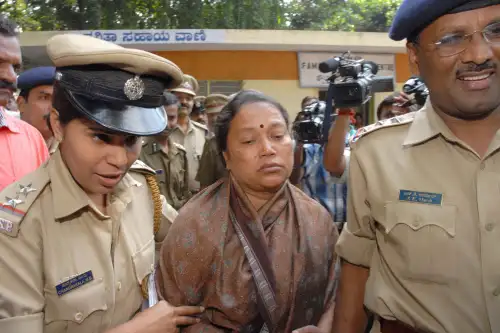
As the police team swooped in from their stakeout positions, Kempamma realised her reign of terror was over. She broke into a panic-stricken sprint, but the cops tackled and cornered her before the gathering crowd even realised who she was.
When officers unzipped her handbag, they found stolen cell phones and SIM cards, pawn shop receipts for stolen gold and the biggest evidence… The key chain for Room No. 28 of the Siddeshwaraswamy Temple where Muniyamma had rotted.
The monster was finally unmasked. The media dubbed her Cyanide Mallika.
The Verdict
Inside the interrogation room, the cold demeanour of "Cyanide Mallika" finally broke, and the terrifying scale of her bloodlust stunned veteran homicide detectives.
As her face dominated national news headlines, phone lines at police headquarters lit up. Other precincts began pulling cold cases off their shelves.
The horrific case of Renuka surfaced. In December 2006, Kempamma was working as a cook alongside a servant woman named Mani. She befriended Mani's sister, Renuka, who was desperate to give birth to a male heir. Kempamma lured Renuka to a guesthouse at the Kaiwara Yogi Narayan Ashram in Kolar under the name "Jayamma," fed her cyanide, robbed her, and vanished. Renuka’s husband, returning home from Dubai, spent a year searching for his missing wife until guesthouse staff recognized Mallika's mugshot on television.
In total, police linked her to at least six confirmed cold-blooded cyanide murders, with five other missing-person cases tied to her dark shadow.
During her high-stakes trial for the murder of Muniyamma, Mallika’s defence attorneys fought aggressively. They pointed out that she signed the hotel ledger under fake names like "Lakshmi," claiming the prosecution was framing their client.
However, the State Public Prosecutor dismantled her defence piece by piece.
-
The Key: The room key to the murder scene was physically found in her purse upon arrest.
-
The Pawn Broker: Bheram Chowdhary, owner of Mangalram Bankers, took the stand and pointed directly at Mallika in the courtroom. He swore under oath that on December 15, 2007, she had pawned Muniyamma's 6-gram gold earrings for 3,000 rupees.
-
The Son's Identification: Muniyamma's son identified the recovered gold right in front of the judge.
On March 24, 2009, the court found K.D. Kempamma guilty of cold-blooded murder and robbery. She was sentenced to death by hanging. In March 2012, she received a second death sentence for the murder of Nagaveni.
In 2014, her death sentences were commuted to life imprisonment without parole.
In the Jail
Even behind the iron bars of Bengaluru’s Parappana Agrahara Central Jail, Cyanide Mallika couldn't stay out of the tabloid headlines.
In late 2014, when former Tamil Nadu Chief Minister J. Jayalalithaa was briefly incarcerated at the facility, Kempamma—a self-proclaimed superfan—begged prison authorities for a chance to meet her idol.
Then, in 2017, Jayalalithaa’s close aide V.K. Sasikala was sent to the very same prison. To the shock of jail staff, Cyanide Mallika was assigned as Sasikala’s immediate cell neighbour.
Prisons are breeding grounds for bizarre rumours, and whispers soon swept through the corridors that the convicted serial killer was standing in long food lines to fetch meals for Sasikala to keep the politician from mingling with common convicts. Intelligence officials feared for Sasikala's life—realising a ruthless poisoner was sitting right next to her.
Without warning, prison authorities secretly packed up Cyanide Mallika under heavy armed guard in the middle of the night and transferred her to the high-security Hindalga Prison in Belagavi, effectively neutralising any threat.
Today, K.D. Kempamma sits in a cold concrete cell, isolated from the world. She went down in history as a deadly predator who weaponised faith, twisted human desperation, and turned holy sanctuaries into slaughterhouses for a handful of gold.
As the famous poet Rudyard Kipling once wrote: "For the female of the species is more deadly than the male." Cyanide Mallika proved those words in the most terrifying way imaginable.
(Anirban Bhattacharyya is a bestselling true crime author and creator-producer of the hit TV shows Savdhaan India & Ishq Kills and producer of Crime Patrol and Fear Files.)
Published: 16 Nov 2026, 11:29 am IST


Related Topics
Disclaimer: Kindly avoid objectionable, derogatory, unlawful and lewd comments, while responding to reports. Such comments are punishable under cyber laws. Please keep away from personal attacks. The opinions expressed here are the personal opinions of readers and not that of Mathrubhumi.
