
India successfully tests Agni-5, a 5,000km range ballistic missile, strengthening its nuclear deterrence and strategic defence capabilities.
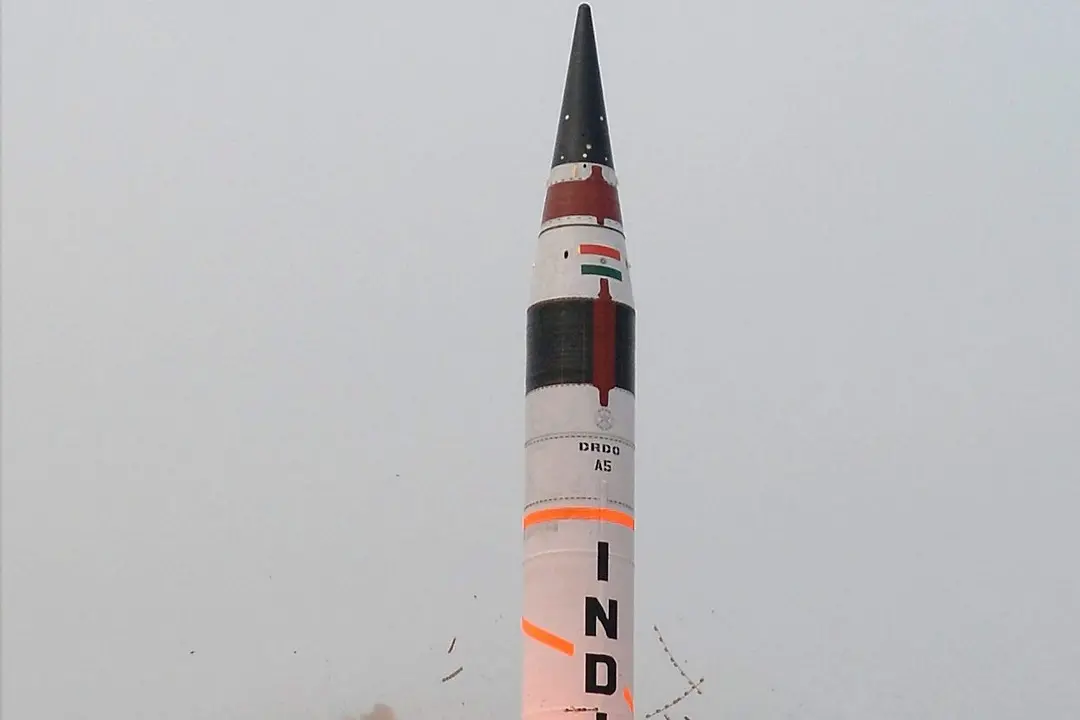
In a major stride toward bolstering its strategic defence capabilities, India has once again proven its technological prowess with the successful test of the Agni-5 intermediate-range ballistic missile (IRBM). But beyond the headlines of another test-firing lies the story of a missile that represents the cutting edge of India’s missile arsenal, both in terms of range and precision.
Designed as a cornerstone of India’s nuclear deterrence strategy, the Agni-5 is capable of striking targets up to 5,000 kilometres away, giving it the ability to cover nearly all of Asia, including northern China, and even reach parts of Europe. This extended reach positions the missile as a vital asset in maintaining credible deterrence amid evolving regional and global security dynamics.
At the heart of Agni-5’s effectiveness is its three-stage solid-fuel propulsion system, which ensures rapid deployment and enhanced mobility. Unlike liquid-fuel missiles that require time-consuming preparation, solid-fuel engines offer a quicker launch readiness, critical in modern warfare scenarios where rapid response is often essential.
One of the most remarkable features of the Agni-5 is its high-precision guidance system. Incorporating advanced navigation and control technologies, the missile is engineered for exceptional accuracy over long distances, making it reliable for delivering strategic payloads to predetermined targets with minimal deviation.
The missile can be launched from mobile platforms, increasing its survivability by making it harder to detect and neutralise in a preemptive strike. This mobility, combined with India’s extensive Integrated Test Range infrastructure, ensures that the missile can be deployed from various terrains across the country.
In terms of payload, the Agni-5 is capable of carrying nuclear warheads, reinforcing its role as a central pillar in India’s no-first-use nuclear policy. Its payload design supports both single and multiple warhead configurations, allowing strategic flexibility based on mission requirements.
The recent test, conducted under the supervision of the Strategic Forces Command at the Integrated Test Range in Chandipur, Odisha, validated the missile’s operational and technical parameters. According to the defence ministry, the successful firing demonstrates the system's full readiness and reliability.
The Agni-5 complements India’s existing Agni missile series, ranging from Agni-1 to Agni-4, which cover shorter ranges between 700 km and 3,500 km. While these have been fully deployed, Agni-5 stands apart as a next-generation system with intercontinental ambitions, capable of securing India's interests far beyond its immediate borders.
Published: 21 Aug 2025, 11:34 am IST
Related Topics
Disclaimer: Kindly avoid objectionable, derogatory, unlawful and lewd comments, while responding to reports. Such comments are punishable under cyber laws. Please keep away from personal attacks. The opinions expressed here are the personal opinions of readers and not that of Mathrubhumi.
