
India observes Mahatma Gandhi Death Anniversary 2026 as Martyrs’ Day (Shaheed Diwas) on January 30 to honour the Father of the Nation and remember his supreme sacrifice. The day reflects on Gandhi’s ideals of truth, non-violence and peace, which continue to inspire generations.
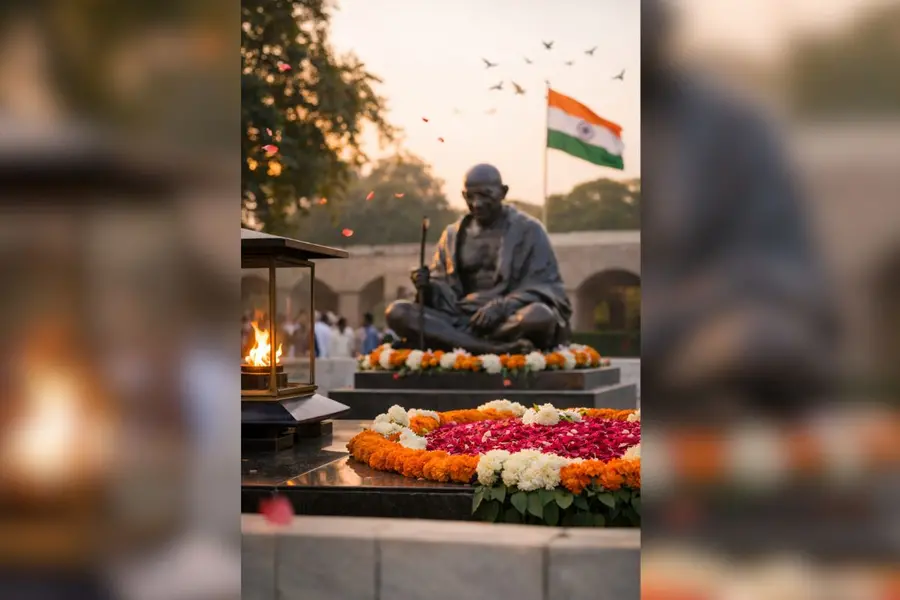
Every year on January 30, India observes the death anniversary of Mahatma Gandhi, also known as Martyrs’ Day or Shaheed Diwas, to honour the life and legacy of the nation’s foremost leader and his ultimate sacrifice for peace, justice, and freedom.
In 2026, this solemn day marks the 78th anniversary of Gandhi’s assassination in 1948. Mahatma Gandhi, born Mohandas Karamchand Gandhi on October 2, 1869, was a lawyer, anti-colonial nationalist, and ethical leader who pioneered the use of non-violent resistance (satyagraha) to challenge British colonial rule in India.
Also Read

His philosophy of ahimsa (non-violence) and commitment to truth and simplicity earned him deep reverence both in India and across the world.
The tragic event that defines this day occurred on January 30, 1948, when Gandhi was shot at point-blank range by Nathuram Godse during a prayer meeting at Birla House (now Gandhi Smriti) in New Delhi.
He was 78 years old at the time. His death sent shockwaves throughout the newly independent nation and remains one of the most poignant moments in Indian history.
History and observance
Since 1948, January 30 has been officially observed as Martyrs’ Day in India to commemorate Gandhi’s martyrdom and to remember others who laid down their lives for the nation’s freedom.
On this day, the President, Prime Minister, and other dignitaries participate in wreath-laying ceremonies at Raj Ghat, Gandhi’s memorial in Delhi, and a two-minute silence is observed nationwide at 11 am as a mark of respect.
Schools, civic institutions, and cultural bodies organise seminars, prayer meetings, and educational events to reflect on Gandhi’s teachings and principles.
The term Shaheed Diwas (“Martyrs’ Day”) is also used to observe other historic sacrifices, for example, March 23 remembers Bhagat Singh, Sukhdev, and Rajguru, but January 30 remains uniquely associated with Gandhi’s influence on the values of peace, tolerance, and unity.
Significance
Martyrs’ Day is not merely about remembering Gandhi’s death; it’s a call to uphold his core ideals of truth (satya) and non-violence (ahimsa) in everyday life. His leadership helped shape India’s freedom struggle and inspired civil rights movements around the world.
Today, Gandhi’s legacy resonates in global discourses on human rights, communal harmony, environmental stewardship, and conflict resolution.
10 Inspiring Quotes by Mahatma Gandhi
- “Be the change that you wish to see in the world.”
- “Live as if you were to die tomorrow. Learn as if you were to live forever.”
- “An eye for an eye will only make the whole world blind.”
- “The weak can never forgive. Forgiveness is the attribute of the strong.”
- “In a gentle way, you can shake the world.”
- “The best way to find yourself is to lose yourself in the service of others.”
- “Freedom is not worth having if it does not include the freedom to make mistakes.”
- “Happiness is when what you think, what you say, and what you do are in harmony.”
- “Strength does not come from physical capacity but from an indomitable will.”
- “Non-violence is the greatest force at the disposal of mankind.”
On this Mahatma Gandhi Death Anniversary 2026, India pays homage not only to a fallen leader but to an enduring philosophy that continues to guide generations toward peace and justice.
Published: 30 Jan 2026, 07:58 am IST
Related Topics
Disclaimer: Kindly avoid objectionable, derogatory, unlawful and lewd comments, while responding to reports. Such comments are punishable under cyber laws. Please keep away from personal attacks. The opinions expressed here are the personal opinions of readers and not that of Mathrubhumi.