
Prisons are often seen as spaces of punishment, but speakers at MBIFL 2026 argued that when dignity, work and purpose are restored, incarceration can also become a path to reform and redemption
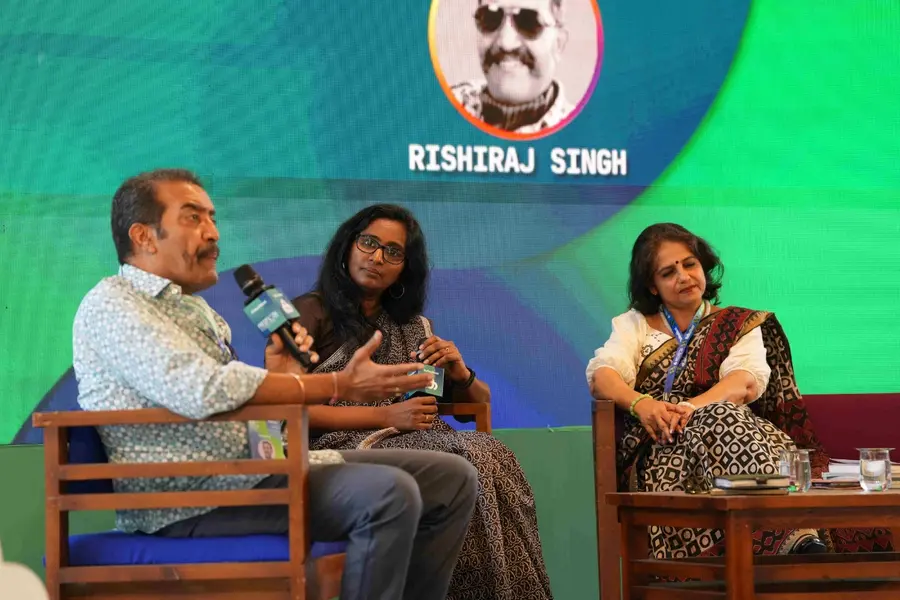
Why would a prisoner run away when he gets to go home every three months? This was the striking question posed by former Director General of Police (DGP) for Prisons Rishiraj Singh, effectively dismantling the popular perception of incarceration during a riveting session at the 7th Edition of the Mathrubhumi International Festival of Letters (MBIFL).
Besides Rishiraj Singh, the discussion titled 'Where Walls Remember: Notes from Prison', the audience was taken on a journey behind the high walls by prison reformer Vartika Nanda and Kerala Police Inspector General R Nishanthini. The conversation, far from a dry administrative debrief, evolved into a profound exploration of human redemption, the economics of crime, and the surprising spirituality found in confinement.
Also Read

"Kerala is way ahead in these matters," Singh noted, anchoring the discussion in the unique landscape of the state’s correctional facilities. While the world views prisons as cages, Kerala has reimagined them as production centers. The state stands as an outlier in the Indian penal system, operating open jails where escape attempts are statistically negligible, not because the walls are higher, but because the incentives to stay are stronger.
Singh detailed a system where inmates are not merely serving time but are actively employed in 36 types of industries, from running petrol pumps to managing printing presses and organic farms.
"After Telangana, we are the only state where petrol pumps are being run by the criminals," Singh revealed, highlighting a radical trust exercise where convicted felons interact with the public daily. They earn wages, up to 500 rupees a day -- which are transferred directly to their families, ensuring that while the individual is confined, their household does not collapse into destitution.
This economic pragmatism is coupled with a humane leave policy found nowhere else in India: a 15-day break every three months for well-behaved prisoners. It is this slice of freedom, Singh argued, that negates the urge to escape.
However, the session quickly moved beyond the mechanics of administration to the "soul" of the prison, a domain championed by Dr Vartika Nanda, founder of the Tinka Tinka Foundation. For Nanda, the prison is not just a correctional home as the rulebooks suggest, but a "space for prayer, self-introspection, and spirituality."
She challenged the cinematic lens that demonizes prison life, arguing that the commercialized cruelty depicted in movies often blinds society to the genuine transformation happening inside.
Nanda illustrated this through the power of "Prison Radio," a concept that has turned inmates into content creators. In the vacuum of what she termed "empty time," where an idle mind can turn toxic, the radio becomes a lifeline.
She recounted the moving story of Sheru, an inmate in Ambala Central Jail -- the historic site of Nathuram Godse’s execution. Sheru, once abandoned by his family, sang a song on the prison radio that eventually reached the Union Health Minister via social media. The ripple effect was immediate: the judiciary took notice, and his estranged family returned to visit him. "Small little steps can bring changes in the lives of the inmates," Nanda observed, emphasizing that when prisoners are given a voice, they often emerge as better versions of themselves.
Yet, the discussion did not shy away from the darker, more uncomfortable realities of justice. Rishiraj Singh brought up a provocative, unresolved policy issue: the forgotten victims. He argued for a system where 30 percent of a prisoner's earnings would go to the victim's family, a concept stalled by the Delhi High Court on grounds of "double jeopardy."
Singh’s frustration was palpable as he questioned why reforms focus solely on the criminal while the victim's family is often left on the streets. "Have you heard of any reform for the families of those people who are victims?" he asked, urging a shift in perspective to include those left behind by the crime.
The conversation took a poignant turn when addressing the aftermath of release. While society is often surprisingly willing to reintegrate former convicts, the rejection frequently comes from closer to home.
Singh shared a heartbreaking anomaly found in Kerala’s jails: nearly 50 inmates who have completed their terms refuse to leave. They remain behind bars not because the state demands it, but because their children have rejected them. "We do not want our father back at home," is the message sent by families, leaving these elderly men to prefer the camaraderie of the cell over the isolation of a society that has moved on without them.
The session also shed light on the gender dynamics of incarceration. Singh pointed out a "satisfying development" in Kerala: the incredibly low number of female convicts, a statistic he attributed to the state's 100 percent literacy rate. However, Nanda offered a counter-narrative regarding the women who do end up inside. She described a "prison within a prison," noting that women’s wards often operate under stricter, unwritten social codes than their male counterparts.
Furthermore, she highlighted the invisible plight of children accompanying their incarcerated parents. Innocent of any crime, these children live in the shadow of the prison walls until the age of six, facing judgment from a world that struggles to separate the child from the parent's circumstances.
Moderated with empathetic precision by IG R Nishanthini, the session concluded by dismantling the binary of "us versus them." As the speakers detailed the transition from "custody" to "correction" and finally to "rehabilitation," the audience was left with a stark realization: The walls of a prison do indeed remember -- they remember the crimes, yes, but they also bear witness to the poetry, the labour, the remorse, and the resilience of those trying to find their way back to humanity. In the end, the most effective prison wall, it seems, is not one made of stone, but one built of purpose and hope.
Published: 01 Feb 2026, 08:20 pm IST
Related Topics
Disclaimer: Kindly avoid objectionable, derogatory, unlawful and lewd comments, while responding to reports. Such comments are punishable under cyber laws. Please keep away from personal attacks. The opinions expressed here are the personal opinions of readers and not that of Mathrubhumi.