
Users can now instruct AI to book travel, swap tokens, or pay for services using natural language.
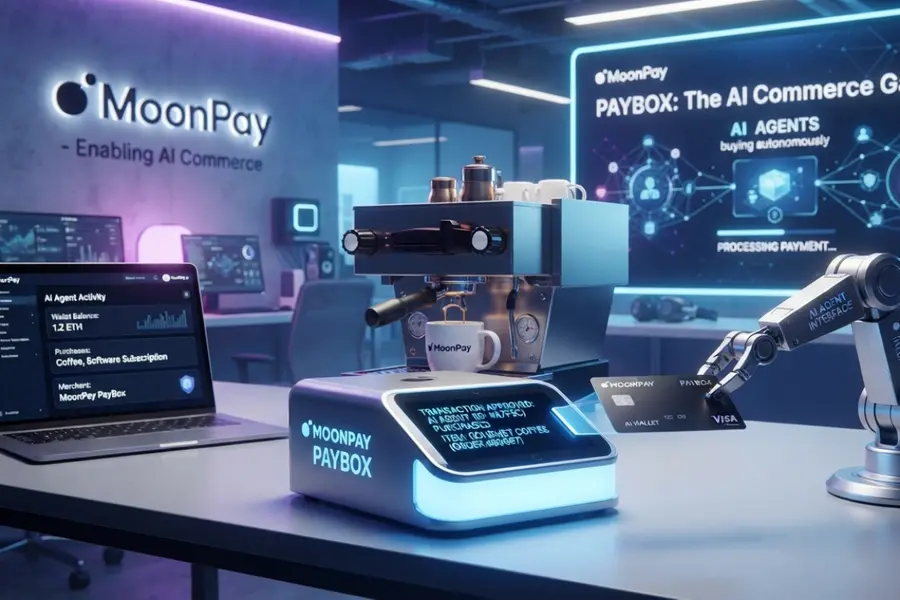
Financial technology firm MoonPay has officially launched PayBox, a pioneering payment vault designed specifically to enable artificial intelligence agents to transact on the open internet. Integrated directly into conversational platforms such as OpenAI's ChatGPT and Anthropic's Claude via a custom connector, the tool translates natural-language prompts into actionable financial operations.
Bridging Conversation and Commerce
Until now, conversational AI assistants have been restricted to planning, writing code, and answering queries without the capability to independently execute financial transactions. With PayBox, users can issue plain-text instructions—such as onboarding funds, swapping tokens, bridging assets across networks, booking travel, or securing restaurant reservations.
According to MoonPay Co-Founder and CEO Ivan Soto-Wright, as stated in company announcements:
"AI agents can code, design, and write, but until now, they couldn't complete the final step of any real-world workflow: paying for things."
Security Architecture and Permissions
PayBox is engineered with stringent security layers to prevent unapproved financial activity and protect sensitive credentials:
- Non-Custodial Design: Wallet keys are shielded using threshold cryptography (MPC) and secure enclaves (TEEs), meaning neither MoonPay nor the AI agent can independently access full private keys or execute transactions alone.
- Card Protection: Card transactions are processed via Visa's agentic commerce protocol, ensuring raw card details are never exposed to or stored by the AI agent.
- User-Defined Controls: Users can configure permissions using an "Always Ask" mode (requiring explicit passkey approval for every transaction) or an "Autonomous" mode (permitting actions strictly within pre-set spending limits).
At launch, PayBox supports Solana and several EVM-compatible networks, including Ethereum, Base, Polygon, Arbitrum, Hyperliquid, Tempo, and Robinhood Chain.
Published: 31 Jul 2026, 10:19 am IST
ABOUT THE AUTHOR

Related Topics
Disclaimer: Kindly avoid objectionable, derogatory, unlawful and lewd comments, while responding to reports. Such comments are punishable under cyber laws. Please keep away from personal attacks. The opinions expressed here are the personal opinions of readers and not that of Mathrubhumi.