
NASA’s Voyager 1 becomes the first human-made object to reach one light-day from Earth—roughly 26 billion kilometres—continuing its interstellar voyage with the Golden Record aboard.
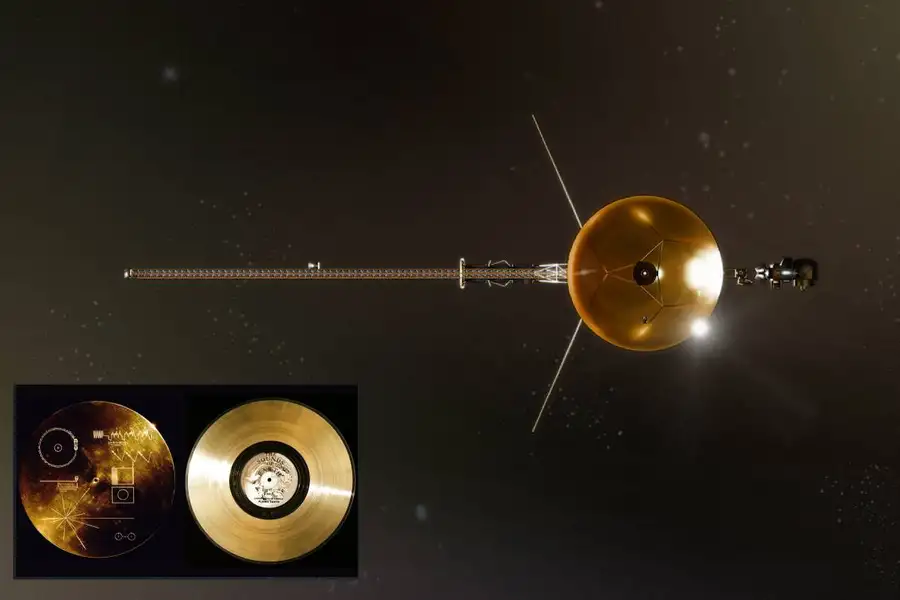
Another unique achievement has been added to the illustrious list of human accomplishments. For the first time, a human-made object has crossed a distance of one light-day! The Voyager 1 spacecraft has achieved this historic feat. One light-day is the distance light travels in 24 hours, which comes to roughly 26 billion kilometres (2,600 crore kilometres).
Voyager 1 is one of the twin spacecraft that form part of NASA's Voyager mission. On November 18, 2026, Voyager 1 crossed the milestone of one light-day. (The next of the twin probes is Voyager 2, which will need to travel for another nine years to cover that same distance). Designed with a lifespan of just five years, the Voyager mission has astonished the world by achieving this historic milestone after 49 years.
As part of the 'Deep Space Network', a radio signal is sent from Earth every day. It is transmitted from one of the sites operating in California, Spain, or Australia. That signal travels beyond the solar system to reach Voyager 1, and the spacecraft sends a reply back! Travelling at the speed of light, the signal now takes 24 hours to travel from Earth to Voyager 1, and the return signal takes just as long to get back here. This process has been repeated for the past half-century. As Voyager 1 travelled further away, the time taken for the signal to reach it and return steadily increased.
When the Voyager probes departed from Earth, the Space Age was not even 20 years old. The world was in the grip of the Cold War. In India, the Emergency had ended only months earlier. Neither mobile phones nor the World Wide Web had been created. Google and social media were things of the distant future.
When Voyager 2 was launched on August 20, 1977 and Voyager 1 on September 5, 1977 from Cape Canaveral in Florida, US (both launched aboard Titan-Centaur rockets), the mission was scheduled to conclude in 1981. Its primary objective was to closely study the outer planets of the solar system: Jupiter, Saturn, Uranus and Neptune.
The first major challenge for Voyager 1 after leaving Earth was crossing the asteroid belt between Mars and Jupiter. It took the spacecraft nine months to traverse it. To conserve power, all scientific instruments aboard the probe were switched off throughout that period.
Voyager 1 began its work by capturing images of Earth's satellite, the Moon. Upon reaching Jupiter in 1979, the spacecraft set off a veritable firework display of discoveries, unleashing a flood of previously unknown information about the solar system.
Among Voyager 1’s most notable discoveries are 23 new moons orbiting the outer planets of the solar system.
In 1979, Voyager 1 transmitted 18,000 images of Jupiter and its moons back to Earth. From those visuals, the scientific world learned with disbelief that active volcanoes existed elsewhere in the solar system besides Earth. The images confirmed active volcanoes on Jupiter's moon Io, with plumes of dust and smoke rising to 30 times the height of Mount Everest.
In 1980, flying past Saturn, Voyager 1 provided a wealth of new data regarding Saturn's rings and moons.
Following the study of Saturn, Voyager Project Scientist Ed Stone and his colleagues made a crucial decision: to divert Voyager 1's trajectory away from the solar system's plane of the planets and send it out of the solar system altogether, while directing Voyager 2 to observe Uranus and Neptune.
In 1990, at a distance of 6 billion kilometres (600 crore kilometres) from Earth, beyond Neptune, Voyager 1 turned back for one final look at its home before shutting off its cameras. In that parting glance, it captured a series of 60 images featuring the Sun, Venus, Earth, Jupiter, Saturn, Uranus, and Neptune.
The most famous among these is the image of Earth known as the 'Pale Blue Dot'. Showing Earth as a tiny, faint blue speck in the vast expanse of the cosmos, the photograph is widely regarded as the ultimate antidote to human arrogance -a poignant reminder of just how insignificant we are.
Voyager 1 also helped accurately measure our home galaxy, the Milky Way. Stars emit 'Lyman-alpha radiation' during their youth when they shine with extreme brightness. While other galaxies can be observed at this wavelength, observing the Milky Way from Earth is difficult due to interference from sunlight.
By 1993, once free from the Sun's glare, Voyager 1 was able to record measurements of the Milky Way at this wavelength. Researchers, however, did not realise it at the time. It was only when Voyager data was re-analysed in 2011 that scientists discovered the spacecraft had recorded the dimensions of the Milky Way in Lyman-alpha radiation.
In 2012, at a distance of 18.1 billion kilometres (1,810 crore kilometres) from the Sun, Voyager 1 exited the Sun's sphere of influence (the heliosphere).
Both Voyager spacecraft are powered by Plutonium-238 'Radioisotope Thermoelectric Generators'. Initially, their output was 315 watts, which decreases by about four watts every year due to radioactive decay.
Voyager 1 is power supply is nearing its end. To conserve energy, all scientific instruments aboard have been switched off except for two (a magnetometer and a plasma wave instrument). These remaining two will also cease functioning before long, ending all communication with Earth.
Golden Record
Even then, the probe will continue its voyage carrying the Golden Record, which bears the imprints of human civilisation. Both Voyager spacecraft carry identical golden phonograph records designed to help any extraterrestrials who might one day encounter them understand Earth. The 12-inch record was the brainchild of Carl Sagan. In addition to telling the story of Earth, these gold-plated copper discs contain greetings in 55 languages, 115 images from Earth, and a variety of Earth's sounds and music.
As Voyager 1 crosses this latest milestone, Ed Stone, who led the Voyager mission for 50 years, is no longer alive to witness it. The scientist, who headed the mission from 1972 to 2022, passed away in 2024.
Based on its current trajectory, Voyager 1 will eventually pass near the star 'Gliese 445', located 17.1 light-years (6,242 light-days) away. Researchers believe there is virtually no chance of the probe colliding with anything in the vast emptiness of space. It is likely to continue its endless journey through interstellar space—though we will never know it.
(Reference and Credits: NASA, New Scientist).
Published: 22 Nov 2026, 02:33 pm IST


Disclaimer: Kindly avoid objectionable, derogatory, unlawful and lewd comments, while responding to reports. Such comments are punishable under cyber laws. Please keep away from personal attacks. The opinions expressed here are the personal opinions of readers and not that of Mathrubhumi.
