
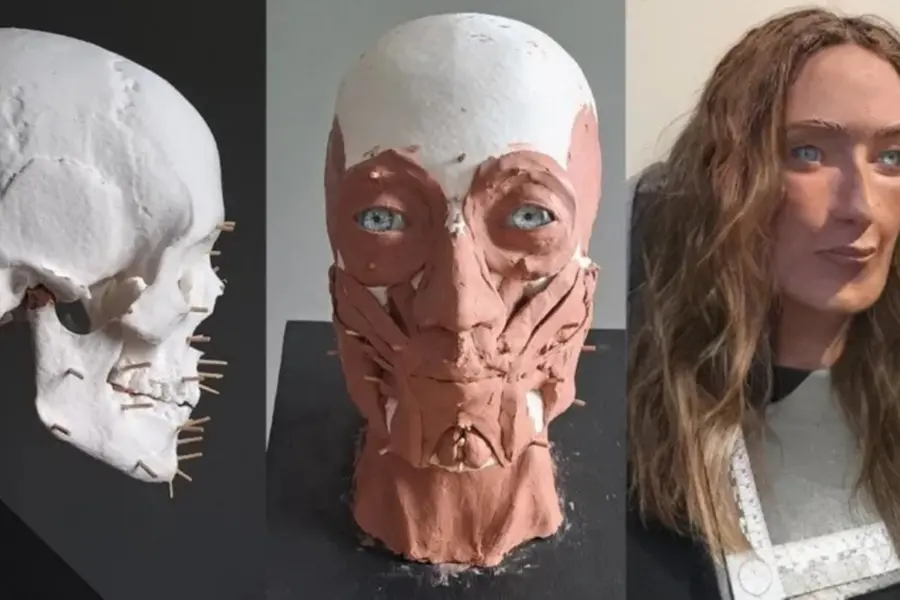
The mysteries of the past have been unveiled with a remarkable reconstruction of a woman who lived in Dorset in South West England nearly 2,000 years ago. Her face, painstakingly recreated from skeletal remains discovered on a cliffside in Kimmeridge Bay, now offers a rare and intimate look at the people who once walked the same lands we do today.
This incredible project was led by Bournemouth bioarchaeologist Amber Manning, who used advanced 3D technology and forensic techniques to give the ancient woman a face for the first time in millennia. The results will soon be on display at Wareham Town Museum, captivating history lovers and curious visitors alike.
In 2000, erosion along the Dorset coast revealed a mystery burial site containing the skeletal remains of a young woman. Archaeologists soon realised they had stumbled upon something extraordinary—a glimpse into life in Britain during the 1st Century AD, a time when the Romans were expanding their influence across the region.
Her remains suggested she was between 20 and 30 years old, with evidence of undernourishment, hinting at the harsh realities of life in ancient Dorset.
To recreate her face, experts used photogrammetry, a technique where hundreds of images from different angles are digitally stitched together to create an exact 3D model of an object—in this case, her skull. The model was then 3D printed, allowing researchers to build a forensic reconstruction that reflects what she may have actually looked like.
"Making a reconstruction, I usually think that we are looking into their world," said Amber Manning, the Bournemouth University master's student behind the project.
She carefully considered key factors like the woman's age, sex, weight, and ethnicity, using scientific data to determine tissue thickness and facial structure. The final result is a hauntingly lifelike representation of a person who lived, breathed, and walked the Dorset coastline thousands of years ago.
Visitors to Wareham Town Museum will soon get the chance to come face-to-face with the past as both the physical and digital reconstructions of the woman’s face go on display from 5 April. The exhibition will also feature details about the archaeological excavation, shedding light on the region’s history and the fascinating process of facial reconstruction.
Dr Martin Smith, associate professor of biological anthropology at Bournemouth University, emphasised the significance of the project:
"We are so happy to display and share some of our findings at Wareham Museum. These discoveries are helping us build an ever more detailed and engaging picture of life during this period."
This reconstruction is more than just an artistic exercise—it is a powerful reminder that history is filled with real people whose lives, struggles, and stories shaped the world we live in today. By bridging archaeology, science, and technology, researchers are allowing us to connect with the past like never before.
Published: 23 Feb 2025, 05:27 pm IST
Related Topics
Disclaimer: Kindly avoid objectionable, derogatory, unlawful and lewd comments, while responding to reports. Such comments are punishable under cyber laws. Please keep away from personal attacks. The opinions expressed here are the personal opinions of readers and not that of Mathrubhumi.
