
One striking feature of the excavation is that the wall above the foundation appears to have been deliberately dismantled to a uniform height.
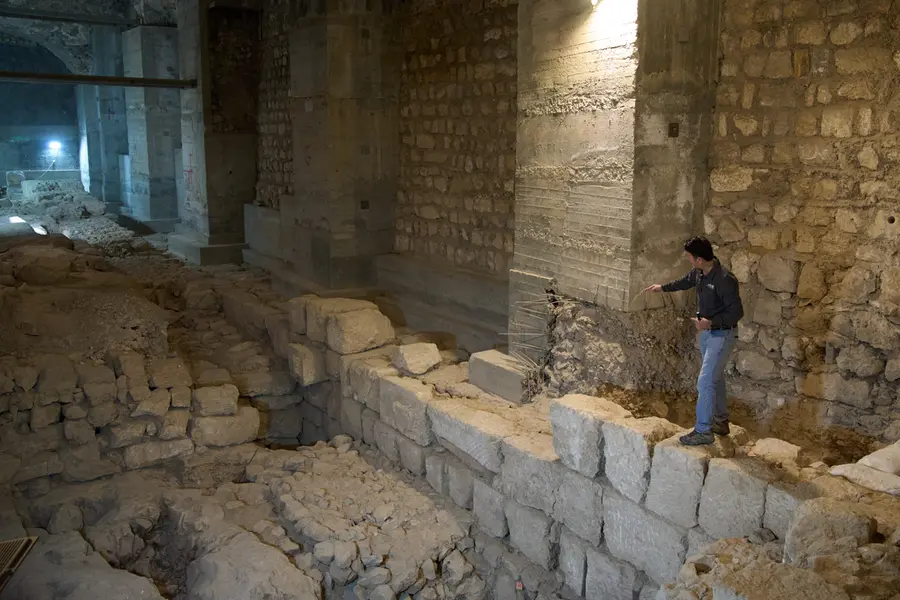
Jerusalem: Archaeologists in Jerusalem have completed the excavation of the longest intact section of an ancient defensive wall dating back more than 2,100 years, possibly offering physical evidence of a historic ceasefire described in ancient texts.
The newly uncovered structure is part of the foundations of the Hasmonean-era walls that once encircled a far larger Jerusalem than the current Old City. The discovery comes just days before Hanukkah, the Jewish festival that commemorates the rededication of the Temple in the second century BC.
The exposed section stretches nearly 50 metres (164 feet) and spans around 5 metres (16 feet) in width. Archaeologists believe it originally supported towering fortifications that surpassed the height of the present-day Ottoman-era walls surrounding Jerusalem’s Old City. Historical accounts say the Hasmonean fortifications once included some 60 watchtowers, each more than 10 metres (33 feet) tall.
One striking feature of the excavation is that the wall above the foundation appears to have been deliberately dismantled to a uniform height. This controlled deconstruction, rather than damage caused by conflict or time, has intrigued experts.
Dr Amit Re’em of the Israel Antiquities Authority, one of the project’s lead archaeologists, said ancient writings may hold the answer. Citing the historian Flavius Josephus, he noted that in 132–133 BC, Hellenistic King Antiochus VII besieged Jerusalem. As Judean forces weakened, Jewish ruler John Hyrcanus I negotiated a deal.
According to Josephus, Hyrcanus raided King David’s tomb to raise 3,000 talents of silver and offered 500 hostages, including his own brother, to secure a ceasefire.
“Antiochus Sidetes (the Seventh) reached a ceasefire agreement with John Hyrcanus, saying, if you want me to remove my army, you yourself, the Jewish king, must raze to the ground the Hasmonean fortification that you and your father built,” Re’em said. Josephus wrote that after the pact was sealed, they “pulled down the walls encircling the city.”
“We just think that we found the archaeological proof for it, so it’s pretty amazing, the archaeology and the ancient stories combining together. This is the magic of Jerusalem,” Re’em added.
However, not all experts agree with this interpretation. Some believe the dismantling may instead be linked to King Herod, who ruled decades later.
Orit Peleg-Barkat, head of classical archaeology at the Hebrew University of Jerusalem, said the section may have been removed to make way for Herod’s palace. She noted that other parts of the Hasmonean wall found elsewhere in Jerusalem were not dismantled. “It’s unlikely that Jerusalem was left unprotected without any security walls for more than a century,” she said.
The wall section was discovered beneath an abandoned wing of the Kishleh, an 1830 military building later used as a prison, including during the British Mandate era. Graffiti etched by former inmates in Hebrew, Arabic and English still marks its walls, and remnants of iron bars remain on the ceilings.
Excavations began in 1999 but were halted during the Second Intifada. Work resumed two years ago, and archaeologists spent that period manually removing dirt and debris equivalent to two Olympic-sized swimming pools. Alongside the Hasmonean foundations, the dig revealed medieval dye pits believed to have been used for fabric production.
The area is now set to form part of the Tower of David Museum’s new Schulich Wing of Archaeology, Art and Innovation. A floating glass floor will eventually allow visitors to view the ruins from above. Renovations are expected to take at least two years following the excavation’s completion.
Published: 09 Dec 2025, 09:46 pm IST
Related Topics
Disclaimer: Kindly avoid objectionable, derogatory, unlawful and lewd comments, while responding to reports. Such comments are punishable under cyber laws. Please keep away from personal attacks. The opinions expressed here are the personal opinions of readers and not that of Mathrubhumi.
