
Dated June 28, 1456, the inscription, a land grant, unexpectedly mentions a bright celestial object, matching Halley's Comet's appearance that year
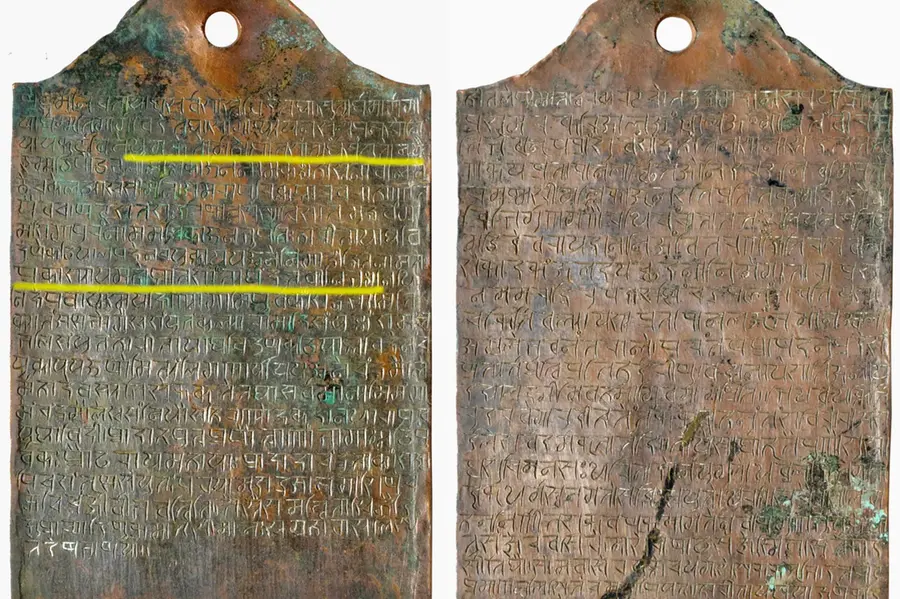
A recent discovery at the Mallikarjuna Swamy Temple in Srisailam, Andhra Pradesh, has shed light on a fascinating link between ancient Indian astronomy and one of the most well-known celestial phenomena; Halley’s Comet.
According to reports, a 15th-century copper plate inscription has now been confirmed as India’s first known epigraphic reference to the comet, dated precisely to 28 June 1456 CE.
A remarkable find from the Vijayanagara empire
The inscription, etched on a durable copper plate, was issued during the rule of Vijayanagara king Mallikarjuna. It served primarily as a legal land grant issued to a Vedic scholar, which was common practice at the time. However, what makes this particular document stand out is not just its legal content but its unexpected reference to a celestial phenomenon, something bright and unusual that lit up the sky.
Amid the formal declarations, historians noted the mention of a brilliant object in the heavens. Astronomers were quick to correlate this description with the known historical appearance of Halley’s Comet in summer 1456, a sight that had also been observed and recorded across Europe and Asia.
A perfect match: Astronomy meets epigraphy
The date mentioned in the inscription, śaka 1378, dhātr̥ āṣāḍha ba. 11, translates exactly to 28 June 1456 CE, the same day Halley’s Comet was seen streaking across the skies. This rare match between a traditional Indian calendar date and modern astronomical data is what confirms the identity of the object mentioned.
Though ancient Indian texts such as the Ṛigveda, Atharvaveda, and Bṛhat Saṃhitā contain symbolic or metaphorical references to comets often viewing them as omens or cosmic messages, this copper plate offers something new.
It is the first direct, date-specific reference to a cometary event, now scientifically verified.
Classical languages, cosmic themes
Written in classical Telugu and Sanskrit, the inscription blends royal authority, religious context, and scientific observation in a single narrative. This combination shows how astronomy was not separate from everyday life, but instead a part of how people understood the world, even in legal documents.
As the document was a land grant, the mention of the comet likely held symbolic value, possibly as an omen or significant event worthy of being noted in royal records. The fact that it made its way into such a formal text shows how seriously such phenomena were taken.
Why this matters today
This is not just an archaeological curiosity. It provides strong evidence that scholars in 15th-century India were observing the skies carefully and recording what they saw. It demonstrates a high level of scientific understanding during the Vijayanagara period, a time better known for its temples and empire-building than for astronomy.
The fact that this comet sighting is preserved in copper, not just remembered in oral tradition or literature, points to a systematic effort to document the cosmos, not unlike what scientists do today.
A glimpse into the past and the Stars
The inscription is more than a legal note; it’s a reminder of India’s rich tradition of sky-watching. As we continue to study the stars using satellites and space telescopes, it’s remarkable to remember that centuries ago, observers without modern tools were also watching, recording, and reflecting on what they saw above.
‘The ‘Pharaoh’s Curse’ may have given us potential cancer cures, but India’s 15th-century sky watchers have given us something equally profound, a comet's trail through time, etched in copper and confirmed by modern science.’
Published: 24 Jun 2025, 10:45 pm IST
Related Topics
Disclaimer: Kindly avoid objectionable, derogatory, unlawful and lewd comments, while responding to reports. Such comments are punishable under cyber laws. Please keep away from personal attacks. The opinions expressed here are the personal opinions of readers and not that of Mathrubhumi.
