
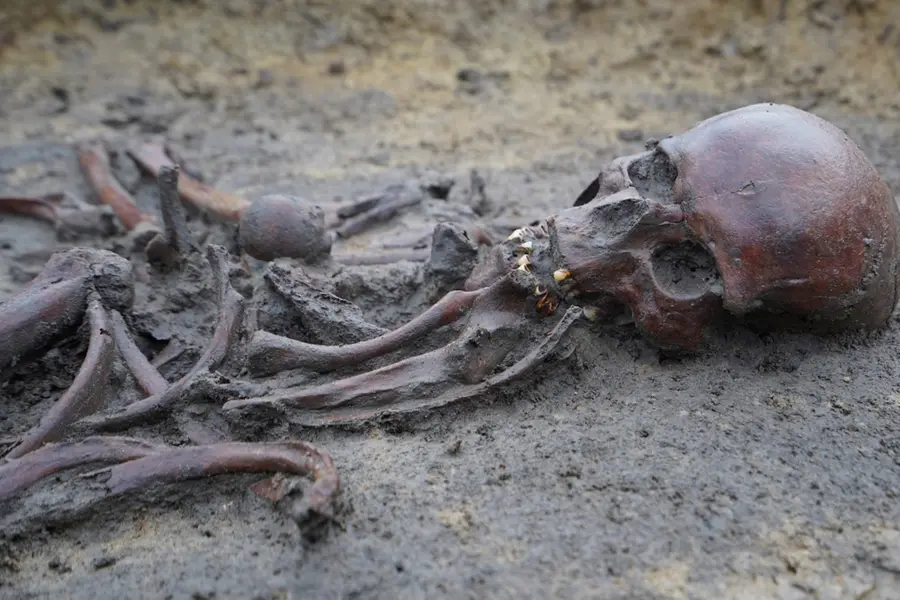
Aasum, Denmark: Archaeologists in a village in central Denmark have made a significant discovery: a burial ground containing around 50 “exceptionally well-preserved” skeletons from the Viking era. This site was found last year during a routine survey for power line renovations near the village of Aasum, about 5 kilometres (3 miles) northeast of Odense, Denmark's third-largest city.
“This is such an exciting find because we found these skeletons that are so very, very well preserved,” said archeologist Michael Borre Lundø, who led the six-month dig. “Normally, we would be lucky to find a few teeth in the graves, but here we have entire skeletons.”
Experts from Museum Odense believe the skeletons have remained well-preserved due to the favourable soil conditions, particularly the chalky soil and high water levels. They plan to conduct DNA analyses and explore the life histories of those buried there, along with studying social patterns from the Viking Age, including kinship and migration.
“This opens a whole new toolbox for scientific discovery,” said Borre Lundø as he stood on the muddy, wind-swept excavation site. “Hopefully we can make a DNA analysis on all the skeletons and see if they are related to each other and even where they come from.”
The Viking Age, spanning from 793 to 1066 A.D., saw Norsemen, known as Vikings, engaging in raids and trade across Europe, even reaching North America. However, the individuals buried at Aasum were likely not warriors. Archaeologist Borre Lundø suggests the site may have been a typical farming community, located 5 kilometres from a nearby ring fortress.
Covering an area of 2,000 square metres (21,500 square feet), the burial ground contains the remains of men, women, and children, along with a few cremated bodies. Notably, one grave contained a woman buried in a wagon, indicating she may have belonged to the “upper part of society.”
In addition to the skeletons, archaeologists discovered brooches, necklace beads, knives, and a small piece of glass that could have been used as an amulet. The designs of the brooches suggest the burials took place between 850 and 900 A.D. “There’s different levels of burials,” he explained. “Some have nothing with them, others have brooches and pearl necklaces.” Many artefacts were sourced from far beyond Denmark, highlighting the extensive trade routes the Vikings operated during the 10th century.
“There’s a lot of trade and commerce going on,” said Borre Lundø. “We also found a brooch that comes from the island of Gotland, on the eastern side of Sweden, but also whetstones for honing your knife … all sorts of things point to Norway and Sweden.”
The excavation began in April and concluded recently. Artefacts have been sent to Museum Odense’s preservation labs for cleaning and analysis. Conservator Jannie Amsgaard Ebsen hopes the soil may also yield additional preserved organic materials attached to the artefacts.
“We’re really hoping to gain the larger picture. Who were the people that were living out there? Who did they interact with?” she said. “It’s a little bit like a jigsaw puzzle: all the various puzzle parts will be placed together.”
Agency
Published: 15 Oct 2024, 02:44 pm IST
Related Topics
Disclaimer: Kindly avoid objectionable, derogatory, unlawful and lewd comments, while responding to reports. Such comments are punishable under cyber laws. Please keep away from personal attacks. The opinions expressed here are the personal opinions of readers and not that of Mathrubhumi.
