
A fresh fleet of Su-34 fighter-bombers has been delivered to the Russian military, fully tested and combat-ready.
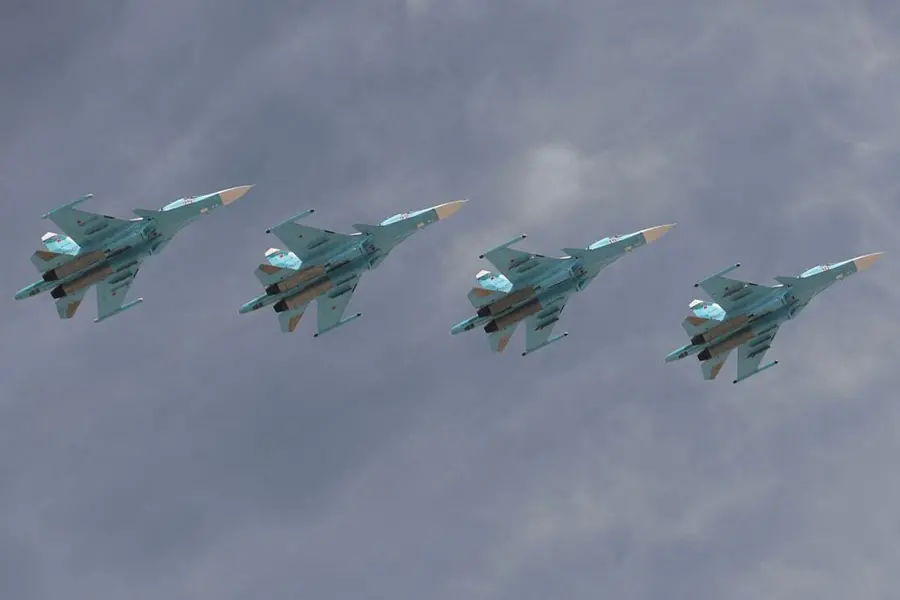
Rostec’s United Aircraft Corporation (UAC) has delivered a new batch of Su-34 fighter-bombers to the Russian Ministry of Defence, now inducted into the operational-tactical aviation fleet of the Russian Aerospace Forces (VKS).
The manufacturer said the aircraft completed a full cycle of factory testing, including checks in various operational modes, before being flown to their designated airbase.
Meanwhile, Russia has reportedly begun producing its upgraded Su-34M fighter-bomber for export, with Algeria expected to be among the first buyers. Recent imagery shows Su-34Ms painted in desert camouflage consistent with Algerian terrain, pointing to growing international interest.
Defence Blog reported that an Su-34M in export configuration was spotted at Zhukovsky Airport near Moscow on August 8, sparking speculation that Russia is advancing long-delayed defence deals with Algiers. In December 2019, Algerian defence outlets reported agreements for 42 aircraft — 14 Su-34MEs, 14 Su-57Es, and 14 Su-35Es — with deliveries originally scheduled to be completed by 2025.
Origins and development
Russia’s Su-34, also known by NATO as the Fullback, is a modern fighter-bomber designed to replace ageing Soviet aircraft and enhance the country’s combat aviation capabilities. Developed by the Sukhoi Design Bureau, the Su-34 is a versatile and heavily armed platform that blends the attack strengths of earlier models with the ability to engage in air-to-air combat.
The Su-34’s roots trace back to the 1980s, when the Soviet Union sought a successor to the Su-24 Fencer and MiG-27 Flogger bombers, both considered outdated by that time. Engineers based the design on the twin-seat Su-27UB, allowing the aircraft to carry both a pilot and a weapons systems officer. The first prototype, known as T-10V-1, took flight in 1990.
However, the disintegration of the Soviet Union in 1991 plunged the programme into uncertainty. Economic turmoil and defence budget cuts delayed production for over a decade, with the first pre-production units only rolling out in the mid-2000s. It was not until 2014 that the Su-34 officially entered service with the Russian Aerospace Forces, benefitting from advances in aerospace technology made during the development pause.
Design and capabilities
According to the National Security Journal, the Su-34 is a two-engine, two-seat supersonic fighter-bomber with a distinctive flat nose, earning it nicknames like “platypus” or “duckling” among Russian crews. At nearly 22 metres in length and with a wingspan of 14.7 metres, it is a relatively large aircraft capable of carrying heavy payloads exceeding 8,500 kilograms.
The Su-34 is engineered to engage ground, surface, and airborne targets at extended ranges, including those shielded by advanced air defence systems. It is capable of functioning effectively under enemy fire and electronic warfare conditions, day or night, and in diverse weather environments. Additionally, the aircraft is capable of performing aerial reconnaissance missions.
Its arsenal is one of the most extensive for precision-guided munitions, including satellite-guided bombs, various air-to-ground missiles, and glide bombs such as the Grom-2. The aircraft is also equipped to defend itself in air combat, carrying a wide range of air-to-air missiles.
The Su-34’s cockpit is pilot-friendly and heavily armoured to protect the crew during combat. The advanced Platan electro-optical targeting system combines television cameras with laser designators, enhancing the accuracy of precision strikes. An impressive electronic warfare suite enables the aircraft to jam enemy radar and disrupt incoming missiles.
Powering the aircraft are two Saturn AL-31FM1 turbofan engines, similar to those on the Su-27SM, allowing a maximum speed of Mach 1.8. While slower than the Su-27 Flanker’s Mach 2.35, the Su-34 balances speed with payload and survivability.
Strengths and limitations
Though designed as a multi-role platform capable of performing both ground strikes and air superiority missions, the Su-34 pays a price for its heavy armour and weapon load. It is less manoeuvrable and slower than many frontline fighters such as the American F-15 Eagle and F-16 Fighting Falcon, which it was originally intended to challenge.
The aircraft’s relatively high mass and lack of stealth features limit its effectiveness against modern air defences. During Russia’s recent operations in Syria, the Su-34 demonstrated strong performance in ground-attack roles, where air defences were less advanced. However, in the ongoing conflict in Ukraine, the aircraft has faced difficulties penetrating sophisticated multi-layered defences, limiting its ability to gain air superiority.
Ukrainian drone and missile strikes have damaged or destroyed Su-34s on the ground, leading Russian forces to reposition these jets further from frontlines and restrict their direct involvement over contested airspace. Instead, Su-34s now primarily launch cruise missiles and glide bombs from safer distances.
Operational use and export prospects
The Su-34 remains one of the heaviest and longest-range fighter-bombers in production worldwide. It boasts a combat range of up to 4,000 kilometres with a full weapons load and can extend this distance through aerial refuelling. Its design includes three lifting surfaces — main wings, canards, and a conventional horizontal tail — providing enhanced lift and control.
Published: 12 Aug 2025, 08:30 pm IST
Related Topics
Disclaimer: Kindly avoid objectionable, derogatory, unlawful and lewd comments, while responding to reports. Such comments are punishable under cyber laws. Please keep away from personal attacks. The opinions expressed here are the personal opinions of readers and not that of Mathrubhumi.
