
President Donald Trump has threatened to invoke the rarely used Insurrection Act to deploy federal troops in Minneapolis amid escalating protests against ICE operations.
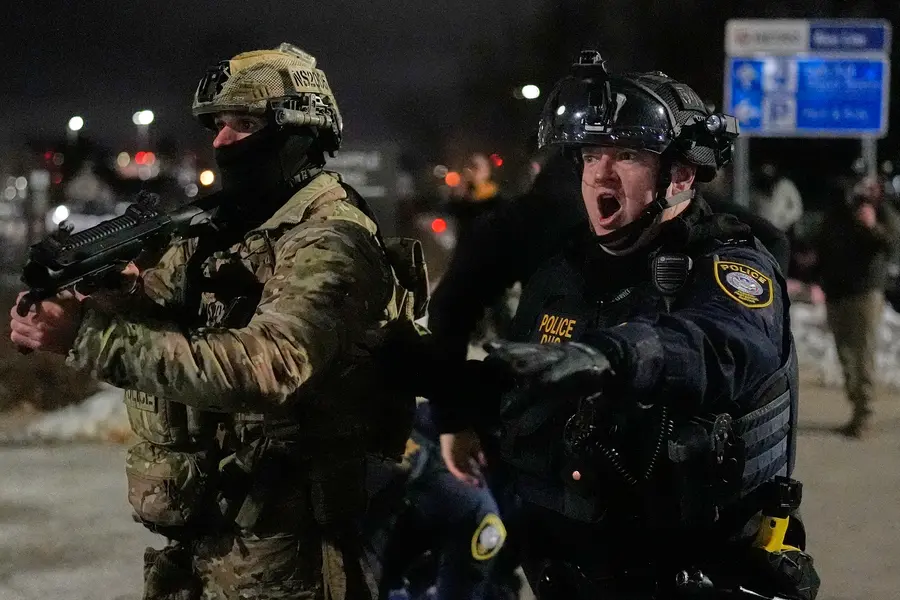
Tensions in Minnesota surged this week after President Donald Trump threatened to invoke the Insurrection Act, a centuries-old statute that would permit the deployment of military forces on US soil to quell escalating protests against federal immigration operations in Minneapolis.
The warning came as anger intensified over a series of confrontations involving Immigration and Customs Enforcement (ICE) officers, including two recent shootings – one of which killed Renee Nicole Good on 7 January. The unrest has thrust renewed national attention on the rarely used law and the sweeping domestic powers it grants the presidency.
In a social-media post, Trump said: “If the corrupt politicians of Minnesota don’t obey the law and stop the professional agitators and insurrectionists from attacking the Patriots of I.C.E., who are only trying to do their job, I will institute the INSURRECTION ACT, which many Presidents have done before me, and quickly put an end to the travesty that is taking place in that once great State.”
Minnesota leaders swiftly pushed back. Governor Tim Walz appealed directly to the president, “Let’s turn the temperature down. Stop this campaign of retribution. This is not who we are.” State Attorney General Keith Ellison vowed to fight any move in court.
As federal agents clash with demonstrators and local officials plead for restraint, questions have resurfaced about what the Insurrection Act actually does – and why it is one of the most controversial authorities in American law.
What is the Insurrection Act?
The Insurrection Act traces its origins to 1807, though the modern law is an amalgamation of statutes passed between 1792 and 1871. It authorises the president to deploy active-duty troops or federalised National Guard units domestically without seeking approval from Congress.
Under the law, a president may use the military to address “unlawful obstructions, combinations or assemblages or rebellion” that hinder the enforcement of federal or state laws. Once such conditions are declared, the military can carry out law-enforcement actions otherwise prohibited under federal statutes, including making arrests and conducting searches.
While commonly referred to as the Insurrection Act of 1807, it functions today as a family of provisions codified under 10 U.S.C. §§ 251–255.
Also read: Massive data breach allegedly leaks personal details of ICE, Border Patrol agents: What’s ICE List?
How is it different from other military deployments?
Presidents can federalise the National Guard through other legal mechanisms, such as Section 12406 of Title 10 – a statute Trump relied on when he sent guard units to several US cities during previous periods of unrest.
But Section 12406 does not permit troops to perform civilian policing. They may protect federal buildings and personnel but cannot arrest civilians.
The Insurrection Act, however, explicitly allows military forces to carry out law-enforcement duties. Because of that, it is considered one of the strongest domestic authorities available to an American president.
Why is the law controversial?
The United States has a long tradition of insulating civilian life from military involvement, a principle reflected in the Posse Comitatus Act of 1878, which bars the armed forces from policing the public. The Insurrection Act acts as an exception to that rule.
Civil liberties advocates warn that the law grants broad discretion to the executive branch, potentially enabling a president to use the military to suppress dissent. Critics also note that the Constitution reserves primary responsibility for maintaining public order to state governments, making unilateral federal intervention deeply contentious.
How often has the Insurrection Act been used?
The Insurrection Act has been invoked more than two dozen times since the 1800s, though its use has declined sharply in recent decades. Most deployments occurred during the civil-rights era, when presidents enforced desegregation orders against the wishes of state officials.
The last invocation came in 1992, when President George HW Bush sent troops to Los Angeles at the request of California’s governor following the Rodney King verdict. In contrast, President George W Bush declined to use it after Hurricane Katrina in 2005 due to opposition from Louisiana’s governor.
Trump considered invoking the law in 2020 amid nationwide protests after the killing of George Floyd but ultimately did not do so.
Can Trump send in troops without Minnesota’s approval?
Yes. Although historically presidents have coordinated with governors when using the law, the statute allows unilateral action if the president determines that a state is unwilling or unable to uphold constitutional rights or enforce federal law.
Minnesota officials argue that aggressive federal immigration operations have fuelled the unrest. Minneapolis Mayor Jacob Frey said: “This is not sustainable … This is an impossible situation that our city is presently being put in.”
The Department of Homeland Security says its Metro Surge operation has resulted in more than 2,500 arrests since late November and has deployed nearly 2,000 officers to the Twin Cities area.
Also read: Actor vs Prez: Mark Ruffalo calls Trump ‘worst human being’, White House retorts with 'worst actor'
What can the courts do?
Courts have traditionally shown significant deference to presidents on military deployment decisions. The 9th US Circuit Court of Appeals recently reiterated that such actions warrant a “great level of deference.” Still, judges have occasionally scrutinised executive claims.
An Oregon federal judge ruled last year that deference does not mean ignoring “the facts on the ground” when reviewing federalised troop activity under alternative legal authorities.
Legal analysts say a court challenge to an Insurrection Act invocation could proceed, though stopping a deployment would be difficult.
Insurrection Act vs martial law
Despite frequent confusion, the Insurrection Act is not martial law.
Martial law involves replacing civilian governance with military authority, suspending civilian courts, and sometimes enabling trial by military tribunal. It has no single statutory basis and has been declared only in extreme circumstances, such as during the Civil War and in Hawaii during the Second World War.
The Insurrection Act, by contrast, preserves civilian government and courts. It merely permits the military to assist with law enforcement under tightly defined statutory conditions.
What could the military do – and what can’t it do?
If invoked, troops could perform federal law-enforcement duties such as making arrests, controlling crowds, establishing blockades, or detaining individuals suspected of obstructing federal law.
However, the authority is not unlimited. Military forces cannot enforce state or municipal laws, and they remain bound by constitutional constraints.
As Joseph Nunn of the Brennan Center told Forbes, troops may enforce federal law, but “there is no circumstance in which the President can deploy the military into a city and a state like New York or Chicago and direct the military to enforce state and local law.”
Minneapolis confrontations intensify
Federal agents and protesters have clashed repeatedly in Minneapolis in recent days. On Wednesday night, officers in gas masks fired tear gas at demonstrators after a chaotic street confrontation. Protesters hurled rocks and set off fireworks in response.
Earlier that day, an ICE officer shot and wounded a man after being attacked with a shovel and broom handle, according to the Department of Homeland Security. The agency said the officer “fired a defensive shot to defend his life.” Police chief Brian O’Hara said the injury was not life-threatening.
Federal vehicles were damaged and vandalised during the response, prompting the FBI to offer a reward of up to $100,000 for information.
Meanwhile, the ACLU of Minnesota has filed a class-action lawsuit on behalf of three U.S. citizens – two Somali, one Hispanic – who say they were unlawfully questioned or detained in recent days. DHS has not publicly responded.
(With inputs from agencies)
Published: 16 Jan 2026, 10:17 am IST
Related Topics
Disclaimer: Kindly avoid objectionable, derogatory, unlawful and lewd comments, while responding to reports. Such comments are punishable under cyber laws. Please keep away from personal attacks. The opinions expressed here are the personal opinions of readers and not that of Mathrubhumi.
