
A spooked Pakistan is looking to wriggle out of the sinkhole its armed minions created in South Kashmir's Pahalgam under the supervision of the terror messiahs on its soil and the country's notorious espionage agency Inter-Services Intelligence.
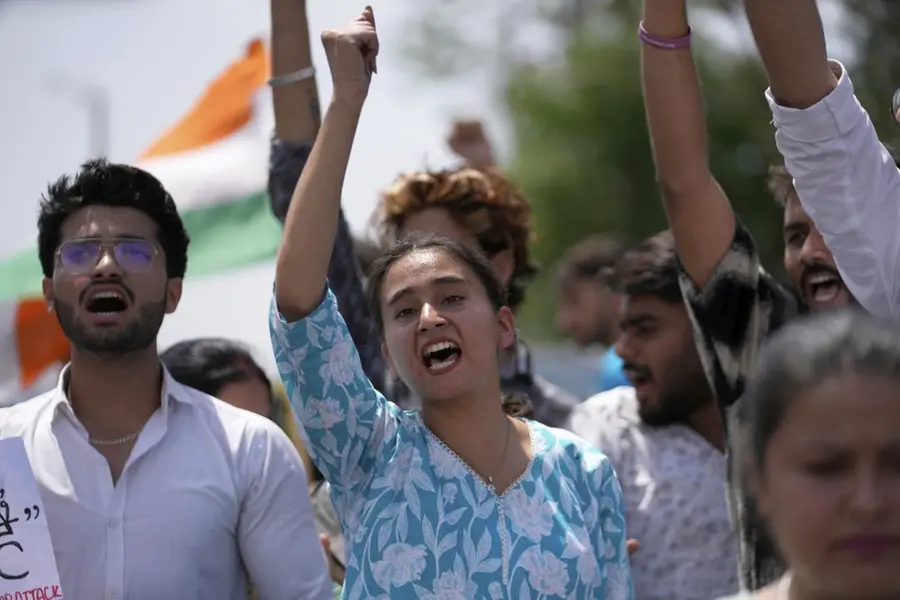
There is seething anger across India over the dastardly killing of 26 innocents on holiday in the scenic tourist destination of Pahalgam. The need to stike and strike hard on terror infrastructure echoes once again throughout the country.
Also Read
The last time such anger boiled over was in the aftermath of the 2019 Pulwama terror attack, and that culminated in Indian fighter aircraft obliterating terror infrastructure inside Pakistani territory.
Wary of a similar retaliation post Pahalgam, Pakistan has re-activated its redundant propaganda machinery. This PR toolkit is now floating conspiracy theories like India targetting its own people and even linking the attack with the visit of US Vice President JD Vance to India.
And then there's the Kashmir card that Islamabad loves harping on. Post-Pahalgam, Islamabad sought to set the narrative that the attack was an attempt by the Narendra Modi government and the Indian Army to divert attention from policy failures in Kashmir.
Islamabad is already asking for proof of its involvement in terror attacks, exactly the same way it has in the past when Pakistan-trained terrorists have crossed over into India to unleash mayhem and bloodshed through cowardly acts of terror.
Comfortably forgotten is the fact that merchants of death continue to have a free run on the streets of Pakistan. How can Islamabad claim innocence when Saifullah Khalid aka Saifullah Kasuri, the deputy chief of Hafiz Saeed's Lashkar-e-Taiba and whose presence in Pakistan is well-documented, plotted the Pahalgam attack?

How can Islamabad claim innocence when just days before the Pahalgam attack, Lashkar-e-Taiba commander Abu Musa called for jihad and bloodshed in Kashmir at a rally in Rawalkot's Khai Gala in Pakistan-occupied Kashmir? Musa, who is believed to be the head of purported Jammu Kashmir United Movement (JKUM), made the remarks during the memorial held for two Lashkar terrorists who were gunned down by Indian forces.
A video from the event has been circulating on social media and verified by Indian intelligence agencies. In the video, Musa is heard declaring, 'India removed Article 370 and 35A to change the demography. You deployed your 10 lakh army. You wanted to echo 'Ram Ram' in Pulwama, Poonch, Rajouri. Lashkar-e-Taiba accepts your challenge. Modi, inside your closed courtrooms, you passed your orders. But the battlefield belongs to the mujahideen. Try it -- Inshallah, we will shower bullets, slit your necks, and honour the sacrifices of our martyrs.'
Lastly, how can Islamabad claim innocence when Pakistan Army Chief Asim Munir seemingly emboldened Jihadis with his "jugular vein" reference to Kashmir. He told a gathering, "Our stance is absolutely clear, it was our jugular vein, it will be our jugular vein, we will not forget it. We will not leave our Kashmiri brothers in their heroic struggle."
Time and again, Pakistan has proved that it is only furthering its own selfish interest in the name of standing of Kashmiris. It has used the Kashmir card for mudslinging and garnering Dollars to support its failing economy. At the same time, its terror factories has been churning out mercenaries whose bullets know no faith.
Pakistan is worried, and it should be. The Pahalgam attack has reopened old wounds. Prime Minister Modi and Home Minister Amit Shah have equivocally declared that the country would not bend before terror, and that those behind the dastardly terror attack will not be spared. "We will come down heavily on the perpetrators with the harshest consequences," said Shah.
Options are open before India. It has dealt with terror with an iron first in the past, and is unlikely to change its stance post Pahalgam.
Pakistani Defence Minister Khawaja Asif may blame "home-grown revolutions" within India for the Pahalgam attacks. He has been shouting from the rooftop that his country "does not support terrorism under any circumstances" and that his country's "national policy clearly prohibits targeting non-combatants". But his country's track-record has time and again proved -- often in bloody barbaric ways -- otherwise.
Published: 23 Apr 2025, 04:12 pm IST
Disclaimer: Kindly avoid objectionable, derogatory, unlawful and lewd comments, while responding to reports. Such comments are punishable under cyber laws. Please keep away from personal attacks. The opinions expressed here are the personal opinions of readers and not that of Mathrubhumi.