
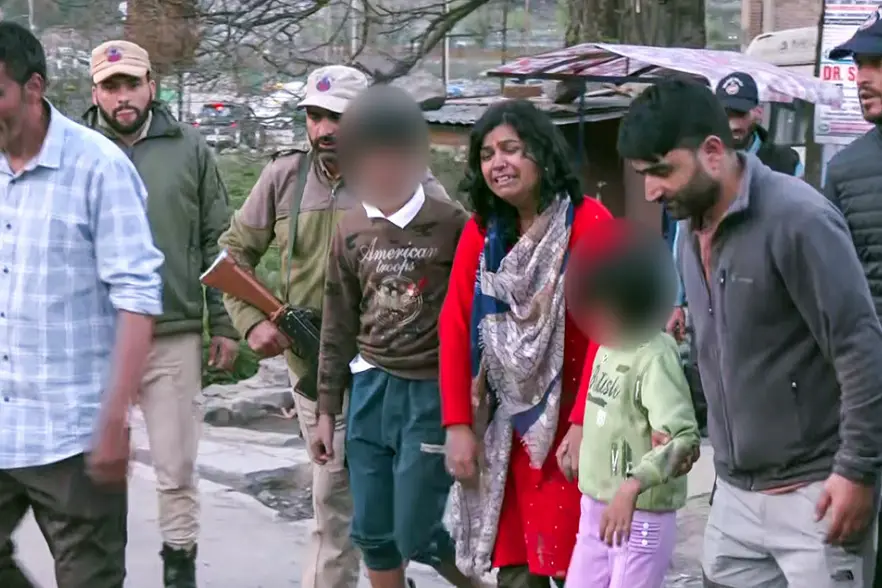
The Resistance Front (TRF), a banned terrorist organization and offshoot of Pakistan-based Lashkar-e-Taiba (LeT), claimed responsibility for Tuesday’s terror attack in Pahalgam, that left 26 people dead.
The attack occurred while US Vice President JD Vance was visiting India and Prime Minister Narendra Modi was on a state visit to Saudi Arabia. Following the incident, Modi cut short his visit and returned to Delhi early Wednesday morning.
Also Read

In a statement circulated on social media, TRF cited alleged demographic changes in Jammu and Kashmir as justification for the violence. The group claimed that the issuance of more than 85,000 domicile certificates to non-locals was an attempt to alter the region's demographics, warning that violence would target those "attempting to settle illegally." The authenticity of the statement is yet to be independently verified.
What is The Resistance Front?
The Resistance Front (TRF) emerged in the aftermath of the abrogation of Article 370 in August 2019. It is widely recognized as a proxy arm of Lashkar-e-Taiba, created to give militancy in Kashmir a more "localized" appearance. TRF was founded in October 2019, with Sheikh Sajjad Gul as its Supreme Commander and Basit Ahmed Dar as its Chief Operational Commander. The group initially drew cadres from Hizbul Mujahideen and LeT.
Sajjad Gul, born on October 10, 1974, in Srinagar, was designated a terrorist by the Indian government in 2022. According to official data, 108 out of 172 terrorists neutralized in Jammu and Kashmir in 2022 were linked to TRF.
In January 2023, India's Ministry of Home Affairs (MHA) formally banned TRF under the Unlawful Activities (Prevention) Act (UAPA), describing its activities as "detrimental to the national security and sovereignty of India." The ministry also noted that TRF engages heavily in psychological warfare on social media to incite violence and recruit new members.
A Record of Brutal Attacks
TRF first drew major attention during a fierce encounter near the Line of Control in Kupwara’s Keran Sector in April 2020, where five infiltrators from Pakistan-occupied Kashmir were neutralized after a four-day battle that also claimed the lives of five Indian soldiers.
The group also claimed responsibility for an attack in October 2024 at a construction site in Jammu and Kashmir’s Ganderbal district, killing a local doctor and six migrant laborers. The attack in Pahalgam follows a pattern of targeting both Kashmiris and non-Kashmiris to discourage integration efforts and development initiatives.
Following past attacks, TRF has released propaganda calling for continued "resistance" against non-local businesses and the issuance of domicile certificates. Their slogan, "Resistance till Victory," underlines their ongoing separatist agenda.
Key figures in the TRF network include Sajid Jatt, Sajjad Gul, and Salim Rehmani -- all closely linked to Lashkar-e-Taiba.
Security agencies remain on high alert as investigations continue into the Pahalgam attack, and efforts are underway to dismantle TRF’s operating modules within the region.
Published: 22 Apr 2025, 08:04 pm IST
Related Topics
Disclaimer: Kindly avoid objectionable, derogatory, unlawful and lewd comments, while responding to reports. Such comments are punishable under cyber laws. Please keep away from personal attacks. The opinions expressed here are the personal opinions of readers and not that of Mathrubhumi.