
These innovative materials, created since 1989, feature large internal spaces allowing gases and chemicals to pass through
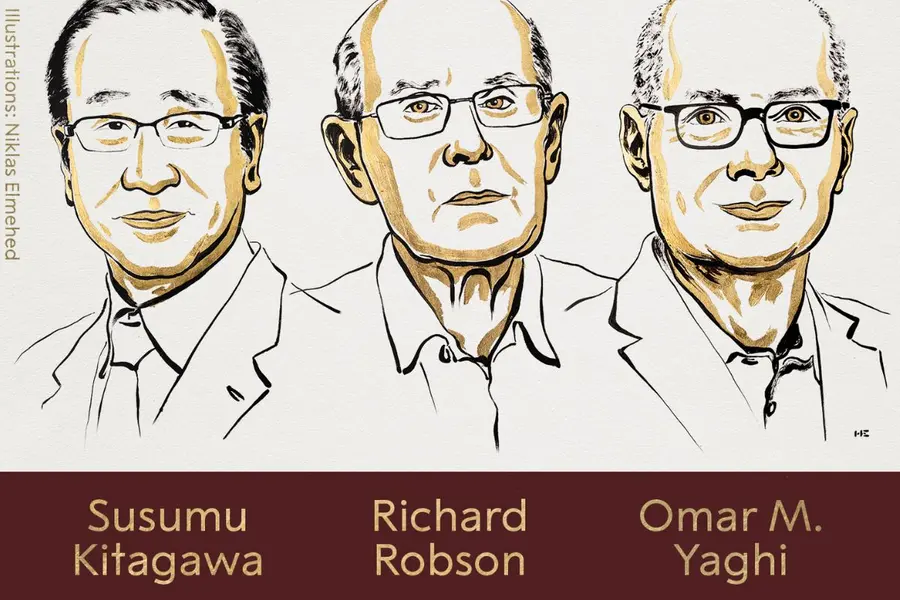
Susumu Kitagawa, Richard Robson, and Omar M. Yaghi have been awarded the 2025 Nobel Prize in Chemistry for their pioneering work on metal–organic frameworks (MOFs), a development dating back to 1989. The Royal Swedish Academy of Sciences announced the prize in Stockholm on Wednesday, marking it as this week’s third Nobel announcement.
Hans Ellegren, secretary-general of the academy, highlighted the significance of their work, saying the laureates "have created molecular constructions with large spaces through which gases and other chemicals can flow." The Nobel Committee said these frameworks can be used to harvest water from desert air, capture carbon dioxide, store toxic gases, or catalyse chemical reactions.
Also Read

Robson, 88, is affiliated with the University of Melbourne in Australia; Kitagawa, 74, with Kyoto University in Japan; and Yaghi, 60, with the University of California, Berkeley. The trio’s research revolutionised how chemists understand and design materials with specific functions. According to Heiner Linke, chair of the Nobel Committee for Chemistry, “Metal-organic frameworks have enormous potential, bringing previously unforeseen opportunities for custom-made materials with new functions.”
The 2025 Chemistry Prize follows other Nobels announced earlier this week, with the medicine prize awarded to Mary E. Brunkow, Fred Ramsdell, and Shimon Sakaguchi, and the physics prize to John Clarke, Michel H. Devoret, and John M. Martinis.
This year's Nobel Prize ceremony is scheduled for December 10, the anniversary of Alfred Nobel's death. Nobel, a Swedish industrialist and inventor of dynamite, established the prizes to honour those who have brought the greatest benefit to humanity.
With inputs from AP
Published: 08 Oct 2025, 03:51 pm IST
Related Topics
Disclaimer: Kindly avoid objectionable, derogatory, unlawful and lewd comments, while responding to reports. Such comments are punishable under cyber laws. Please keep away from personal attacks. The opinions expressed here are the personal opinions of readers and not that of Mathrubhumi.