
DIET has developed the equipment design and experimental systems and plans to collaborate with startups to manufacture and supply the kits on a larger scale.
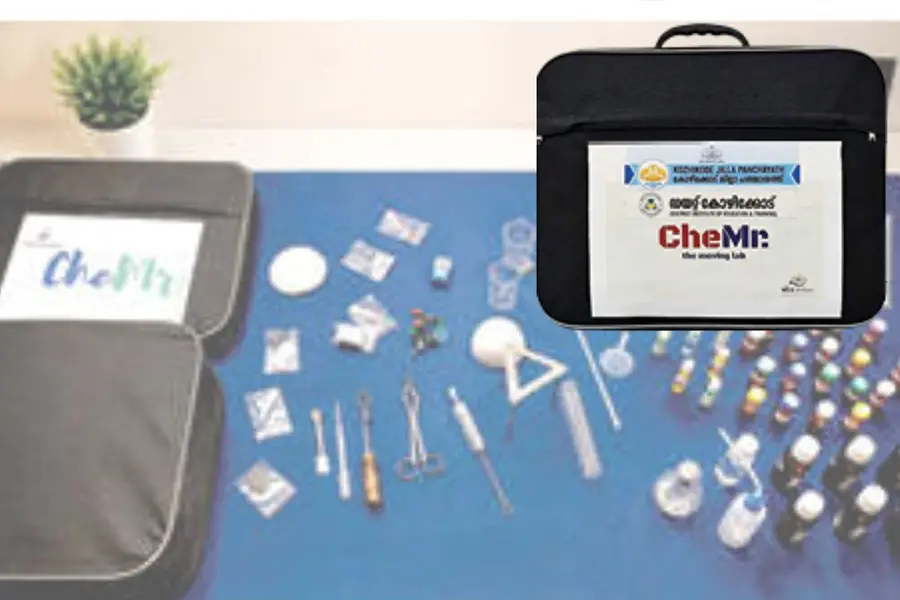
Kozhikode: A state-run teacher training institute in Kerala has developed a portable chemistry laboratory kit that can be carried directly into classrooms, aiming to make practical science learning more accessible for school students.
Developed by the District Institute of Education and Training (DIET), Kozhikode, the kit, named ‘CheMr.’—the moving lab, packs an entire chemistry laboratory into a briefcase-sized box. The initiative is being described as the first of its kind in the state.
The project seeks to address a common challenge in schools, where chemistry experiments are often demonstrated by teachers rather than carried out by students themselves because of limitations in laboratory access, equipment or time.
DIET officials said the moving laboratory would enable students to perform experiments as part of regular classroom teaching, helping make chemistry lessons more interactive and practical.
Miniature laboratory designed for Classes 5 to 10
The kit contains all the equipment and chemicals required for experiments prescribed in the current chemistry curriculum for Classes 5 to 10.
It includes 47 types of chemicals and 52 laboratory instruments, among them miniature test tubes, China dishes, beakers, hydrochloric acid and zinc sulphate.
All the materials are arranged inside a compact box measuring around 60 cm in width and 40 cm in length, allowing the kit to be transported easily between classrooms.
The laboratory apparatus has been scaled down to about one-tenth of its conventional size. As a result, experiments require much smaller quantities of chemicals, reducing both consumption and handling requirements.
Student performance review led to the project
The idea for the portable laboratory emerged after DIET analysed student performance data from examinations conducted during the previous academic year.
Marks and grades uploaded to the state’s Sampoorna education management software were reviewed as part of the assessment process. The analysis indicated that students were performing below expectations in subjects including chemistry, physics, mathematics and social science.
Based on those findings, DIET decided to begin its intervention efforts with chemistry, focusing on increasing opportunities for practical learning.
Officials also noted that many teachers have limited access to laboratory-based training, making it difficult to conduct hands-on experiments regularly in schools.
Plans to expand through local body-funded projects
DIET has developed the equipment design and experimental systems and plans to collaborate with startups to manufacture and supply the kits on a larger scale.
The institute expects the kits could be introduced through education projects funded by district panchayats, municipal corporations and municipalities.
At present, each unit costs about ₹8,000 to produce. Once the chemicals are exhausted, replenishing the stock is expected to cost around ₹250.
Before the programme is rolled out more widely, teachers will be given training on using the kits and conducting experiments in classrooms.
“DIET itself will initially set up the moving lab in selected schools. That is the quickest way to launch the project. The kit has been designed to eliminate delays and minimise risks. Feedback from students and teachers will be reviewed, and necessary changes will be made,” DIET Principal U.K. Abdunnasar said.
Published: 10 Jun 2026, 08:06 am IST
Related Topics
Disclaimer: Kindly avoid objectionable, derogatory, unlawful and lewd comments, while responding to reports. Such comments are punishable under cyber laws. Please keep away from personal attacks. The opinions expressed here are the personal opinions of readers and not that of Mathrubhumi.
