
Their work, which demonstrated quantum effects in visible circuits, laid the foundation for quantum computing, cryptography, and sensors
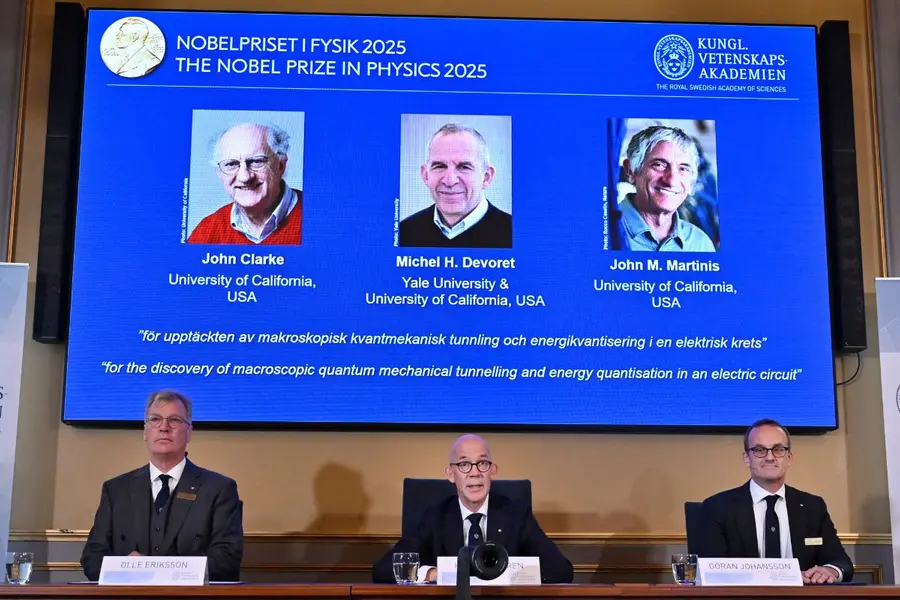
John Clarke, Michel H. Devoret, and John M. Martinis have been awarded the 2025 Nobel Prize in Physics for their discovery of macroscopic quantum mechanical tunnelling and energy quantisation in an electric circuit, a breakthrough that has become a cornerstone of quantum computing, quantum cryptography, and quantum sensors. Their pioneering experiments in the mid-1980s demonstrated that the bizarre laws of quantum mechanics—such as particles passing through barriers and energy existing in discrete levels—could be observed not just in atoms, but in electrical circuits large enough to be seen with the naked eye.
Quantum Tunnelling on a Chip
Also Read

The laureates conducted their groundbreaking work using superconducting circuits at the University of California, Berkeley, and Santa Barbara, and later at Yale University. In these circuits, electrons form Cooper pairs that move in unison, allowing current to flow without resistance. Clarke, Devoret, and Martinis showed that this collective behaviour enabled the entire circuit to act like a single quantum particle, despite being composed of billions of electrons.
Their key discovery was macroscopic quantum tunnelling: the circuit could spontaneously generate a voltage by tunnelling through an energy barrier, a phenomenon impossible in classical physics. This is akin to a ball passing through a wall, a hallmark of quantum behaviour. The Nobel Committee highlighted this as a pivotal moment in physics, proving that quantum effects are not confined to the microscopic world.
Quantised Energy and the Birth of the Artificial Atom
In addition to tunnelling, the trio demonstrated that the system’s energy was quantised, meaning it could only absorb or emit energy in specific, discrete amounts. This confirmed a fundamental prediction of quantum mechanics and earned their device the nickname “artificial atom”—a man-made system that mimics the quantum behaviour of real atoms. Theorist Anthony Leggett compared their discovery to a real-world version of Schrödinger’s cat, where a system exists in two states at once, but on a scale large enough to be engineered and measured.
From Fundamental Science to Quantum Technology
The research has become the foundation of superconducting qubits, the building blocks of today’s most advanced quantum computers. John Martinis later applied these principles at Google to develop high-performance quantum processors, using the very energy quantisation the trio discovered to encode information. Their work also enables quantum sensors capable of detecting minute magnetic fields and quantum cryptography for ultra-secure communication.
Olle Eriksson, Chair of the Nobel Committee for Physics, stated, “There is no advanced technology today that does not rely on quantum mechanics,” praising the laureates for revealing its “new surprises” decades after its inception. The prize of 11 million Swedish kronor (approximately $1.2 million) will be shared equally, recognising a discovery that has brought the “weirdness” of quantum mechanics into the tangible world of chips and circuits.
Published: 07 Oct 2025, 06:51 pm IST
Related Topics
Disclaimer: Kindly avoid objectionable, derogatory, unlawful and lewd comments, while responding to reports. Such comments are punishable under cyber laws. Please keep away from personal attacks. The opinions expressed here are the personal opinions of readers and not that of Mathrubhumi.