
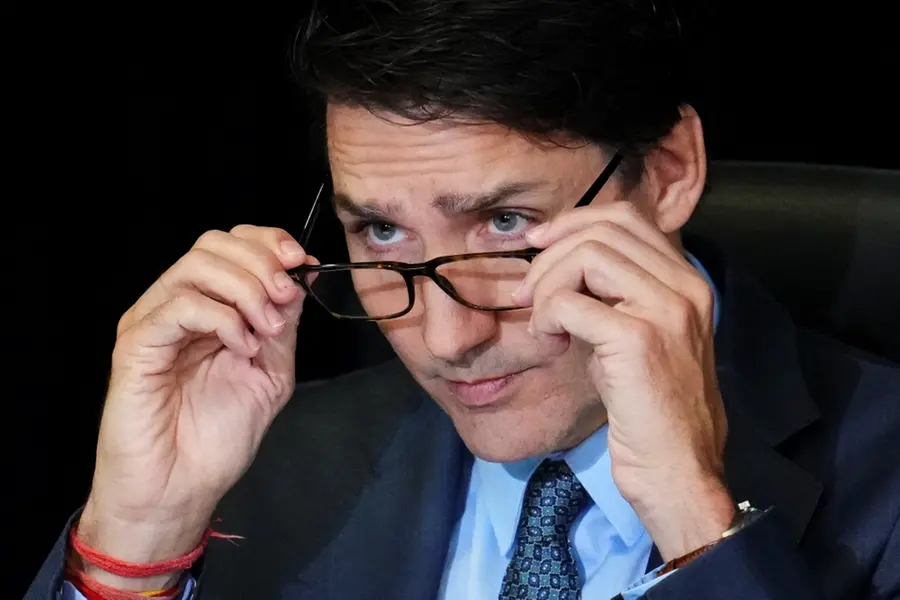
Ottawa: In a major embarrassment for Canada, Prime Minister Justin Trudeau admitted on Wednesday that the government only provided some intelligence information and no solid proof before accusing India of being involved in the death of Khalistani terrorist Hardeep Singh Nijjar.
During a hearing on foreign interference, Trudeau acknowledged that India had requested evidence to support the claims - something India continues to demand. "At that point, it was primarily intelligence, not hard evidentiary proof," the Canadian PM admitted in an on-camera hearing before the committee.
Also Read

While asserting he had "credible evidence" of India's involvement, Trudeau also mentioned the alleged role of gangster Lawrence Bishnoi in Nijjar's killing.
Trudeau is facing backlash from India for spreading what they call false information, and he is under increasing pressure to step down from some members of his own party. Long-time Liberal MP Sean Casey openly called for Trudeau's resignation. "People have had enough. They've tuned him out and they want him to go," Casey told CBC News Network in an interview.
"The message that I've been getting loud and clear -- and more and more strongly as time goes by -- is that it is time for (Trudeau) to go. And I agree," he added. Casey also stated that there is a "high level of anxiety" within the Liberal caucus about his leadership. "I would say it's wider than meets the eye. There are a lot of people who have concerns," he said.
Local media reports indicate that many Liberal MPs are becoming frustrated with Trudeau's leadership and lack of clear strategy. Earlier this year, another Liberal MP, Ken McDonald, raised concerns about whether Trudeau was the right leader for the party.
Analysts believe the growing criticism of Trudeau marks a new chapter in the ongoing debate about his leadership skills. "For the first time since the June Toronto--St. Paul's byelection, the caucus is now flexing its muscles. I don't think it matters whether it's 20 or 40, if several MPs are organising through this, I think it does demonstrate that something has changed. I guess the ultimate question now is what comes of this?" Liberal strategist Andrew Perez told Canada's 'National Post' newspaper.
The political situation in Canada appears to support India's claims that Trudeau has been hostile towards India for political reasons. "Under criticism for turning a blind eye to foreign interference in Canadian politics, his government has deliberately brought in India in an attempt to mitigate the damage. This latest development targeting Indian diplomats is now the next step in that direction," the Ministry of External Affairs (MEA) said on October 14, a few hours before it decided to withdraw the Indian High Commissioner and "other targeted diplomats and officials" from Canada.
New Delhi has suggested that the Trudeau government has been pursuing a "deliberate strategy" to criticise India for its own political gain. "It is no coincidence that it takes place as Prime Minister Trudeau is to depose before a Commission on foreign interference. It also serves the anti-India separatist agenda that the Trudeau government has constantly pandered to for narrow political gains," the MEA added.
Agency
Published: 17 Oct 2024, 07:37 am IST
Related Topics
Disclaimer: Kindly avoid objectionable, derogatory, unlawful and lewd comments, while responding to reports. Such comments are punishable under cyber laws. Please keep away from personal attacks. The opinions expressed here are the personal opinions of readers and not that of Mathrubhumi.